October 28, 2008 weblog
Soapy property improves electron mobility in organic semiconductors
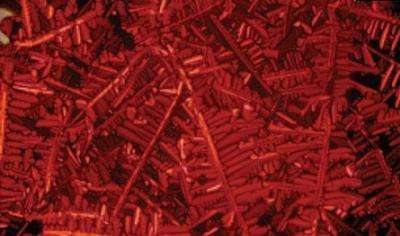
(PhysOrg.com) -- Organic semiconductors are a main component in a variety of future organic electronics, such as flexible flat-panel displays, inexpensive solar cells, and other unique devices. Because of their advantages - which include being energy-efficient, inexpensive, and lightweight - organic electronics are expected to compose a multi-billion industry.
Taking a step toward that goal, physicists have made an important advance in the development of organic semiconductors in terms of their electron mobility. Generally, organic semiconductors have low electron mobility, meaning that the overall motion of their electrons is too random and not directed enough to provide a good electric current and conductivity.
The physicists demonstrated how to improve the electron mobility of liquid crystalline semiconductors to 0.27cm2/ V•s, which is 10 times higher than the current highest level for room-temperature columnar liquid crystalline materials. The physicists, from the University of Tokyo, Kyoto University, Osaka University, and the Japan Synchrotron Radiation Research Institute, published their study in a recent issue of the Journal of the American Chemical Society.
The scientists modified a molecule known as a condensed porphyrin copper complex to make it self-assemble into a liquid crystalline state at room temperature (throughout a wide range from -17 to 99°C). They achieved the record mobility at a temperature of 16°C.
The key modification was adding hydrophobic side chains to one side of the molecule and hydrophilic side chains to the other. By being both hydrophobic and hydrophilic, the molecule has now become "amphiphilic." Other common amphiphilic substances include soaps and detergents, which have molecules that can both attach to grease and easily be washed away by water.
The amphiphilic property is useful for improving electron mobility because amphiphilic molecules tend to gather together in an orderly manner. Specifically, the amphiphilic molecular design enhanced the ð-stacking interaction, and molecules with larger ð-conjugated cores tend to have higher electron mobility. The physicists explain that ð-stacking is improved due to a nanoscale phase separation caused by the incompatibility between the hydrophobic and hydrophilic side chains of the molecules.
The scientists also noted that the new organic semiconductor is especially efficient at absorbing visible light, which could make them useful for organic thin-film solar cells.
More information: Sakurai, Tsuneaki, et al. "Prominent Electron Transport Property Observed for Triply Fused Metalloporphyrin Dimer: Directed Columnar Liquid Crystalline Assembly by Amphiphilic Molecular Design." J. Am. Chem. Soc., 130 (42), 13812-13813, 2008. 10.1021/ja8030714.
via: Tech-On!


