Insect world royalty shows they really count... up to four
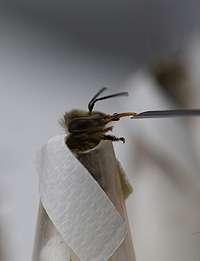
October 28, 2008 A bee being rewarded

A bee being rewarded

(PhysOrg.com) -- Research led by the head of visual neuroscience at UQ's Queensland Brain Institute (QBI) has demonstrated honey bees are capable of routinely counting up to four.

Professor Mandyam Srinivasan and a colleague from Sweden discovered a new insight into honey bee cognition after developing a series of experiments based on sugar-water incentives.

"We began by asking whether bees can learn to ‘count' the number of landmarks that they encounter on the way to a food source," Professor Srinivasan said.

"Individually marked bees were trained to receive a reward of sugar solution after they had flown past a specific number of regularly spaced yellow stripes during their flight through a narrow tunnel.

"Depending upon the experiment, this number was one, two, three or four.

"After training, the bees were individually tested by removing the food reward, and observing their searching behaviour in the tunnel to determine which landmark they had associated most strongly with the reward during the training."

When the research team randomly introduced random objects that were outside the bees' range of experience, the bees' ability to count to four did not appear to be hampered.

"Bees trained in this way are able to count novel objects, which they have never previously encountered," Professor Srinivasan said.

"Our findings provide evidence that bees are capable of counting objects on the way to a food source.

"In all probability, this counting is performed sequentially, and required the ability to maintain a running tally of the number of events, incrementing the tally by one each time an event occurs."

Professor Srinivasan took up a Professorship in visual neuroscience at QBI in January 2007. In August 2007, he was awarded the Queensland Smart State Premier's Fellowship, and in October 2006, he was awarded the Prime Minister's Prize for Science.

Professor Srinivasan's research paper Evidence for Counting Bees appears in the journal Animal Cognition 11, 683–689 (2008).

Provided by University of Queensland


print this article email this article download pdf blog this article bookmark this article     Stumble it Digg this share on Facebook retweet share on Reddit add to delicious
Rate this story - 4.3 /5 (9 votes)


October 28, 2008 all stories

Comments: 0

4.3 /5 (9 votes)
  • Stumble this up

  • Digg this

  • share this

  • hide
  • Related Stories

  • Inland ants prefer salty snacks to sweet
    created Oct 27, 2008 | popularity not rated yet | comments 0
  • Study finds bees can learn differences in food's temperature
    created Nov 17, 2009 | popularity not rated yet | comments 0
  • Robots perform Shakespeare to learn how to save people
    created Nov 13, 2009 | popularity not rated yet | comments 0
  • A biology whodunnit: are rodents helping protect trees from fire?
    created Nov 12, 2009 | popularity not rated yet | comments 0
  • Oldest known spider's web found in amber
    created Nov 02, 2009 | popularity not rated yet | comments 0


Other News

First-ever blueprint of a minimal cell is more complex than expected

First-ever blueprint of a minimal cell is more complex than expected

Biology / Cell & Microbiology

created 6 hours ago | popularity 5 / 5 (9) | comments 0

What are the bare essentials of life, the indispensable ingredients required to produce a cell that can survive on its own? Can we describe the molecular anatomy of a cell, and understand how an entire organism ...


Ecological speciation by sexual selection on good genes: Is speciation adaptive?

Biology / Ecology

created 6 hours ago | popularity not rated yet | comments 0

Darwin suggested that the action of natural selection can produce new species, but 150 years after the publication of his famous book, 'On the Origin of Species', debate still continues on the mechanisms of speciation. New ...


The six elephants in Sierra Leone were shot and "crudely butchered"

S.Leone elephants 'wiped out' by poachers: official

Biology / Ecology

created 8 hours ago | popularity 5 / 5 (4) | comments 4

Poachers "wiped out" the entire elephant herd in Sierra Leone's only wildlife park, wildlife managers said Thursday after police said they had arrested a gang of 10 poachers.


Knockouts in human cells point to pathogenic targets

Knockouts in human cells point to pathogenic targets

Biology / Cell & Microbiology

created 10 hours ago | popularity not rated yet | comments 0

(PhysOrg.com) -- Whitehead researchers have developed a new approach for genetics in human cells and used this technique to identify specific genes and proteins required for pathogens.


Whiteflies sabotage alarm system of plant in distress

Whiteflies sabotage alarm system of plant in distress

Biology / Plants & Animals

created 10 hours ago | popularity 5 / 5 (1) | comments 0

(PhysOrg.com) -- When spider mites attack a bean plant, the plant responds by producing odours which attract predatory mites. These predatory mites then exterminate the spider mite population, thus acting ...