Study Confirms Amphibians' Ability to Predict Changes in Biodiversity
October 28, 2008 By Kim McDonald
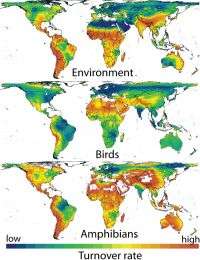
The study found that species turnover in amphibians more closely follows changes in the environment when compared to birds. Image: Lauren Buckley, UCSB
(PhysOrg.com) -- Biologists have long suspected that amphibians, whose moist permeable skins make them susceptible to slight changes in the environment, might be good bellwethers for impending alterations in biodiversity during rapid climate change.
Now two University of California biologists have verified the predictive power of this sensitive group of animals in a global study of species turnover among amphibians and birds. The study appears this week in the advance online version of the journal Proceedings of the National Academy of Sciences.
“Our study supports the role of amphibians as ‘canaries in the coal mine’,” said Lauren Buckley, a postdoctoral fellow at UC Santa Barbara's National Center for Ecological Analysis and Synthesis and the first author of the study. “Amphibians are likely to be the first to respond to environmental changes and their responses can forecast how other species will respond.”
“Amphibians are much more tuned in to the changes in their specific environments,” said Walter Jetz, an associate professor of biology at UC San Diego and the other author of the study. “They are much more sensitive to differences in environmental conditions as you move geographically from one location to another.”
The two scientists used maps of the environment and amphibian and bird distributions to answer the question of how the environment—as well as the distribution of birds and amphibians—changes as one moves from one place to another around the globe.
The researchers found that if the environment changes rapidly as one travels from one location to another, the amphibian and bird communities also change rapidly. However, the species of amphibians would change more quickly than species of birds. This confirms that amphibians are particularly sensitive to changes in the environment, the researchers conclude, and that this sensitivity is particularly acute given their narrow distributions.
Whether one is traveling through a tropical or temperature region also influences how quickly the types of animals change. Given a mountain of a certain size, the researchers found, the amphibian and bird communities change more quickly if one is climbing a mountain in the tropics than in a temperate region.
“There are more species in the tropics and the species are generally more specially adapted to particular environmental conditions,” said Jetz. “This suggests that tropical species may be more severely impacted by a given temperature increase as a result of climate change.”
For the study, he and Buckley produced a series of global maps of environmental turnover and the associated changes in amphibian and bird communities that reveal that the identities of birds and amphibians change particularly quickly in mountainous regions such as the Andes and Himalayas.
“Understanding how environmental changes over space influence biodiversity patterns provides important background for forecasting how biodiversity will respond to environmental changes over time such as ongoing temperature increases,” said Buckley.
Provided by University of California
-
U.S. to lease waters off Mid-Atlantic for wind farms
Feb 07, 2012 |
1 / 5 (1) |
0
-
Soundscape ecologists spawn new field
Feb 07, 2012 |
5 / 5 (1) |
0
-
Scientists predict where seabirds forage
Feb 07, 2012 |
5 / 5 (1) |
0
-
New insights into invasive plant management
Feb 06, 2012 |
5 / 5 (1) |
0
-
Progress and promise in DIAL LIDAR
Feb 06, 2012 |
5 / 5 (4) |
0
-
Engineers build first sub-10-nm carbon nanotube transistor
Feb 01, 2012 |
4.9 / 5 (30) |
30
-
Something old, something new: Evolution and the structural divergence of duplicate genes
Jan 31, 2012 |
4.6 / 5 (7) |
1
-
The hidden nanoworld of ice crystals: Revealing the dynamic behavior of quasi-liquid layers
Jan 30, 2012 |
5 / 5 (3) |
1
-
Stock market network reveals investor clustering
Jan 27, 2012 |
3.9 / 5 (23) |
8
-
Of microchemistry and molecules: Electronic microfluidic device synthesizes biocompatible probes
Jan 26, 2012 |
5 / 5 (1) |
0
More news stories
The power of estrogen -- male snakes attract other males
A new study has shown that boosting the estrogen levels of male garter snakes causes them to secrete the same pheromones that females use to attract suitors, and turned the males into just about the sexiest ...
2 hours ago |
not rated yet |
0
|
Experts reveal how plants don't get sunburn
(PhysOrg.com) -- Experts at the University of Glasgow have discovered how plants survive the harmful rays of the sun.
2 hours ago |
5 / 5 (2) |
0
|
Protein libraries in a snap
(PhysOrg.com) -- A Rice University undergraduate will depart with not only a degree but also a possible patent for his invention of an efficient way to create protein libraries, an important component of biomolecular ...
5 hours ago |
5 / 5 (1) |
0
|
New drugs schedule makes horse racing a sure thing
What do Gai Waterhouse and Anthony Cummings have in common with Queen Elizabeth II?
2 hours ago |
not rated yet |
0
Miami battling invasion of giant African snails
No one knows how they got there. But an invasion of African giant snails has southern Florida in a panic over potential crop damage, disease and general yuckiness surrounding the slimy gastropods.
6 hours ago |
not rated yet |
2
New understanding of DNA repair could eventually lead to cancer therapy
A research group in the Faculty of Medicine & Dentistry at the University of Alberta is hoping its latest discovery could one day be used to develop new therapies that target certain types of cancers.
Zuckerberg's focus drives Facebook's ascent
When Mark Zuckerberg showed up to rent Judy Fusco's Los Altos, Calif., house in the fall of 2004, soon after he'd arrived in Silicon Valley, the landlord was immediately struck by his confidence.
Antidepressants and pregnancy: Women must consider the impact of drugs on baby, and of depression on baby, themselves
Upon learning they are pregnant, most women dutifully nix the alcohol, sushi and caffeine. But what about antidepressants?
Both maternal and paternal age linked to autism
Older maternal and paternal age are jointly associated with having a child with autism, according to a recently published study led by researchers at The University of Texas Health Science Center at Houston (UTHealth).
Night, weekend delivery OK for babies with birth defects
Weekday delivery is no better than night or weekend delivery for infants with birth defects, according to a new study presented today at The Pregnancy Meeting, the Society for Maternal-Fetal Medicine's annual conference. ...
From virginity to Viagra
Americans will spend more than $17 billion on Valentine's Day, but far less on programs like sex education for adolescents. The editors of the new book, Sex for Life, From Virginity to Viagra, How Sexuality Changes Throughout ...
Oct 28, 2008
Rank: 1 / 5 (1)
Fare enough to use them as two ends of an extreme table but that is about all.
Just about every living group of animals will be more susceptible to the environmental changes than birds are.
Stupid stupid stupid. Birds can travel more easily than any other creature on the planet. If they cannot survive in one place they can up and fly a thousand miles if need be. Not even giraffes, with their long legs can do anything like that.
Birds can jump across from one mountain range to another, from one continent to another. Sure forest birds don't want to leave a forest, but they do cross small clearings, even highways to get to the other side. I don't see many amphibians surviving that kind of trip.