Toshiba to launch 43nm SLC NAND flash memory
October 28, 2008 Toshiba to launch 43nm SLC NAND flash memory

Enlarge

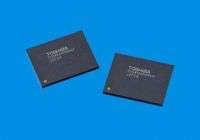
Toshiba today announced the launch of a new line-up of 43nm single-level cell (SLC) NAND flash memory products available in densities ranging from 512Mbits to 64 gigabits (Gb) and in a total of 16 versions.

The new range includes three products, 16Gb, 32Gb and 64Gb, which integrate monolithic 16Gb chips fabricated with 43nm generation process technology, the highest density chips available. The new devices will start to come to market in the first quarter of 2009.

SLC chips can read and write large amounts of data at high speed, support a very large number of read and write times, and offer high-level reliability. Toshiba developed the new SLC devices to meet diversifying applications, and its enhanced line-up offers support for mobile phones, flat panel TVs, OA equipment, and servers, all of which require high levels of read and write speeds and reliability.

In recent years, Toshiba Corporation has promoted expansion of the NAND flash memory market by accelerating development of high density multi-level-cell (MLC) chips to be used for high capacity data storage in such markets as memory cards and MP3 players. Production of SLC chips has been limited, and with 56nm and 70nm process technologies. In bringing a wider range of SLC flash memories which suit to store data at an advanced level into its line-up, Toshiba aims to expand its line-up of high-value added products for diverse embedded applications, and will promote mass production through the application of advanced process technology.

Source: Toshiba


print this article email this article download pdf blog this article bookmark this article     Stumble it Digg this share on Facebook retweet share on Reddit add to delicious
Rate this story - 4.3 /5 (3 votes)


October 28, 2008 all stories

Comments: 0

4.3 /5 (3 votes)
  • Stumble this up

  • Digg this

  • share this

  • hide
  • Related Stories


  • hide
  • Relevant PhysicsForums posts

  • frequency increase
    created 1hour ago
  • 'puff' capacitor??
    created 2 hours ago
  • Fourier Frequency Identification
    created 3 hours ago
  • DC brushless motor controller for high current
    created 9 hours ago
  • More from Physics Forums - Electrical Engineering

Other News

Design chosen for British 1,000 mph car

Design chosen for British 1,000 mph car (w/ Video)

Technology / Engineering

created 5 hours ago | popularity 5 / 5 (2) | comments 1

(PhysOrg.com) -- A British team hoping to be the first to get a car to 1,000 mph (1,610 km/h) has made its final design selection. The six-tonne car, known as the Bloodhound, will be powered by a Eurofighter ...


EU assembly adopts Internet, phone user rights

Technology / Telecom

created 1hour ago | popularity not rated yet | comments 0

(AP) -- The European Parliament has endorsed new telecom rules that would give phone and Internet users more rights and allow them to appeal to national courts if they are cut off for illegal file-sharing.


Magic box for mission impossible

Technology / Telecom

created 3 hours ago | popularity not rated yet | comments 0

On September 11, firefighters, police officers and ambulance workers faced a terrifying rescue effort in the World Trade Center complex. They battled to save people from the collapsing Twin Towers, searched for survivors, ...


Taking the drudgery out of software development

Taking the drudgery out of software development

Technology / Software

created 19 hours ago | popularity 3.6 / 5 (10) | comments 7

(PhysOrg.com) -- Software developers will no longer have to reinvent the wheel when writing new programs and applications thanks to a clever new set of tools and a central repository of 'building blocks'.


Selling chip makers on optical computing

Selling chip makers on optical computing

Technology / Semiconductors

created 22 hours ago | popularity 4.7 / 5 (9) | comments 1

(PhysOrg.com) -- Computer chips that transmit data with light instead of electricity consume much less power than conventional chips, but so far, they've remained laboratory curiosities. Professors Vladimir ...