T.rex 'followed its nose' while hunting
October 29, 2008 T.rex

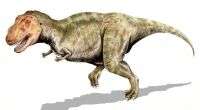
Tyrannosaurus rex, a theropod from the Late Cretaceous of North America, pencil drawing. Image: Wikipedia.

Although we know quite a bit about the lifestyle of dinosaur; where they lived, what they ate, how they walked, not much was known about their sense of smell, until now.

Scientists at the University of Calgary and the Royal Tyrrell Museum are providing new insight into the sense of smell of carnivorous dinosaurs and primitive birds in a research paper published in the British journal Proceedings of the Royal Society B.

The study, by U of C paleontologist Darla Zelenitsky and Royal Tyrrell Museum curator of dinosaur palaeoecology François Therrien, is the first time that the sense of smell has been evaluated in prehistoric meat-eating dinosaurs. They found that Tyrannosaurus rex had the best nose of all meat-eating dinosaurs, and their results tone down the reputation of T. rex as a scavenger.

The researchers looked at the importance of the sense of smell among various meat-eating dinosaurs, also called theropods, based on the size of their olfactory bulbs, the part of the brain associated with the sense of smell. Although the brains of dinosaurs are not preserved, the impressions they left on skull bones or the space they occupied in the skull reveals the size and shape of the different parts of the brain. Zelenitsky and Therrien CT-scanned and measured the skulls of a wide variety of theropod dinosaurs, including raptors and ostrich-like dinosaurs, as well as the primitive bird Archaeopteryx.

"T. rex has previously been accused of being a scavenger due to its keen sniffer, although its nose may point to alternative lifestyles based on what we see in living animals" says Zelenitsky, the lead investigator on the study. "Large olfactory bulbs are found in living birds and mammals that rely heavily on smell to find meat, in animals that are active at night, and in those animals that patrol large areas. Although the king of carnivorous dinosaurs wouldn't have passed on scavenging a free dead meal, it may have used its sense of smell to strike at night or to navigate through large territories to find its next victim."

In addition to providing clues about the biology and behavior of the ancient predators, the study also reveals some surprising information about the sense of smell in the ancestors of modern birds.

Therrien and Zelenitsky found that the extinct bird Archaeopteryx, known to have evolved from small meat-eating dinosaurs, had an olfactory bulb size comparable to most theropod dinosaurs. Although sight is very good in most birds today, their sense of smell is usually poor, a pattern that does not hold true in the ancestry of living birds.

"Our results tell us that the sense of smell in early birds was not inferior to that of meat-eating dinosaurs," says Therrien. "Although it had been previously suggested that smell had become less important than eye sight in the ancestors of birds, we have shown that this wasn't so. The primitive bird Archaeopteryx had a sense of smell comparable to meat-eating dinosaurs, while at the same time it had very good eye sight. The sense of smell must have become less important at some point during the evolution of those birds more advanced than Archaeopteryx."

Source: University of Calgary


print this article email this article download pdf blog this article bookmark this article     Stumble it Digg this share on Facebook retweet share on Reddit add to delicious
Rate this story - 4.8 /5 (16 votes)

Rank Filter

Move the slider to adjust rank threshold, so that you can hide some of the comments.


Display comments: newest first

  • jeffsaunders - Oct 29, 2008
    • Rank: 5 / 5 (1)
    Finally a point that may not be lost in translation. You see, the common man continually believes that evolution leads to better and better. What they fail to understand and what needs to be emphasized over and over again is that evolution has nothing to do with advancement whatsoever.

    Evolution could probably be more easily linked to specialization than to advancement, but that is not correct either.

    Things do not get better with evolution, better, smarter or stronger has nothing to do with evolution.

    If you will survive to breed more often by sitting on your fat backside and doing nothing but picking your nose and eating it, then that becomes a survival trait and will therefore be something that evolution will decide is better.

    Your environment tends to dictate what is and what is not a survival trait. This is why sea lions and seals do so well in the water and not so well in the desert even though they are very advanced creatures.
  • rubberman - Nov 03, 2008
    • Rank: not rated yet
    So in your first paragraph you say that evolution has nothing to do with advancement whatsoever.....and you finish with the statement that evolution will decide which survival traits are better and an example to back up that statement, in which you use the word advanced to describe an animal which has evolved to survive ideally in it's own environment, but not an environment that is completely alien to it.

    Thanks

October 29, 2008 all stories

Comments: 2

4.8 /5 (16 votes)
  • Stumble this up

  • Digg this

  • share this

  • hide
  • Related Stories


Other News

neuron

To make memories, new neurons must erase older ones

Biology / Cell & Microbiology

created 30 minutes ago | popularity not rated yet | comments 0

Short-term memory may depend in a surprising way on the ability of newly formed neurons to erase older connections. That's the conclusion of a report in the November 13th issue of the journal Cell that provid ...


Hoping for a fluorescent basket case: How HIV is assembled and released from infected cells

Biology / Cell & Microbiology

created 59 minutes ago | popularity not rated yet | comments 0

Although recent advances have raised hopes that a protective vaccine can be developed, acquired immunodeficiency syndrome (AIDS) remains a major public health problem. Much has been learned about HIV-1, the virus that causes ...


New explanation for nature's hardiest life form

Biology / Cell & Microbiology

created 2 hours ago | popularity 4.5 / 5 (2) | comments 0

Got food poisoning? The cause might be bacterial spores, en extremely hardy survival form of bacteria, a nightmare for health care and the food industry and an enigma for scientists. Spore-forming bacteria, present almost ...


Researchers discover mechanism of insulin production that can lead to better treatment for diabetes

Researchers discover mechanism of insulin production that can lead to better treatment for diabetes

Biology / Cell & Microbiology

created 2 hours ago | popularity not rated yet | comments 0

How a specific gene within the pancreas affects secretion of insulin has been discovered by researchers from the Hebrew University of Jerusalem, in collaboration with Japanese and American universities. Their ...


Explained: RNA interference

Explained: RNA interference

Biology / Cell & Microbiology

created 6 hours ago | popularity 4.5 / 5 (2) | comments 0

Every high school biology student learns the basics of how genes are expressed: DNA, the cell’s master information keeper, is copied into messenger RNA, which carries protein-building instructions to the ribosome, ...