Scientists Create New Robust Genetic Clock
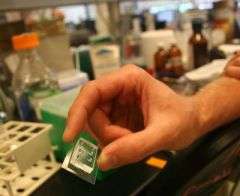
UC San Diego bioengineers have created the first stable, fast and programmable genetic clock that reliably keeps time by the blinking of fluorescent proteins inside E. coli cells. The clock's blink rate changes when the temperature, energy source or other environmental conditions change, a fact that could lead to new kinds of sensors that convey information about the environment through the blinking rate.
The researchers published their synthetic biology advance in the journal Nature on 29 October, 2008.
One next step is to synchronize the clocks within large numbers of E. coli cells so that all the cells in a test tube would blink in unison. "This would start to look a lot like the makings of a fascinating environmental sensor," said Jeff Hasty, a UC San Diego bioengineering professor and senior author on the Nature paper. Researchers in his lab have also developed sophisticated microfluidic systems capable of controlling environmental conditions of their E. coli cells with great precision. This enables the bioengineers to track exactly what environmental conditions affect their clocks' blink rates.
Synthetic Biology
A three-step approach to synthetic biology provides the foundation for Jeff Hasty's Systems Biodynamics Lab at UC San Diego. You first write down computational models for a particular system, such as a genetic clock, and then you develop design criteria from these models. Finally, you build gene networks based on these design criteria—and see if these networks behave as the models predict.
"Instead of just iterating forever and trying to figure it out that way, we try to codify our ideas into a computational model and use that model to generate design criteria and then build the gene networks based on what we learned through the process," explained Scott Cookson, an author on the new Nature paper and a Ph.D. student in Hasty's lab.
Hasty has been working on building a robust genetic clock from scratch since his years as a postdoctoral researcher in the early 2000s.
"We finally determined that a crucial aspect is a small time delay in the negative feedback loop of the genetic network," explained Hasty. "This is an example in which synthetic biology can lead to a better understanding of the importance of specific aspects of gene regulatory networks. Because you can't model every aspect of a genetic network, you have to figure out what needs to be accounted for in your models and what doesn't."
"By assembling genes with distinct properties into synthetic circuits that behave predictably, we increase our knowledge of the fundamental principles by which cells function," said James Anderson, Ph.D., who oversees synthetic biology grants at the National Institute of General Medical Sciences of the National Institutes of Health. "This knowledge will enable scientists to devise new strategies to remedy human health problems and to design improvements in organisms on which we depend for food, medicines and industrial chemicals."
The Fast, Robust, Tunable Genetic Clock
At the core of the new clock is a negative feedback loop that includes a two-minute delay between when the mRNA is made and when the functional proteins are made. On top of this is the positive feedback loop which makes the clock more regular and robust.
"It looks like the negative feedback loop is at the core and the positive feedback is the icing on top," said Matthew Bennett, an author on the paper and postdoctoral researcher in the bioengineering department at UC San Diego.
"Circadian clocks are hugely complicated. It's hard to know what the essential modules are, but based on our synthetic clock, it looks as though circadian clocks could have easily started as some kind of primitive negative feedback loop, with the positive loop coming later to regularize it," said Hasty.
Wild Oscillations
More and more studies are being published showing that gene function oscillates in cells in the wild.
"Within individual cells, researchers are seeing many genes whose activity oscillates up and down. They are not simply statically on or off," said Hasty. This observation only recently emerged because it was previously difficult to synchronize cell populations to the extent that the oscillations can be seen in gene expression arrays.
"Based on our finding that all you need is a little delay and negative feedback to build a simple oscillator, I am not surprised that we are seeing genome-wide oscillations. I think we are going to see more of this in the future," said Hasty.
When asked to look ever further into the future and predict how this synthetic biology might be applied, Hasty said, "At some point, the vector issue for gene therapy is going to be worked out. Once researchers figure out how to reliably get DNA into cells in a controlled fashion, the more sophisticated step will be to read the state of the cell with sensors and then act accordingly. You could have a sequence of logical steps coded into the DNA that will react to the cellular environment. This is eventually where we are going to get, but to do this, you need to do the fundamental work we are doing now to understand how gene networks function."
Article: "A fast, robust and tunable synthetic gene oscillator," by Jesse Stricker, Scott Cookson, Matthew R. Bennett, William H. Mather, Lev S. Tsimring, and Jeff Hasty from the University of California, San Diego.
Source: University of California - San Diego


