Nanoscale Dimensioning Is Fast, Cheap with New Optical Technique
October 29, 2008 Nanoscale Dimensioning Is Fast, Cheap with New Optical Technique

Enlarge

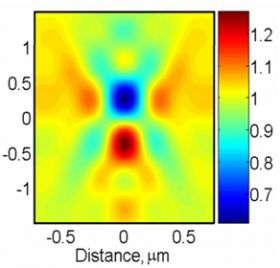
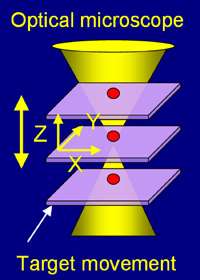
This schematic (below) shows how a TSOM image is acquired. Using an optical microscope, several images of a 60 nanometer gold particle sample (shown in red) are taken at different focal positions and stacked together. The computer-created image on the right shows the resultant TSOM image. Image: NIST

(PhysOrg.com) -- A novel technique under development at the National Institute of Standards and Technology uses a relatively inexpensive optical microscope to quickly and cheaply analyze nanoscale dimensions with nanoscale measurement sensitivity. Termed “Through-focus Scanning Optical Microscope” (TSOM) imaging, the technique has potential applications in nanomanufacturing, semiconductor process control and biotechnology.

Optical microscopes are not widely considered for checking nanoscale (below 100 nanometers) dimensions because of the limitation imposed by wavelength of light—you can’t get a precise image with a probe three times the object’s size. NIST researcher Ravikiran Attota gets around this, paradoxically, by considering lots of “bad” (out-of-focus) images.
Nanoscale Dimensioning Is Fast, Cheap with New Optical Technique

This schematic shows how a TSOM image is acquired. Image: NIST

“This imaging uses a set of blurry, out-of-focus optical images for nanometer dimensional measurement sensitivity,” he says. Instead of repeatedly focusing on a sample to acquire one best image, the new technique captures a series of images with an optical microscope at different focal positions and stacks them one on top of the other to create the TSOM image. A computer program Attota developed analyzes the image.

While Attota believes this simple technique can be used in a variety of applications, he has worked with two. The TSOM image can compare two nanoscale objects such as silicon lines on an integrated circuit. The software “subtracts” one image from the other. This enables sensitivity to dimensional differences at the nanoscale—line height, width or side-wall angle. Each type of difference generates a distinct signal.

TSOM has also been theoretically evaluated in another quality control application. Medical researchers are studying the use of gold nanoparticles to deliver advanced pharmaceuticals to specific locations within the human body. Perfect size will be critical. To address this application, a TSOM image of a gold nanoparticle can be taken and compared to a library of simulated images to obtain “best-match” images with the intent of determining if each nanoparticle passes or fails.

This new imaging technology requires a research-quality optical microscope, a camera and a microscope stage that can move at preset distances. “The setup is easily under $50,000, which is much less expensive than electron or probe microscopes currently used for measuring materials at the nanoscale,” Attota explains. “This method is another approach to extend the range of optical microscopy from microscale to nanoscale dimensional analysis.” So far, sensitivity to a 3 nm difference in line widths has been demonstrated in the laboratory.

Citation: R. Attota, T.A. Germer and R.M. Silver. Through-focus scanning-optical-microscope imaging method for nanoscale dimensional analysis, Optics Letters 33, 1990 (2008).

Provided by NIST


print this article email this article download pdf blog this article bookmark this article     Stumble it Digg this share on Facebook retweet share on Reddit add to delicious
Rate this story - 4.6 /5 (17 votes)


October 29, 2008 all stories

Comments: 0

4.6 /5 (17 votes)
  • Stumble this up

  • Digg this

  • share this

  • hide
  • Related Stories

  • Imaging a catalyst one atom at a time
    created Nov 09, 2009 | popularity not rated yet | comments 0
  • Scientists increase imaging efficiency in cell structure studies
    created Sep 03, 2009 | popularity not rated yet | comments 0
  • Nanoscale zipper cavity responds to single photons of light
    created Jun 04, 2009 | popularity not rated yet | comments 0
  • Revolutionizing the diagnosis of serious disease
    created Jun 02, 2009 | popularity not rated yet | comments 0
  • Seeing the small picture: X-ray nanoprobe pushes observation to ever smaller frontiers
    created Mar 02, 2009 | popularity not rated yet | comments 0


  • hide
  • Relevant PhysicsForums posts

  • What is wrong with this argument?
    created 1hour ago
  • One-way mirror ball
    created 1hour ago
  • magnetic field and displacement current
    created 1hour ago
  • V-shaped Pendulum help
    created 2 hours ago
  • More from Physics Forums - General Physics

Other News

Nanowire Formation

Nanowires key to future transistors, electronics

Nanotechnology / Nanophysics

created 6 hours ago | popularity 5 / 5 (4) | comments 0

(PhysOrg.com) -- A new generation of ultrasmall transistors and more powerful computer chips using tiny structures called semiconducting nanowires are closer to reality after a key discovery by researchers ...


Nanotube defects equal better energy and storage systems

Nanotube defects equal better energy and storage systems

Nanotechnology / Nanomaterials

created Nov 19, 2009 | popularity 4.4 / 5 (10) | comments 2

(PhysOrg.com) -- Most people would like to be able to charge their cell phones and other personal electronics quickly and not too often. A recent discovery made by UC San Diego engineers could lead to carbon ...


Water droplets direct self-assembly process in thin-film materials

Nanotechnology / Nanomaterials

created Nov 23, 2009 | popularity 5 / 5 (4) | comments 2

You can think of it as origami - very high-tech origami. Researchers at the University of Illinois have developed a technique for fabricating three-dimensional, single-crystalline silicon structures from thin films by coupling ...


Using superconducting probes to get a picture of what it's like inside CNTs

Nanotechnology / Nanophysics

created Nov 20, 2009 | popularity 4.4 / 5 (9) | comments 0

(PhysOrg.com) -- "Carbon nanotubes are exciting for fundamental physics, and for potential technological applications," Nadya Mason tells PhysOrg.com. "However, we are generally limited in the way that we can study them. ...


Fast, easy, and highly sensitive arsenic detection with gold nanoparticles

Nanotechnology / Nanomaterials

created Nov 25, 2009 | popularity 5 / 5 (1) | comments 0

(PhysOrg.com) -- Mention of arsenic poisoning usually brings to mind underhanded murder. However, the danger of arsenic poisoning from contaminated drinking water is far greater. Low concentrations of arsenic are found in ...