Agricultural Chemicals Linked to Infections in a Declining Amphibian Species
October 29, 2008 Agricultural Chemicals Linked to Infections in a Declining Amphibian Species

Enlarge

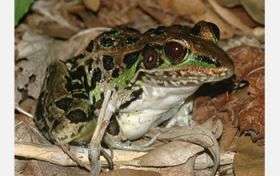
An adult leopard frog. Credit: Neal Halstead, University of South Florida

(PhysOrg.com) -- Amphibians around the world are on the decline from disease. In an article in this week's issue of the journal Nature, Jason Rohr of the University of South Florida (USF) and colleagues revealed that chemical pollution can increase often deadly trematode (parasitic flatworm) infections in the northern leopard frog, a declining amphibian species.

"The combination of atrazine, a widely used herbicide, and phosphate, a primary ingredient in fertilizers, accounted for 74 percent of the variation in larval trematode abundance in the frogs," said Rohr. "These agrochemicals increase trematode infections by augmenting snail intermediate hosts--the source of trematodes that infect amphibians--and suppressing amphibian immune responses." The research was funded by National Science Foundation (NSF) and U.S. Department of Agriculture grants.

According to Rohr, identifying the main risk factors and predictors for disease in amphibians is important. This study showed that atrazine and phosphate concentrations in the Minnesota wetlands they investigated were the best of over 240 plausible predictors of trematode abundance in frogs. In a manipulative experiment conducted in outdoor, 300 gallon tanks, Rohr and colleagues verified that atrazine increased snail abundance, caused amphibian immuno-suppression, and elevated amphibian trematode loads.

"At concentrations commonly occurring in freshwater ecosystems, atrazine and phosphate can be drivers of amphibian trematode infections, raising concerns about the role of these chemicals in amphibian declines," concluded Rohr. "Reducing atrazine and phosphate inputs to wetlands might remediate these often debilitating amphibian trematode infections."

Like canaries used to gauge the safety of air in coal mines, amphibians are thought to be the "canaries" in our freshwater environments; reductions in their health can warn of subsequent species declines and degradation of ecosystem services.

"Atrazine and fertilizers might not be the only chemicals affecting disease risk," says Rohr. "Many chemicals can be immuno-suppressive, and standard toxicity tests used to register chemicals in the United States and Europe are conducted on isolated individuals, ignoring interactions with other species, such as their parasites. Thus, our findings are likely the tip of the iceberg for pollution-induced disease emergence in both humans and wildlife."

"The spread of infectious disease and loss of biodiversity are each a serious challenge to scientists seeking a fundamental understanding of ecological systems, and to policy makers charged with protecting the environment," said Alan Tessier, an NSF program director. "Rohr and his colleagues demonstrate how both of these phenomena are linked to the widespread use of a common agrochemical in the case of a declining amphibians species. This work illustrates how predicting anthropogenic impacts requires a fundamental understanding of the complexity of species interactions embedded within food webs."

Provided by NSF


print this article email this article download pdf blog this article bookmark this article     Stumble it Digg this share on Facebook retweet share on Reddit add to delicious
Rate this story - 3.7 /5 (7 votes)


October 29, 2008 all stories

Comments: 0

3.7 /5 (7 votes)
  • Stumble this up

  • Digg this

  • share this

  • hide
  • Related Stories

  • Study suggests link between agricultural chemicals and frog decline
    created Feb 04, 2009 | popularity not rated yet | comments 0
  • Global warming link to amphibian declines in doubt
    created Nov 12, 2008 | popularity not rated yet | comments 0
  • Nutrient pollution drives frog deformities by ramping up infections
    created Sep 24, 2007 | popularity not rated yet | comments 0
  • Timber harvest impacts amphibians differently during life stages
    created Nov 03, 2009 | popularity not rated yet | comments 0
  • Over 17,000 species threatened by extinction
    created Nov 02, 2009 | popularity not rated yet | comments 0


  • hide
  • Relevant PhysicsForums posts

  • The Origin of the term 'fossil' fuels
    created Nov 05, 2009
  • co2
    created Nov 03, 2009
  • Early Earths Sulfidic Ocean Conditions
    created Oct 30, 2009
  • vegetation
    created Oct 29, 2009
  • More from Physics Forums - Earth

Other News

'Dropouts' pinpoint earliest galaxies

'Dropouts' pinpoint earliest galaxies

Space & Earth / Astronomy

created 12 hours ago | popularity 4 / 5 (8) | comments 3

Astronomers, conducting the broadest survey to date of galaxies from about 800 million years after the Big Bang, have found 22 early galaxies and confirmed the age of one by its characteristic hydrogen signature ...


The politics of climate fixes

The politics of climate fixes

Space & Earth / Environment

created 13 hours ago | popularity 1.5 / 5 (8) | comments 6

In the middle of a day filled with a stream of information-packed PowerPoint displays and alarming projections of what the future holds for our planet and our civilization, Judith Layzer’s talk was something ...


Kepler

Kepler Mission Update

Space & Earth / Space Exploration

created 13 hours ago | popularity 4.6 / 5 (5) | comments 0

(PhysOrg.com) -- Kepler completed another science data download over October 18-19. In this download, a month's worth of science data was transmitted through the NASA Deep Space Network and into the Science ...


Station Prepares For New Spacecraft, Monitors Debris

Station Prepares For New Spacecraft, Monitors Debris

Space & Earth / Space Exploration

created 11 hours ago | popularity 5 / 5 (1) | comments 2

The station crew prepared Friday for the arrival of the Russian Mini-Research Module 2 (MRM2) which is scheduled for launch from the Baikonur Cosmodrome, Kazakhstan on Nov. 10. The MRM2 will arrive at the ...


Mars: Chaotic terrain between Kasei Valles and Sacra Fossae

Mars: Chaotic terrain between Kasei Valles and Sacra Fossae

Space & Earth / Space Exploration

created 16 hours ago | popularity 4.6 / 5 (5) | comments 0

(PhysOrg.com) -- Mars Express flew over the boundary between Kasei Valles and Sacra Fossae and imaged the region, acquiring spectacular views of the chaotic terrain in the area.