Study reveals marriage dowry as major cause of poverty in Bangladesh
More than 35 million people in Bangladesh, around a quarter of its population, face acute poverty and hunger. Dowry payments of more than 200 times the daily wage and costly medical expenses are major causes of this chronic poverty says research from the University of Bath.
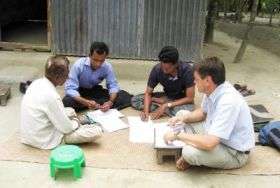
Dr Peter Davis, of the Centre for Development Studies based in the University's Department of Economics & International Development, has been investigating the issues forcing families into poverty as part of a long-term study in collaboration with the International Food Policy Research Institute (IFPRI), the Chronic Poverty Research Centre (CPRC), and Data Analysis and Technical Assistance Ltd., Dhaka (DATA).
The research found that those households with lower levels of education, that owned less land, had fewer assets and had many young children and elderly relatives, faced the most difficulty in escaping poverty.
The custom of paying a dowry to the future husband's family when a daughter is married is illegal in Bangladesh, but is still practised by most families living in rural areas. Payment is normally upwards from 20,000 Taka (around £190) and since typical earnings are only 100 Taka (94 pence) per day, this can be a major contributor to poverty for many families with daughters.
Dr Davis found that medical expenses involved in the care of elderly relatives were also a common issue for families living in poverty.
"Some families face a 'double whammy', having to pay wedding expenses and dowry for their daughters at the same time in life when elderly relatives are needing more expensive medical care," said Dr Davis, who spent several months in the country training and working with researchers from DATA Bangladesh to conduct interviews with families for the study.
"Measures such as improving education, employment and health services could play a really significant role in alleviating poverty in these families.
"The government in Bangladesh has already taken positive steps in increasing the enrolment of girls in schools, which should decrease the practice of giving and demanding dowry."
The researchers surveyed 2,000 households based in 102 rural villages across Bangladesh, that were originally interviewed between eight and 14 years ago, to assess the changes in poverty and well-being that occurred over time.
They found that almost half moved out of poverty during this time, but around one fifth remained chronically poor and a small percentage fell into poverty.
Uniquely, the researchers combined household data with about 300 individual life histories to provide a deeper understanding of the causes of chronic poverty in the country, rather than purely using quantitative conventional research approaches.
Dr Davis explained: "This research is different because it is qualitative as well as quantitative, so it doesn't just measure the trends, but also finds out the stories behind the trends.
"The life histories collected for this study show that many poor people's lives improve and decline in a 'saw-tooth' pattern, where slow improvements are reversed by sharp declines caused by events such as illness, large medical expenses, wedding expenses and legal disputes.
"This contrasts with the smooth pattern of progress or decline which is often suggested by more conventional research approaches."
Dr Davis presented the findings with collaborators Agnes Quisumbing from IFPRI and Bob Baulch from the Chronic Poverty Research Centre at a workshop in August in Dhaka, Bangladesh.
The workshop was chaired by the director of the Bangladesh Institute of Development Studies and was attended by more than 100 senior government officials, international donors and civil society representatives.
Dr Davis added: "We've had a lot of very positive feedback on the research we presented at the workshop and we are planning to hold further meetings with senior government officials and policy makers after the December elections."
Source: University of Bath


