Hubble scores a perfect ten
October 30, 2008 Hubble scores a perfect 10

Enlarge

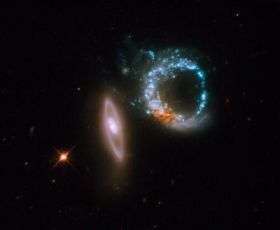
The NASA/ESA Hubble Space Telescope is back in business. Just a couple of days after the orbiting observatory was brought back online, Hubble aimed its prime working camera, the Wide Field Planetary Camera 2 (WFPC2), at a particularly intriguing target, a pair of gravitationally interacting galaxies called Arp 147. The two galaxies happen to be oriented so that they appear to mark the number 10. The left-most galaxy, or the "one" in this image, is relatively undisturbed, apart from a smooth ring of starlight. It appears nearly edge-on to our line of sight. The right-most galaxy, the "zero" of the pair, exhibits a clumpy, blue ring of intense star formation. Credit: NASA, ESA and M. Livio (STScI)

(PhysOrg.com) -- The Hubble Space Telescope is back in business after a one-month breakdown with a snapshot of the fascinating galaxy pair Arp 147. Scientists made two repair attempts, and last week's effort apparently worked.

Just a couple of days after the orbiting observatory was brought back online, Hubble aimed its prime working camera, the Wide Field Planetary Camera 2 (WFPC2), at a particularly intriguing target, a pair of gravitationally interacting galaxies called Arp 147.

The image demonstrated that the camera is working exactly as it was before going offline, thereby scoring a "perfect 10" both for performance and beauty.

And literally "10" for appearance too, due to the chance alignment of the two galaxies. The left-most galaxy, or the "one" in this image, is relatively undisturbed, apart from a smooth ring of starlight. It appears nearly edge-on to our line of sight. The right-most galaxy, the "zero" of the pair, exhibits a clumpy, blue ring of intense star formation.

The blue ring was formed after the galaxy on the left passed through the galaxy on the right. Just as a pebble thrown into a pond creates an outwardly moving circular wave, or ripples, an outwardly propagating ring of higher density was generated at the point of impact of the two galaxies. As this excess density collided with outer material that was moving inwards due to the gravitational pull of the two galaxies, shocks and dense gas were produced, stimulating star formation.

The dusty reddish knot at the lower left of the blue ring probably marks the location of the original nucleus of the galaxy that was hit.

Arp 147 appears in the Arp Atlas of Peculiar Galaxies, compiled by Halton Arp in the 1960s and published in 1966. This picture was assembled from WFPC2 images taken with three separate filters. The colours blue, green, and red represent the blue, visible-light, and infrared filters respectively.

The galaxy pair was photographed on 27-28 October 2008. Arp 147 lies in the constellation of Cetus, more than 400 million light-years away from Earth.

Provided by Hubble Information Centre


print this article email this article download pdf blog this article bookmark this article     Stumble it Digg this share on Facebook retweet share on Reddit add to delicious
Rate this story - 4.8 /5 (42 votes)

Rank Filter

Move the slider to adjust rank threshold, so that you can hide some of the comments.


Display comments: newest first

  • deatopmg - Oct 30, 2008
    • Rank: 1 / 5 (4)
    YAHOO! what about some shots of the moon?
  • holmstar - Oct 30, 2008
    • Rank: 3.8 / 5 (4)
    we already have high-res images of the moon... what do you expect to find?
  • earls - Oct 30, 2008
    • Rank: 5 / 5 (3)
    Besides, I don't think YAHOO! is responsible for shots of the moon. :)
  • deatopmg - Oct 30, 2008
    • Rank: 1 / 5 (7)
    we already have high-res images of the moon... what do you expect to find?


    Hi res images NOT altered by JPL. Search for moon images. look at how they have been selectively blurred in places. This is especially true of older ones where the masking technology was not as good as today. For really old ones see if you can find those same photo's released by the USSR. Note the differences.

    Look at the "Official" back side of the moon today, 10 yrs ago, 20 yrs ago, 30 yrs ago, the old Soviet pictures. Compare them. You probably won't need me to answer your question after you've done those tasks.

    All these photo's and more are available on line.
  • gopher65 - Oct 30, 2008
    • Rank: 4.8 / 5 (5)
    FFS man. Hubble is simply not big enough to see anything significant at that distance. At least, not the size that you're looking for. At the distance of the moon a telescope like Hubble could have a maximum resolution of something like a few hundred metres per pixel. What exactly do you expect to see at that resolution?

    Conspiracy theorists are universally idiots.
  • yyz - Oct 30, 2008
    • Rank: 5 / 5 (1)
    Check out the original 5m (200 inch) Arp photo @ http://tinyurl.com/2dg5y3 and look for Arp 147, then click on the galaxy's image for a large GIF image. How far we've come since 1966!
  • yyz - Oct 30, 2008
    • Rank: 5 / 5 (1)
    For great HST images of all types (including Arp 147) check out the HST page @ http://hubblesite...a/.Every size from wallpaper to huge hi-res TIFF files are available at this site for most images. Other HASA images from myriad missions are available in a plethora of resolutions, though. Good luck hunting !
  • yyz - Oct 30, 2008
    • Rank: 5 / 5 (1)
    @gopher65, while I agree with your overall assessment of super-high res not being possible with Hubble or any other scope, just a casual glance of the image shows the open-on (O shaped) galaxy to be in a starburst state while the other, edge-on ring galaxy is curiously quiet and not rapidly forming new stars and star clusters. A very curious and telling observation of this weird system.
  • yyz - Oct 30, 2008
    • Rank: not rated yet
    The edge-on ring galaxy also has a faintly bluish ring & nucleus, but all new star formation in it appears to have recently ceased. The E-O ring galaxy's nucleus also exhibits a peculiar absorption lane. With all the starburst activity in the face-on galaxy, it appears that it may have stripped neutral hydrogen from its edge-on companion, fueling its current starburst phase. Quite a remarkable image !
  • TrustTheONE - Oct 31, 2008
    • Rank: 4 / 5 (2)
    Are you nuts?? Dont you know waht it is??? ITS A STARGATE!!!!
  • deatopmg - Oct 31, 2008
    • Rank: 4 / 5 (1)
    Gopher65 thanks for clearing that up!
  • gopher65 - Nov 01, 2008
    • Rank: 5 / 5 (1)
    Sorry for sounding so cross, but I see a lot of posts like that. If people want to see what is on the moon in close detail then an orbiter needs to be sent. And, IIRC, there are several planned orbiters over the next decade that will have a high enough resolution to pick out the remnants of the lunar landers.
  • SmartK8 - Nov 03, 2008
    • Rank: 5 / 5 (1)
    For all the conspirationists check out the results of the KAGUYA at http://tinyurl.com/2vvqz3 select TC in the upper menu (as in Terrain Camera). Check out the Appolo 15 landing site (picture 4/4). Pretty close enough for the NASA don't you think.

October 30, 2008 all stories

Comments: 13

4.8 /5 (42 votes)
  • Stumble this up

  • Digg this

  • share this

  • hide
  • Related Stories


  • hide
  • Relevant PhysicsForums posts

  • Sideral question
    created 12 hours ago
  • Doppler shifted blackbody spectrum
    created 14 hours ago
  • Earth v. Moon
    created 16 hours ago
  • help me with coordinates and orbits
    created 17 hours ago
  • More from Physics Forums - General Astronomy

Other News

Astronauts finish another spacewalk, still no baby (AP)

Astronauts finish another spacewalk, still no baby

Space & Earth / Space Exploration

created 3 hours ago | popularity 5 / 5 (1) | comments 0

(AP) -- A spacewalking astronaut put aside the impending birth of his daughter and blazed through his first-ever venture outside the International Space Station on Saturday.


Unseasonably hot and dry weather combined with strong winds to fan scores of blazes in the country's southeastern states

Australia issues 'catastrophic' alerts as fires rage

Space & Earth / Environment

created 9 hours ago | popularity 4 / 5 (1) | comments 0

Australia has issued "catastrophic" alerts after record-breaking temperatures and wild lightning storms sparked more than 100 fires across the country, officials said Saturday.


Commuters wait on the platform shrouded by fog in London

Climate change not man-made, say majority of Britons: poll

Space & Earth / Environment

created Nov 15, 2009 | popularity 3.3 / 5 (15) | comments 45

Less than half of Britons believes that human activity is to blame for global warming, according to a poll carried out for The Times newspaper and published on Saturday.


Mysteriously warm times in Antarctica

Mysteriously warm times in Antarctica

Space & Earth / Earth Sciences

created Nov 18, 2009 | popularity 4.2 / 5 (21) | comments 28

(PhysOrg.com) -- A new study of Antarctica's past climate reveals that temperatures during the warm periods between ice ages (interglacials) may have been higher than previously thought. The latest analysis ...


UN: Fight climate change with free condoms (AP)

UN: Fight climate change with free condoms

Space & Earth / Environment

created Nov 18, 2009 | popularity 3.1 / 5 (11) | comments 22

(AP) -- The battle against global warming could be helped if the world slowed population growth by making free condoms and family planning advice more widely available, the U.N. Population Fund said Wednesday.