Phoenix Mars Lander Enters Safe Mode
October 30, 2008 Phoenix Mars Lander Enters Safe Mode

Enlarge

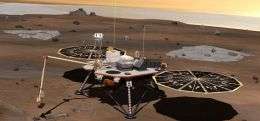
NASA's Phoenix Mars Lander monitors the atmosphere overhead and reaches out to the soil below in this artist's depiction of the spacecraft fully deployed on the surface of Mars.

(PhysOrg.com) -- NASA'S Phoenix Mars Lander entered safe mode late yesterday in response to a low-power fault brought on by deteriorating weather conditions. While engineers anticipated that a fault could occur due to the diminishing power supply, the lander also unexpectedly switched to the "B" side of its redundant electronics and shut down one of its two batteries.

During safe mode, the lander stops non-critical activities and awaits further instructions from the mission team. Within hours of receiving information of the safing event, mission engineers at NASA's Jet Propulsion Laboratory, Pasadena, Calif., and at Lockheed Martin in Denver, were able to send commands to restart battery charging. It is not likely that any energy was lost.

Weather conditions at the landing site in the north polar region of Mars have deteriorated in recent days, with overnight temperatures falling to -141F (-96C), and daytime temperatures only as high as -50F (-45C), the lowest temperatures experienced so far in the mission. A mild dust storm blowing through the area, along with water-ice clouds, further complicated the situation by reducing the amount of sunlight reaching the lander's solar arrays, thereby reducing the amount of power it could generate. Low temperatures caused the lander's battery heaters to turn on Tuesday for the first time, creating another drain on precious power supplies.

Science activities will remain on hold for the next several days to allow the spacecraft to recharge and conserve power. Attempts to resume normal operations will not take place before the weekend.

"This is a precarious time for Phoenix," said Phoenix Project Manager Barry Goldstein of JPL. "We're in the bonus round of the extended mission, and we're aware that the end could come at any time. The engineering team is doing all it can to keep the spacecraft alive and collecting science, but at this point survivability depends on some factors out of our control, such as the weather and temperatures on Mars."

The ability to communicate with the spacecraft has not been impacted. However, the team decided to cancel communication sessions Wednesday morning in order to conserve spacecraft power. The next communication pass is anticipated at 9:30 p.m. PDT Wednesday.

Yesterday, the mission announced plans to turn off four heaters, one at a time, in an effort to preserve power. The faults experienced late Tuesday prompted engineers to command the lander to shut down two heaters instead of one as originally planned. One of those heaters warmed electronics for Phoenix's robotic arm, robotic-arm camera, and thermal and evolved-gas analyzer (TEGA), an instrument that bakes and sniffs Martian soil to assess volatile ingredients. The second heater served the lander's pyrotechnic initiation unit, which hasn't been used since landing. By turning off selected heaters, the mission hopes to preserve power and prolong the use of the lander's camera and meteorological instruments.

Originally scheduled to last 90 days, Phoenix has completed a fifth month of exploration in the Martian arctic. As the Martian northern hemisphere shifts from summer to autumn, the lander was expected to generate less power due to fewer hours of sunlight reaching its solar panels. "It could be a matter of days, or weeks, before the daily power generated by Phoenix is less than needed to operate the spacecraft," said JPL mission manager Chris Lewicki. "We have only a few options left to reduce the energy usage."

Provided by NASA


print this article email this article download pdf blog this article bookmark this article     Stumble it Digg this share on Facebook retweet share on Reddit add to delicious
Rate this story - 5 /5 (4 votes)


October 30, 2008 all stories

Comments: 0

5 /5 (4 votes)
  • Stumble this up

  • Digg this

  • share this

  • hide
  • Related Stories

  • Frost-Covered Phoenix Lander Seen in Winter Images
    created Nov 05, 2009 | popularity not rated yet | comments 0
  • NASA and X Prize Announce Winners of Lunar Lander Challenge
    created Nov 03, 2009 | popularity not rated yet | comments 0
  • A Mars Rover Named 'Curiosity'
    created Oct 30, 2009 | popularity not rated yet | comments 0
  • NASA puts new Ares I-X rocket on launch pad for test flight
    created Oct 20, 2009 | popularity not rated yet | comments 0
  • Mars explorer says we'll find life on other planets within 10 years
    created Apr 21, 2009 | popularity not rated yet | comments 0


  • hide
  • Relevant PhysicsForums posts

  • Consistency of Meteor Shower Dates (i.e. the peak of Perseids always on Aug 13th)
    created Nov 10, 2009
  • Favourite Astronomy Book?
    created Nov 10, 2009
  • dark energy
    created Nov 10, 2009
  • The shape of our solar system's orbits.
    created Nov 07, 2009
  • More from Physics Forums - General Astronomy

Other News

Exoplanets Clue to Sun's Curious Chemistry

Exoplanets Clue to Sun's Curious Chemistry

Space & Earth / Astronomy

created 7 hours ago | popularity 4.8 / 5 (11) | comments 7

(PhysOrg.com) -- A ground-breaking census of 500 stars, 70 of which are known to host planets, has successfully linked the long-standing "lithium mystery" observed in the Sun to the presence of planetary systems. ...


Earth's early ocean cooled more than a billion years earlier than thought: Stanford study

Earth's early ocean cooled more than a billion years earlier than thought (w/ Video)

Space & Earth / Earth Sciences

created 7 hours ago | popularity 4.8 / 5 (4) | comments 0

(PhysOrg.com) -- The scalding-hot sea that supposedly covered the early Earth may in fact never have existed, according to a new study by Stanford University researchers who analyzed isotope ratios in 3.4 ...


A Tale of Planetary Woe

A Tale of Planetary Woe (w/ Video)

Space & Earth / Space Exploration

created 4 hours ago | popularity 5 / 5 (3) | comments 1

Once upon a time — roughly four billion years ago — Mars was warm and wet, much like Earth. Liquid water flowed on the Martian surface in long rivers that emptied into shallow seas. A thick atmosphere blanketed ...


Researchers Discover Use for Carbon Dioxide in Conversion of Biomass Into Biofuel

Researchers Discover Use for Carbon Dioxide in Conversion of Biomass Into Biofuel

Space & Earth / Environment

created 4 hours ago | popularity 3.6 / 5 (5) | comments 1

(PhysOrg.com) -- Researchers at Columbia University have successfully discovered a beneficial use for carbon dioxide in the conversion of organic materials, such as grass and bark, into fuel. Their findings ...


A bubbling ball of gas

A bubbling ball of gas (w/ Video)

Space & Earth / Space Exploration

created 9 hours ago | popularity 5 / 5 (10) | comments 3

The Sun is a bubbling mass. Packages of gas rise and sink, lending the sun its grainy surface structure, its granulation. Dark spots appear and disappear, clouds of matter dart up - and behind the whole thing ...