Ancient mummy has no modern children, says 'Iceman' study
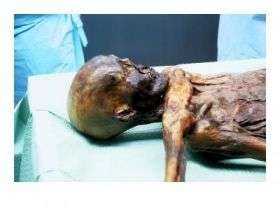
The 5,300 year old human mummy – dubbed Öetzi or 'the Tyrolean Iceman' – is highly unlikely to have modern day relatives, according to new research published today.
A team comprising scientists from Italy and the UK has sequenced Öetzi's entire mitochondrial DNA (mtDNA) genome - which is passed down through the maternal line – and found that he belonged to a genetic lineage that is either extremely rare, or that has died out.
Published in this month's issue of Current Biology, the research has generated the oldest complete Homo sapiens mtDNA genome to date, and overturns previous research conducted in 1994 on a small section of Öetzi's mtDNA, which suggested that relatives of Öetzi may still exist in Europe.
"Changes arise only gradually in mitochondrial DNA as it is passed down the generations," says co-author Professor Martin Richards of the University of Leeds' Faculty of Biological Sciences, "and so it provides an effective way of tracking ancestry through the female line across many thousands of years, as well as examining evolutionary relatedness across human populations."
The team, led by Professor Franco Rollo at the University of Camerino and Dr Luca Ermini working at both Camerino and Leeds, used powerful new technologies to sequence Öetzi's mtDNA and match it with a modern day haplogroup – in genetic terms, a group that shares a common ancestral DNA sequence. He belonged to a branch of haplogroup K1, which is still common throughout Europe today. However, almost all members of K1 sampled from modern Europeans belong to one of three sub-lineages, whereas Öetzi's lineage was completely distinct.
After death DNA begins to degrade immediately, so ancient DNA is very fragmented and any study of it has to be completed in hundreds of sections. For this research the team tested around 250 fragments, each of which had to be sequenced many times to ensure the results were not distorted.
"Our analysis confirms that Öetzi belonged to a previously unidentified lineage of K1 that has not been seen to date in modern European populations. The frequency of genetic lineages tends to change over time, due to random variations in the number of children people have - a process known as 'genetic drift' - and as a result, some variants die out. Our research suggests that Öetzi's lineage may indeed have become extinct," says Prof Richards.
"We'll only know for sure by sampling intensively in the Alpine valleys where Öetzi was born. However, our results do suggest that studies of ancient samples can fill in gaps in our knowledge left open simply because many genetic lineages died out thousands of years ago. The techniques we've used here are potentially applicable to many other ancient remains."
Öetzi's mummified remains were discovered in September 1991 in the Eastern Alps near the Austro-Italian border. He was approximately 46 years old when he died, and examinations revealed that he had been severely wounded by an arrow and possibly finished off with a mace blow to the face. He is estimated to have lain undiscovered for approximately 5,300 years. His body was almost wholly preserved, together with an array of clothes and weapons, providing an unprecedented insight into the Late Neolithic or Copper Age in Europe. Since 1998 he has been on display at the South Tyrol Museum of Archaeology in Bolzano, Italy.
Source: University of Leeds


