Without glial cells, animals lose their senses
(PhysOrg.com) -- Sensory neurons have always put on a good show. But now, it turns out, they'll be sharing the credit. In groundbreaking research to appear in the October 31 issue of Science, Rockefeller University scientists show that while neurons play the lead role in detecting sensory information, a second type of cell, the glial cell, pulls the strings behind the scenes. The findings, point to a mechanism that may explain not only how glia are required for bringing sensory information into the brain but also how glia may influence connections between neurons deep within in it.
"This is a convincing demonstration that glia play an essential role in the function of the nervous system," says Shai Shaham, head of the Laboratory of Developmental Genetics. "Without sensory neurons, animals can't sense their environment and react to it. What we found is that glia are required for the activity of these neurons and that glia are required to establish the quality of the animal's response to its environment."
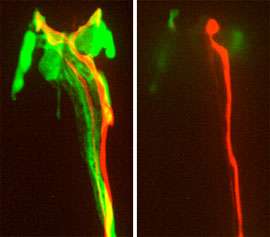
In their work, Shaham, graduate student Taulant Bacaj, and postdoctoral fellow Maya Tevlin worked with a structure called the amphid, a sensory organ in the C. elegans nervous system that contains glia and neurons. Of the organ's 12 neurons, four are completely ensheathed by glia and eight are partially ensheathed, with sensory endings exposed to the outside environment (via the worm's nose). To see what glia do for these neurons, Bacaj removed the glia and observed the effect on the neurons' shape, their ability to generate behavior when exposed to odors and temperatures, and their ability to absorb certain dyes.
The results were striking. The absence of glia affected at least one of these three properties in each of the neurons, suggesting that glia not only regulate all of these properties but that they specifically regulate them in different neurons. In the absence of glia, for example, the sensory endings of the ensheathed neurons lost their intricate branch-like structure, shriveling into nubs. However, the partially ensheathed neurons retained their normal shape, despite their inability to respond to stimuli in their environment..
"Instead of finding their perfect temperature, the worms kept crawling toward warmer and warmer regions," says Bacaj. "Also, they didn't avoid odors they didn't like and weren't drawn to odors that they did like, suggesting that the neurons could not coordinate an appropriate behavioral response."
"It's a new layer of complexity that was never described before," says Shaham.
To get a molecular handle on how glia regulate the functions of neurons, Shaham, Tevlin and Bacaj looked at which proteins are expressed more in glial cells than in any other cell in C. elegans. They found that one of these proteins, called FIG-1, was exclusively expressed in glia surrounding the amphid sensory organ (and its sister organ in the tail). When the glia secreted this protein, neurons in the sensory organ could sense the environment; without it, the neurons had difficulties in picking up specific sensory cues.
Because FIG-1 resembles a human protein called thrombospondin, which is secreted by glia in vertabrates, the results suggest that interactions between neurons and glia in C. elegans may be similar to those in humans. They also suggest that glia-neuron interactions at sensory organs may provide insight into glia-neuron interactions at synapses, connection sites between neurons deep within the brain.
"The FIG-1 protein is similar to a glial protein found at vertebrate synapses," says Shaham. "So we think there might be a connection between glial proteins in C. elegans and those in vertebrates. The difference is that at synapses, you have a neuron receiving information from another neuron, whereas at sensory organs, a neuron is receiving information from the outside world."
Provided by Rockefeller University


