Magnetic fields record the early histories of planets
October 30, 2008 Magnetic fields record the early histories of planets

Enlarge

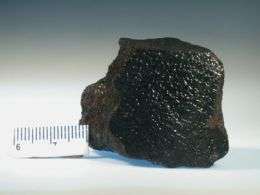
A picture of the first discovered (and therefore eponymous) angrite "Angra dos Reis"; which was observed to fall from the sky in 1869 near the town of Angra dos Reis in Brazil. The black; shiny face was produced from melting of the meteorite's surface during passage through Earth's atmosphere. Scale bar is in centimeters. Photo courtesy / Maria Zucolotto (Museu Nacional; Brasil)

(PhysOrg.com) -- Meteorites that are among the oldest rocks ever found have provided new clues about the conditions that existed at the beginning of the solar system, solving a longstanding mystery and overturning some accepted ideas about the way planets form.

The ancient meteorites, like disk drives salvaged from an ancient computer, still contain magnetic records about the very early history of planets, according to research by MIT planetary scientist Benjamin P. Weiss.

Weiss, the Victor P. Starr Career Development Assistant Professor of Planetary Sciences in the Department of Earth, Atmospheric and Planetary Sciences, and his five co-authors examined pieces of three meteorites called angrites, which are among the most ancient rocks known. The results of their study are being published in Science on Oct. 31.

The analysis showed that surprisingly, during the formation of the solar system, when dust and rubble in a disk around the sun collided and stuck together to form ever-larger rocks and eventually the planets we know today, even objects much smaller than planets — just 160 kilometers across or so — were large enough to melt almost completely.

This total melting of the planet-forming chunks of rock, called planetesimals, caused their constituents to separate out, with lighter materials including silicates floating to the surface and eventually forming a crust, while heavier iron-rich material sank down to the core, where it began swirling around to produce a magnetic dynamo. The researchers were able to study traces of the magnetic fields produced by that dynamo, now recorded in the meteorites that fell to Earth.

"The magnetism in meteorites has been a longstanding mystery," Weiss said, and the realization that such small bodies could have melted and formed magnetic dynamos is a major step toward solving that riddle.

Until relatively recently, it was commonly thought that the planetesimals — similar to the asteroids seen in the solar system today — that came together to build planets were "just homogenous, unmelted rocky material, with no large-scale structure," Weiss said. "Now we're realizing that many of the things that were forming planets were mini-planets themselves, with crusts and mantles and cores."

That could change theorists' picture of how the planets themselves took shape. If the smaller bodies were already molten as they slammed together to build up larger planet-sized bodies, that could "significantly change our understanding" of the processes that took place in the early years of the nascent planets, as their internal structures were forming, Weiss said. This could have implications for how different minerals are distributed in the Earth's crust, mantle and core today, for example.

"In the last five or 10 years," Weiss said, "our understanding of the early history of the solar system has undergone a sort of mini-revolution, driven by analytical advances in geochemistry. In this study we used a geophysical technique to independently test many of these new ideas. "

"Events happened surprisingly fast at the beginning of the solar system," he said. Some of the angrite meteorites in this study formed just 3 million years after the birth of the solar system itself, 4,568 million years ago, and show signs that their parent body had a magnetic field that was 20 to 40 percent as strong as Earth's today. "We are used to thinking of dynamo magnetic fields in rocky bodies as uncommon phenomena today. But it may be that short-lived planetesimal dynamos were widespread in the early solar system."

Source: Massachusetts Institute of Technology


print this article email this article download pdf blog this article bookmark this article     Stumble it Digg this share on Facebook retweet share on Reddit add to delicious
Rate this story - 4.6 /5 (16 votes)

Rank Filter

Move the slider to adjust rank threshold, so that you can hide some of the comments.


Display comments: newest first

  • jsylvest - Oct 31, 2008
    • Rank: not rated yet
    Not to belabor the obvious, but fused planetesimals are not required for solar system natal material magnetic influences. I see no mention in this report of the possibility of Jovian magnetic field influence on cold materials. Before revising current theory on plantesimal formation, it would be wise to subject meteoric or chemically similar materials to Jovian magnetic field strengths at various temperatures and planetary distances. A more advanced inquiry might look at the effects of high speed impact and pass through of Jovian level magnetic fields on the same materials.
  • jsylvest - Oct 31, 2008
    • Rank: not rated yet
    Sorry about the jump, still getting used to editing this. Equally, material impact heating and cooling is a given in the planetary formation process. Cooling occurring in a region with a magnetic field will freeze that influence. Not so coincdientally, objects achieving magnetic field generation size will provide growing disturbances in the orbital equilibrium of the natal system. These disturbances would result in more implacts in the vicinity of the objects.
  • smiffy - Oct 31, 2008
    • Rank: not rated yet
    I think that the researchers may well be on to something here. I cannot really see how a permanent magnetic field could be created in a meteorite unless the source of that magentic field was local to, and within the inertial frame of the meteorite.

    Picking up a magnetic field from Jupiter might be possible but I would have thought unlikely. An impact that melted the material whilst it was in the vicinity of Jupiter would mean that the object would have to cool fast and be 'spinning' slow enough to pick up the field. It would also have to mean that it was on a trajectory that was close to Jupiter but not close enough to escape Jupiter's massive gravitational clutches.

October 30, 2008 all stories

Comments: 3

4.6 /5 (16 votes)
  • Stumble this up

  • Digg this

  • share this

  • hide
  • Related Stories

  • Cassini's Big Sky: The View from the Center of Our Solar System
    created Nov 20, 2009 | popularity not rated yet | comments 0
  • The Stars My Destination
    created Nov 10, 2009 | popularity not rated yet | comments 0
  • NASA on crusade to debunk 2012 apocalypse myths
    created Nov 09, 2009 | popularity not rated yet | comments 0
  • Solar winds triggered by magnetic fields
    created Nov 02, 2009 | popularity not rated yet | comments 0
  • Icebreaker: Scientist brings out big gun to explore behavior of ice in planetary collisions
    created Oct 29, 2009 | popularity not rated yet | comments 0


  • hide
  • Relevant PhysicsForums posts

  • Sideral question
    created Nov 21, 2009
  • Doppler shifted blackbody spectrum
    created Nov 21, 2009
  • Earth v. Moon
    created Nov 21, 2009
  • help me with coordinates and orbits
    created Nov 21, 2009
  • More from Physics Forums - General Astronomy

Other News

The shore of Deception Island in Antarctica, in 2008

Antarctic ice loss vaster, faster than thought: study

Space & Earth / Earth Sciences

created 4 hours ago | popularity 3.5 / 5 (6) | comments 6

The East Antarctic icesheet, once seen as largely unaffected by global warming, has lost billions of tonnes of ice since 2006 and could boost sea levels in the future, according to a new study.


Astronaut's baby daughter born as he circles Earth (AP)

Astronaut's baby daughter born as he circles Earth

Space & Earth / Space Exploration

created 4 hours ago | popularity 5 / 5 (1) | comments 0

(AP) -- Astronaut Randolph Bresnik jubilantly welcomed his new daughter into the world Sunday as he floated 220 miles above it.


Denmark: 65 world leaders for UN climate summit (AP)

Denmark: 65 world leaders for UN climate summit

Space & Earth / Environment

created 4 hours ago | popularity 1 / 5 (1) | comments 1

(AP) -- Sixty-five world leaders have said they will attend the Copenhagen climate summit in December, and several more have responded positively to invitations, Danish officials said Sunday.


Commuters wait on the platform shrouded by fog in London

Climate change not man-made, say majority of Britons: poll

Space & Earth / Environment

created Nov 15, 2009 | popularity 3.4 / 5 (16) | comments 46

Less than half of Britons believes that human activity is to blame for global warming, according to a poll carried out for The Times newspaper and published on Saturday.


Mysteriously warm times in Antarctica

Mysteriously warm times in Antarctica

Space & Earth / Earth Sciences

created Nov 18, 2009 | popularity 4.2 / 5 (21) | comments 31

(PhysOrg.com) -- A new study of Antarctica's past climate reveals that temperatures during the warm periods between ice ages (interglacials) may have been higher than previously thought. The latest analysis ...