Bee smart, bee healthy
October 30, 2008 Bee smart, bee healthy

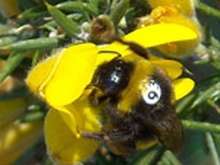
Fast learning bees fight off infection © Nigel Raine

(PhysOrg.com) -- Bumblebee colonies which are fast learners are also better able to fight off infection, according to scientists from Queen Mary, University of London and the University of Leicester.

Dr Nigel Raine from Queen Mary's School of Biological and Chemical Sciences, and Akram Alghamdi, Ezio Rosato and Eamonn Mallon from the University of Leicester tested the learning performance and immune responses of bumblebees from twelve colonies.

The team tested the ability of 180 bees to learn that yellow flowers provided the biggest nectar rewards, and to ignore blue flowers. To test the evolutionary relationship between learning and immunity, they also took workers from the same colonies and tested their immune response against bacterial infection.

Like humans, bees' ability to learn appears reduced when they are ill. The prediction was that good learners would be worse at fighting infections – but surprisingly, this was not the case.

Writing in the Royal Society journal Biology Letters, the team reports a positive relationship between a bumblebee colony's learning performance and their immune response, as Dr Raine explains: "Bees from fast learning colonies are not only the best nectar collectors, but also better able to fight infections. These colonies are probably much better equipped to thrive under difficult conditions."

The team expected that immunity is likely to be a really important trait in social species (like bumblebees, honeybees and ants) that have high-contact rates with closely related individuals leading to a greater chance of infection. There were big differences between colonies in how well they could fight off a bacterial infection, but these differences did not affect learning performance as previous studies had predicted.

The team found a positive correlation between the ability of a colony's workers to learn and the strength of their immune response, so there was no evidence for an evolutionary trade-off between these traits. Dr Raine adds: "Once again the humble bee is proving more complex than most people thought. These essential pollinators learn many things in short their life and fight off a range of infections to survive."

Citation: ‘No evidence for an evolutionary trade-off between learning and immunity in a social insect’ is published in the journal Biology Letters on Wednesday 29 November 2008: doi:10.1098/rsbl.2008.0514.

Provided by Queen Mary, University of London


print this article email this article download pdf blog this article bookmark this article     Stumble it Digg this share on Facebook retweet share on Reddit add to delicious
Rate this story - 4.4 /5 (5 votes)


October 30, 2008 all stories

Comments: 0

4.4 /5 (5 votes)
  • Stumble this up

  • Digg this

  • share this

  • hide
  • Related Stories

  • Embryo's heartbeat drives blood stem cell formation
    created May 13, 2009 | popularity not rated yet | comments 0
  • Dendritic cells stimulate cancer-cell growth
    created Nov 17, 2006 | popularity not rated yet | comments 0
  • The White Stuff: Marine Lab Team Seeks to Understand Coral Bleaching
    created Oct 20, 2009 | popularity not rated yet | comments 0
  • Researchers identify workings of L-form bacteria
    created Oct 13, 2009 | popularity not rated yet | comments 0
  • Experts watch health of bat colonies in wake of white-nose syndrome
    created Sep 18, 2009 | popularity not rated yet | comments 0


Other News

W. Africa's last giraffes make surprising comeback (AP)

W. Africa's last giraffes make surprising comeback

Biology / Ecology

created 8 hours ago | popularity not rated yet | comments 0

(AP) -- A crisp African dawn is breaking overhead, and Zibo Mounkaila is on the back of a pickup truck bounding across a sparse landscape of rocky orange soil.


W. Africa's last giraffes make surprising comeback (AP)

China sends panda expert to Taiwan to aid breeding

Biology / Plants & Animals

created 8 hours ago | popularity not rated yet | comments 0

(AP) -- Nothing like a little time apart to rekindle the affections that could lead to a baby panda.


Laser etching safe alternative for labeling grapefruit

Laser etching safe alternative for labeling grapefruit

Biology / Other

created Nov 03, 2009 | popularity 4.4 / 5 (14) | comments 8

Laser labeling of fruit and vegetables is a new, patented technology in which a low-energy carbon dioxide laser beam is used to label, or "etch" information on produce, thereby eliminating the need for common ...


Wolves, moose and biodiversity: An unexpected connection

Wolves, moose and biodiversity: An unexpected connection

Biology / Ecology

created Nov 02, 2009 | popularity 4.8 / 5 (6) | comments 4

Moose eat plants; wolves kill moose. What difference does this classic predator-prey interaction make to biodiversity?


Caught in the act: Butterfly mate preference shows how 1 species can become 2

Caught in the act: Scientists find butterflies splitting into two species

Biology / Plants & Animals

created Nov 05, 2009 | popularity 4.5 / 5 (8) | comments 2

(PhysOrg.com) -- Breaking up may actually not be hard to do, say scientists who've found a population of tropical butterflies that may be on its way to a split into two distinct species.