Geologists blame gas drilling for Indonesia mud disaster
October 30, 2008
Lusi Mud Volcano

Enlarge

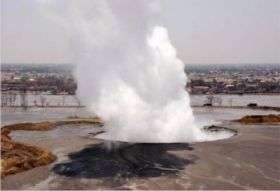
The main vent of the Lusi mud volcano taken within a few months of eruption. Credit: Durham University

A resounding vote of international petroleum geologists from around the globe concluded that the mud volcano was triggered by drilling of a nearby gas exploration well. This may have implications for compensation of the local population affected.

Lusi started to erupt in East Java, Indonesia, on May 29th 2006, and is still spewing huge volumes of boiling mud over the surrounding area. It has displaced around 30,000 people from their homes and swamped 12 villages.

The cause of Lusi was considered at a debate this week at an International conference in Cape Town, South Africa, which concluded with a vote between 74 world-leading petroleum scientists who considered the evidence presented by four experts in the field*.

Some 42 scientists voted that gas exploration well, Banjar-Panji-1, which was being drilled by oil and gas company called Lapindo Brantas, was the cause.

Only 3 scientists voted for the alternative explanation – that the Yogyakarta earthquake two days before the eruption, whose epicentre was 280km from the mud volcano, was the cause. Some 16 scientists voted that the evidence was inconclusive and 13 that a combination of earthquake and drilling were the cause.

The vote, taken this week at the American Association of Petroleum Geologists Conference in South Africa*, follows months of scientific investigation and analysis published by some of the world's leading experts in their field.

Key reasons supporting drilling rather than the earthquake as the cause include:

-- the earthquake was too small and too far away to have had a role.

-- the well was being drilled at the same time and only 150 m from the volcano site.

-- the well took a huge influx of fluid the day before the eruption, resulting in pressures that the well could not tolerate.

-- the pressure measured in the well after the influx provides strong evidence that the well was leaking and even evidence for the initial eruption at the surface.

One of the speakers, leading geologist Professor Richard Davies of Durham University, UK, commented: "The conference allowed us to present new data on the pressures in the well the day before the eruption and these provide a compelling tape recording of the well as it started to leak.''

"We were particularly grateful to Lapindo, the company involved in the drilling, who were widely applauded at the meeting for their willingness to take part in the discussion."

Prof Davies added: "I remain convinced that drilling was the cause of the mud volcano. The opinion of the international scientists at the event in South Africa adds further weight to my conviction and the conclusions of many other leading scientists who have studied Lusi."

Susila Lusiaga a drilling engineer and part of the Indonesian police investigation team said: "There is no question, the pressures in the well went way beyond what it could tolerate – and it triggered the mud volcano."

Michael Manga, Professor of Earth and Planetary Science at the University of California, Berkeley, said: "The key observation from an earthquake perspective is that there were many much larger and quite a bit closer earthquakes that did not trigger an eruption'.

"The Yogyakarta earthquake was simply too small and too far away to initiate an eruption."

Lusi is still flowing at 100,000 cubic metres per day, enough to fill 53 Olympic swimming pools.

Recent research by Durham University UK, and the Institute of Technology Bandung in Indonesia, showed Lusi is collapsing by at about 13 m per year and sometimes 3 m overnight and could subside to depths of more than 140 metres, having a significant environmental impact on the surrounding area for years to come.

Source: Durham University

4.2 /5 (17 votes)  

Filter


Move the slider to adjust rank threshold, so that you can hide some of the comments.


Display comments: newest first

Loverman
Aug 06, 2009

Rank: not rated yet
We've only just begun to experience these sort of disasters, perhaps? As more oil is drilled, who knows what to expect next, hopefully not the sinking of Persian Gulf, or an earthquake in California, because of off shore drilling?
Rank 4.2 /5 (17 votes)
Relevant PhysicsForums posts
  • Discrepancy between oxygen and carbon-dioxide levels
    created5 hours ago
  • where gems are found in the world
    created8 hours ago
  • Wind Waves in Reservoir ~ Wind run-up and Wind set-up
    createdFeb 08, 2012
  • Balance of oxygen in the atmosphere
    createdFeb 01, 2012
  • The case for a methanol-based economy
    createdJan 30, 2012
  • Weather in a rotating cylinder
    createdJan 25, 2012
  • More from Physics Forums - Earth

More news stories

New views show old NASA Mars landers

(PhysOrg.com) -- The High Resolution Imaging Science Experiment (HiRISE) camera on NASA's Mars Reconnaissance Orbiter recorded a scene on Jan. 29, 2012, that includes the first color image from orbit showing ...

Space & Earth / Space Exploration

created 19 hours ago | popularity 4.9 / 5 (7) | comments 7 | with audio podcast

Deconstructing a mystery: What caused Snowmaggedon?

In the quiet after the storms, streets and cars had all but disappeared under piles of snow. The U.S. Postal Service suspended service for the first time in 30 years. Snow plows struggled to push the evidence ...

Space & Earth / Earth Sciences

created 11 hours ago | popularity 4.7 / 5 (3) | comments 1 | with audio podcast

Black holes and star formation

(PhysOrg.com) -- It has long been recognized that galaxy mergers or even close interactions can play a vital role in shaping the morphology of galaxies. One way they can do so, it is thought, is by triggering ...

Space & Earth / Astronomy

created 18 hours ago | popularity 4.1 / 5 (7) | comments 5 | with audio podcast

Ocean microbe communities changing, but long-term environmental impact is unclear

As oceans warm due to climate change, water layers will mix less and affect the microbes and plankton that pump carbon out of the atmosphere – but researchers say it's still unclear whether these processes ...

Space & Earth / Earth Sciences

created 13 hours ago | popularity 5 / 5 (2) | comments 2 | with audio podcast

Researchers create 3-D laser maps that show how earthquake changes landscape

Geologists have a new tool to study how earthquakes change the landscape down to a few inches, and it's giving them insight into how earthquake faults behave. In the Feb. 10 issue of the journal Science, a team ...

Space & Earth / Earth Sciences

created 13 hours ago | popularity 5 / 5 (4) | comments 0 | with audio podcast


'Dark plasmons' transmit energy

Microscopic channels of gold nanoparticles have the ability to transmit electromagnetic energy that starts as light and propagates via "dark plasmons," according to researchers at Rice University.

FDA-approved drug rapidly clears amyloid from the brain, reverses Alzheimer's symptoms in mice

Neuroscientists at Case Western Reserve University School of Medicine have made a dramatic breakthrough in their efforts to find a cure for Alzheimer's disease. The researchers' findings, published in the journal Science, show t ...

Hydrogen from acidic water: Researchers develop potential low cost alternative to platinum for splitting water

A technique for creating a new molecule that structurally and chemically replicates the active part of the widely used industrial catalyst molybdenite has been developed by researchers with the Lawrence Berkeley ...

Ultraviolet protection molecule in plants yields its secrets

Lying around in the sun all day is hazardous not just for humans but also for plants, which have no means of escape. Ultraviolet (UV) radiation from the sun can damage proteins and DNA inside cells, leading ...

Soraa LED light may dim 50-watt halogen rivals

(PhysOrg.com) -- Soraa, a Fremont, California company founded in 2008, this week launched its first product, a light that uses LEDS (light emitting diodes). The "Soraa LED MR16 lamp" is the "perfect" replacement ...

Anyone can learn to be more inventive, cognitive researcher says

There will always be a wild and unpredictable quality to creativity and invention, says Anthony McCaffrey, a cognitive psychology researcher at the University of Massachusetts Amherst, because an "Aha moment" is rare and ...