Reducing roads could boost bear population
October 30, 2008 Reducing roads could boost bear population

Enlarge

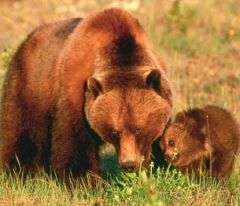
Bear populations could increase by as much as five per cent if logging roads are restricted.

Alberta's scant grizzly bear population could grow by up to five per cent a year if fewer logging roads are built in the animals' habitat, according to University of Alberta researchers.

A study conducted by biologists Scott Nielsen and Mark Boyce showed that, regardless of any ecologically friendly harvesting practices adopted by industry, if road density is not reduced in logging areas, the grizzly population may continue to decline. It is estimated that there are currently less than 500 grizzly bears in Alberta.

The study, conducted in a 9,800 square-kilometre area of west-central Alberta that includes parts of Jasper National Park, compared current harvesting practices that use small clearcuts in a checkerboard pattern, with one that would mimic a naturally-occurring disturbance like a wildfire, resulting in large clear-cut areas. The second method is thought to be more environmentally friendly to the animals, but was found by the researchers to have little benefit because of associated roads.

The U of A study tracked 40 grizzlies fitted with GPS radio collars. Their foraging and bedding patterns were monitored over a five-year period and the two potential future landscapes relating to forest harvest patterns were modelled for the next 100 years. The results showed that while both harvesting scenarios increased overall habitat conditions for the bears, that benefit was offset by increased risk of human-caused mortality associated with roads.

Roads in and out of logging areas increase the animals' risk of death though human-bear conflict, vehicle-caused collisions, poaching and displacement from feeding and habitat areas.

The results were published recently in the journal Biological Conservation.

"No matter what kind of forestry harvesting practices are used, without reducing human access to grizzly habitat, the population remains threatened," said Boyce, a professor in the Department of Biological Sciences.

"Road development, access management and human attitudes are far more important factors to Alberta grizzly populations than the size and shape of clearcuts," said Nielsen, an assistant professor in the U of A Department of Renewable Resources.

With controlled access to logging areas, Boyce estimated that the province's beleaguered bear population could increase by up to five per cent a year, based on a similar situation in the Yellowstone ecosystem. In 1983 road controls were placed on grizzly habitat there, and the population has since grown from 183 bears to more than 600. "With careful management, we should be able to achieve a similar growth rate in Alberta," he said.

"Ideally, unnecessary roads would be decommissioned or gated by industry and limits on road development identified."

Source: University of Alberta


Rate this story - 2.4 /5 (8 votes)

Rank Filter

Move the slider to adjust rank threshold, so that you can hide some of the comments.


Display comments: newest first

  • MikeB - Oct 30, 2008
    • Rank: 2.6 / 5 (5)
    Ya what we need are a whole lot more big grizzly bears in the woods. Not enough campers and hikers being mauled to death.
  • GrayMouser - Oct 31, 2008
    • Rank: 3 / 5 (4)
    "...without reducing human access to grizzly habitat..."

    So they obviously want to close off large tracts of the western US to humans.
  • Geoffsimosvho - Oct 31, 2008
    • Rank: 2.8 / 5 (6)
    Roads are a threat to many different organisms. They can separate populations into sub populations which encourages inbreeding, decreasing biodiversity within each sub population.

    This is especially dangerous when organisms are facing an ecological disaster that could cause a drastic decrease in population size. The lack of diversity within a population makes it less adaptable to changes in the environment.
  • MikeB - Oct 31, 2008
    • Rank: 2.6 / 5 (5)
    Roads are a threat to many different organisms. They can separate populations into sub populations which encourages inbreeding, decreasing biodiversity within each sub population.

    This is especially dangerous when organisms are facing an ecological disaster that could cause a drastic decrease in population size. The lack of diversity within a population makes it less adaptable to changes in the environment.


    Huh?
  • GrayMouser - Oct 31, 2008
    • Rank: 2.6 / 5 (5)
    Roads are a threat to many different organisms. They can separate populations into sub populations which encourages inbreeding, decreasing biodiversity within each sub population.

    This is especially dangerous when organisms are facing an ecological disaster that could cause a drastic decrease in population size. The lack of diversity within a population makes it less adaptable to changes in the environment.


    Huh?


    Your not supposed to ask that...
  • Velanarris - Nov 02, 2008
    • Rank: 1.8 / 5 (4)
    Roads are a threat to many different organisms. They can separate populations into sub populations which encourages inbreeding, decreasing biodiversity within each sub population.

    This is especially dangerous when organisms are facing an ecological disaster that could cause a drastic decrease in population size. The lack of diversity within a population makes it less adaptable to changes in the environment.


    Sub group diversity is a well known evolutionary mechanism. Part of the reason why we have so many species of bears is due to geological population sub division. If their genetic similarity was so great then one disease would wipe them all out.

    You're not wrong, but you're misleading. You have to frame your reference by how small a group the current human infrastructure is creating. Last i checked, bears are rather well populated in their respective zones, and far from decline, let alone inbreeding danger.

    The greatest dangers that these bears face are being hunted or displaced, not population division.
  • Velanarris - Nov 04, 2008
    • Rank: 1 / 5 (1)
    barakn, Excalibur, weigh in if you feel so strongly.
  • deepsand - Nov 06, 2008
    • Rank: 1 / 5 (2)
    The greatest dangers that these bears face are being hunted or displaced, not population division.
    You've missed the obvious fact that displacement frequently results in sub-division.
  • Velanarris - Nov 07, 2008
    • Rank: not rated yet
    The greatest dangers that these bears face are being hunted or displaced, not population division.
    You've missed the obvious fact that displacement frequently results in sub-division.


    Which means you can take displacement off the lists of threats, my bad.

October 30, 2008 all stories

Comments: 9

2.4 /5 (8 votes)

  • hide
  • Related Stories

  • Climate change isolates Rocky Mountain butterflies
    created Aug 13, 2007 | popularity not rated yet | comments 0
  • Grizzlies may lose 'threatened' status
    created Nov 15, 2005 | popularity not rated yet | comments 0
  • List of 'unsung' wildlife affected by climate change released
    created Dec 07, 2009 | popularity not rated yet | comments 0
  • Wolves lose their predatory edge in mid-life, study shows
    created Oct 26, 2009 | popularity not rated yet | comments 0
  • Fed judge says grizzlies still threatened
    created Sep 21, 2009 | popularity not rated yet | comments 0


  • hide
  • Relevant PhysicsForums posts

  • Carbon Dioxide emissions question
    created Feb 08, 2010
  • Photosynthesis vs. carbonization
    created Feb 07, 2010
  • Sheep's footprints
    created Feb 05, 2010
  • How did Victorians estimate the ages of fossils?
    created Feb 03, 2010
  • More from Physics Forums - Earth

Other News

Climate 'Tipping Points' May Arrive Without Warning, Says Top Forecaster

Space & Earth / Environment

created 6 hours ago | popularity 3 / 5 (4) | comments 5 | with audio podcast

(PhysOrg.com) -- A new University of California, Davis, study by a top ecological forecaster says it is harder than experts thought to predict when sudden shifts in Earth's natural systems will occur -- a worrisome finding ...


Rho Ophiuchus cloud

Professor: We have a 'moral obligation' to seed universe with life

Space & Earth / Astronomy

created 17 hours ago | popularity 3.3 / 5 (22) | comments 47 | with audio podcast report

(PhysOrg.com) -- Eventually, the day will come when life on Earth ends. Whether that’s tomorrow or five billion years from now, whether by nuclear war, climate change, or the Sun burning up its fuel, the last ...


38 percent of world's surface in danger of desertification

38 percent of world's surface in danger of desertification

Space & Earth / Environment

created 3 hours ago | popularity 2.3 / 5 (3) | comments 4

A team of Spanish researchers has measured the degradation of the planet's soil using the Life Cycle Assessment (LCA), a scientific methodology that analyses the environmental impact of human activities, and ...


A new 3-D map of the interstellar gas within 300 parsecs from the sun

A new 3D map of the interstellar gas within 300 parsecs from the Sun

Space & Earth / Astronomy

created 9 hours ago | popularity 5 / 5 (4) | comments 0 | with audio podcast

(PhysOrg.com) -- Astronomy & Astrophysics is publishing new 3D maps of the interstellar gas in the local area around our Sun. A French-American team of astronomers presents new absorption measurements toward ...


URI researcher calls for global effort to monitor marine pollutants

Space & Earth / Environment

created 7 hours ago | popularity 3 / 5 (2) | comments 1

A University of Rhode Island researcher who studies chemical pollutants in the marine environment has called on colleagues around the world to establish a global monitoring network to verify that the chemicals banned by the ...