Too much of a good thing: Cells with extra chromosomes share detrimental traits
October 30, 2008 By Anne Trafton Too much of a good thing: Cells with extra chromosomes share detrimental traits

Enlarge

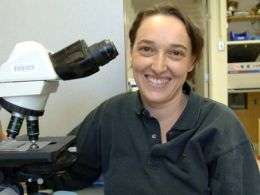
Professor of Biology Angelika Amon reports new insights into how cells divide, a process important to cancer research. Photo / Donna Coveney

(PhysOrg.com) -- Mammalian cells with extra chromosomes share some common traits that could be exploited to develop cancer treatments, according to MIT biologists.

Having too many chromosomes, a condition known as aneuploidy, wreaks havoc on an organism, usually resulting in birth defects or death. However, it seems to confer an advantage on tumor cells, which are nearly always aneuploid.

"Now we can look for compounds that specifically kill aneuploid cells, or look for genes that when you knock them down, kill aneuploid cells," said Angelika Amon, professor of biology and senior author of a paper describing the work in the Oct. 31 issue of Science.

Amon and her colleagues have started screening such compounds and already identified one promising candidate.

In this study -- the first to systematically examine the effects of aneuploidy in mammalian cells -- the researchers looked at aneuploidy of four different mouse chromosomes (mice have 20 pairs of chromosomes).

They found that in addition to specific detrimental effects of each extra chromosome, aneuploidy seems to provoke a generalized response in all cells.

The aneuploid cells all divided very slowly, grew too large and displayed other metabolic changes that indicate the cells are under stress and need extra energy to cope with protein imbalances produced by aneuploidy.

"We propose that these cells are chronically stressed," said Amon, who is a member of the David H. Koch Institute for Integrative Cancer Research.

That finding creates a paradox. Aneuploidy seems to give cells a proliferative disadvantage, yet aneuploid tumor cells tend to proliferate rapidly.

There are multiple theories that could explain this apparent paradox, Amon said. One theory is that even though aneuploid cells don't grow very well, they may still grow better than the normal cells surrounding them. As Amon explains it, "the one-eyed man is king in the country of the blind."

Another view, which is Amon's preferred theory, is that aneuploidy puts so much stress on the cell that it starts generating more mutations than normal, eventually driving it to become cancerous.

Lastly, it's possible that aneuploidy doesn't play a role in how cancerous cells develop -- it's just a byproduct of tumor generation.

Lead author of the paper is Bret Williams, a postdoctoral associate in the Koch Institute. Other authors are Vineet Prabhu, a graduate student in biology; Karen Hunter, a 2006 MIT graduate and former technician in Amon's lab; Christina Glazier SB '07, a technician in Amon's lab; Charles Whittaker, a research scientist in the Koch Institute; and David Housman, a professor of biology and member of the Koch Institute.

Provided by MIT


print this article email this article download pdf blog this article bookmark this article     Stumble it Digg this share on Facebook retweet share on Reddit add to delicious
Rate this story - 5 /5 (5 votes)


October 30, 2008 all stories

Comments: 0

5 /5 (5 votes)
  • Stumble this up

  • Digg this

  • share this

  • hide
  • Related Stories

  • When you've doubled your genes, what's 1 chromosome more or less?
    created Sep 14, 2009 | popularity not rated yet | comments 0
  • Research sheds light on cause of Down syndrome and other genetic disorders
    created Jul 20, 2009 | popularity not rated yet | comments 0
  • New blood test for Down syndrome
    created Oct 07, 2008 | popularity not rated yet | comments 0
  • An alternative theory on cancer
    created Jun 27, 2007 | popularity not rated yet | comments 0
  • Researchers shed light on how tumor cells form
    created Jun 21, 2006 | popularity not rated yet | comments 0


Other News

Hammerhead shark

Wide heads give hammerheads exceptional stereo view

Biology / Plants & Animals

created 21 hours ago | popularity 4.5 / 5 (6) | comments 4

Hammerhead sharks are some of the Ocean's most distinctive residents. 'Everyone wants to understand why they have this strange head shape,' says Michelle McComb from Florida Atlantic University. One possible ...


Golden Oldie: Key Role for Ancient Protein in Algae Photosynthesis

Golden Oldie: Key Role for Ancient Protein in Algae Photosynthesis

Biology / Biotechnology

created 13 hours ago | popularity not rated yet | comments 1

The discovery that an ancient light harvesting protein plays a pivotal role in the photosynthesis of green algae should help the effort to develop algae as a biofuels feedstock. Researchers with the Lawrence ...


Tough yet stiff deer antler is materials scientist's dream

Biology / Plants & Animals

created 21 hours ago | popularity 3 / 5 (2) | comments 2

Prized for their impressive antlers, red deer have been caught in the hunters' sights for generations. But a deer's antlers are much more than decorative. They are lethal weapons that stags crash together when duelling. John ...


Indonesia rejects Bali plan for turtle sacrifices (AP)

Indonesia rejects Bali plan for turtle sacrifices

Biology / Ecology

created 19 hours ago | popularity 5 / 5 (1) | comments 0

(AP) -- Indonesia has rejected a push by the resort island of Bali for rare turtles to be legally slain in Hindu ceremonies, siding with conservationists of the protected reptiles against religious advocates, ...


Ecologists sound out new solution for monitoring cryptic species

Biology / Ecology

created 21 hours ago | popularity not rated yet | comments 0

Ecologists have at last worked out a way of using recordings of birdsong to accurately measure the size of bird populations. This is the first time sound recordings from a microphone array have been translated into accurate ...