Explosion on chip sets liquid in motion
October 30, 2008
Explosion on chip sets liquid in motion

Enlarge

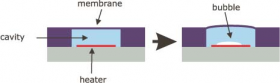
Simplified version of the micro-bubble actuator developed by Van den Broek. The right illustration shows that the membrane is deflected by the bubble formed near the heater.

(PhysOrg.com) -- PhD student, Dennis van den Broek, of the University of Twente, Netherlands, has developed a new type of miniature motor, the micro-bubble actuator. This ‘motor’, which can be used in laboratories the size of a chip, for instance, converts the energy released during explosive evaporation into motion. Van den Broek will be defending his PhD on 31 October at the Faculty of Electrical Engineering, Mathematics and Computer Science (EEMCS).

A (micro-)actuator is a device that converts energy, such as magnetic or heat energy into motion. There are many different types of micro-actuators, each with its own advantages and disadvantages. Often actuators are fast or powerful, but not both. However, Van den Broek has designed a micro-actuator that is fast and powerful at the same time. To this end he used heat. This heat is converted into motion by the micro-actuator.

The micro-actuator developed by Van den Broek consists of a cavity filled with a liquid (for instance, ethanol), with a heater at the bottom. The cavity is closed off by a membrane or thin skin that closes the system. Actuators can be found in various places, including in the ‘lab-on-a-chip’, a tiny chemical laboratory the size of a chip. In order to pump liquids through the tiny canals, pumps and valves of the same size are required. The micro-actuator developed by Van den Broek may fulfil a key role in this.

The micro-bubble actuator

In order to make the new actuator powerful and fast, Van den Broek used a promising technology based on explosive evaporation. Explosive evaporation takes place when a liquid is exposed to a high temperature. In a few microseconds the liquid reaches a temperature close to the critical point, far above the boiling point of the liquid in question under normal conditions. At this temperature the liquid evaporates. This is characterized by the formation of a large number of bubbles in the liquid, similar to when water boils. The bubbles formed merge almost immediately to form a layer of vapour. The resulting pressure that builds up is used to deflect a membrane. The 'bulging' of the membrane sets the liquid above it in motion.

Because the bubbles arise in a small volume, the actuator is fast. Van den Broek sent a heat impulse through the heater at least every 0.1 millisecond. This means that a bubble is formed 10,000 times a second and the membrane is deflected. Combined with the high pressure that can be generated by the heat, the actuator is also powerful.

Micro-pumps

The new actuator can be used as a tiny pump in a micro-fluidic system, an example of which is the ‘lab-on-a-chip’. The tiny channels through which the liquid must flow are squeezed together by the bulging, so that the liquid acquires speed. If enough of these micro-actuators are placed one after the other and activated in the right order, the liquid will continue to flow.

Source: University of Twente

4.8 /5 (5 votes)  

Filter


Move the slider to adjust rank threshold, so that you can hide some of the comments.


Display comments: newest first

crisw
Oct 31, 2008

Rank: not rated yet
A method very close to this was described in IEE Electronics Letters, ca. 1967, as an interface between electrical and fluidic systems.
Rank 4.8 /5 (5 votes)
Relevant PhysicsForums posts

More news stories

Scientists discover molecular secrets of 2,000-year-old Chinese herbal remedy

For roughly two thousand years, Chinese herbalists have treated Malaria using a root extract, commonly known as Chang Shan, from a type of hydrangea that grows in Tibet and Nepal. More recent studies suggest that halofuginone, ...

Chemistry / Biochemistry

created 12 hours ago | popularity 4.5 / 5 (19) | comments 16 | with audio podcast

New method to examine batteries -- MRI from the inside

There is an ever-increasing need for advanced batteries for portable electronics, such as phones, cameras, and music players, but also to power electric vehicles and to facilitate the distribution and storage of energy derived ...

Chemistry / Analytical Chemistry

created 12 hours ago | popularity 5 / 5 (7) | comments 0 | with audio podcast

Hydrogen from acidic water: Researchers develop potential low cost alternative to platinum for splitting water

A technique for creating a new molecule that structurally and chemically replicates the active part of the widely used industrial catalyst molybdenite has been developed by researchers with the Lawrence Berkeley ...

Chemistry / Materials Science

created Feb 09, 2012 | popularity 4.8 / 5 (16) | comments 21 | with audio podcast

Fool's gold may prove an unlikely alternative to overexploited catalytic materials

Catalytic materials, which lower the energy barriers for chemical reactions, are used in everything from the commercial production of chemicals to catalytic converters in car engines. However, with current catalytic materials ...

Chemistry / Materials Science

created Feb 10, 2012 | popularity 4.4 / 5 (8) | comments 9 | with audio podcast

Research provides octagonal window of opportunity for carbon capture

(PhysOrg.com) -- Filtering carbon dioxide, a greenhouse gas, from factory smokestacks is a necessary, but expensive part of many manufacturing processes. However, a collaborative research team from the National ...

Chemistry / Materials Science

created Feb 08, 2012 | popularity 5 / 5 (2) | comments 6 | with audio podcast


A mitosis mystery solved: How chromosomes align perfectly in a dividing cell

Although the process of mitotic cell division has been studied intensely for more than 50 years, Whitehead Institute researchers have only now solved the mystery of how cells correctly align their chromosomes during symmetric ...

Google might launch Drive for cloud storage soon

(PhysOrg.com) -- Google's next big move, according to the Wall Street Journal, is a cloud storage service called Drive. Hardly first to the plate, Google is simply catching up to introducing its cloud reposi ...

Lab study raises questions over nano-particle impact

Tests involving chickens have raised questions about the impact on health from engineered nano-particles, the ultra-fine grains commonly used in drugs and processed foods, scientists said on Sunday.

Starve a virus, feed a cure? Findings show how some cells protect themselves against HIV

A protein that protects some of our immune cells from the most common and virulent form of HIV works by starving the virus of the molecular building blocks that it needs to replicate, according to research published online ...

Researchers find extensive RNA editing in human transcriptome

In a new study published online in Nature Biotechnology, researchers from BGI, the world's largest genomics organization, reported the evidence of extensive RNA editing in a human cell line by analysis of RNA-seq data, demons ...

The proteins ensuring genome protection

Researchers from the University of Geneva (UNIGE), Switzerland, have discovered the crucial role of two proteins in developing a cell 'anti-enzyme shield'. This protection system, which operates at the level of molecular ...