Phoenix Mars Lander Out Of Communication
October 30, 2008 Pheonix

Enlarge

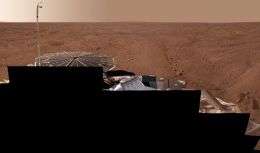
This view combines more than 400 images taken during the first several weeks after NASA's Phoenix Mars Lander arrived on an arctic plain at 68.22 degrees north latitude, 234.25 degrees east longitude on Mars.

(PhysOrg.com) -- NASA'S Phoenix Mars Lander, with its solar-electric power shrinking due to shorter daylight hours and a dust storm, did not respond to an orbiter's attempt to communicate with it Wednesday night and Thursday morning.

Mission controllers judge the most likely situation to be that declining power has triggered a pre-set precautionary behavior of waking up for only about two hours per day to listen for an orbiter's hailing signal. If that is the case, the wake-sleep cycling would have begun at an unknown time when batteries became depleted.

"We will be coordinating with the orbiter teams to hail Phoenix as often as feasible to catch the time when it can respond," said Phoenix Project Manager Barry Goldstein at NASA's Jet Propulsion Laboratory, Pasadena, Calif. "If we can reestablish communication, we can begin to get the spacecraft back in condition to resume science. In the best case, if weather cooperates, that would take the better part of a week."

The Phoenix lander has operated at a Martian arctic site for more than two months longer than its initially planned, three-month prime mission. The sun stayed above the horizon around the clock during the prime mission, but is now below the horizon for about 7 hours each night.

Engineers at JPL and at Lockheed Martin Space Systems, Denver, operate Phoenix and the two NASA orbiters used for relaying communications with the lander, Mars Reconnaissance Orbiter and Mars Odyssey.

Provided by JPL, NASA


print this article email this article download pdf blog this article bookmark this article     Stumble it Digg this share on Facebook retweet share on Reddit add to delicious
Rate this story - 4.9 /5 (8 votes)


October 30, 2008 all stories

Comments: 0

4.9 /5 (8 votes)
  • Stumble this up

  • Digg this

  • share this

  • hide
  • Related Stories

  • Frost-Covered Phoenix Lander Seen in Winter Images
    created Nov 05, 2009 | popularity not rated yet | comments 0
  • Scientists see water ice in fresh meteorite craters on Mars
    created Sep 24, 2009 | popularity not rated yet | comments 0
  • Biosphere 2 Opens Phoenix Mars Lander Exhibit
    created Sep 18, 2009 | popularity not rated yet | comments 0
  • Reconstruct Mars automatically in minutes
    created Sep 18, 2009 | popularity not rated yet | comments 0
  • Telltale tells story of winds at Phoenix landing site
    created Sep 16, 2009 | popularity not rated yet | comments 0


  • hide
  • Relevant PhysicsForums posts

  • The shape of our solar system's orbits.
    created Nov 07, 2009
  • Above or Below the Line of Nodes
    created Nov 07, 2009
  • Supernova vs. Nova?
    created Nov 07, 2009
  • Supernova's Gamma Rays and Comets
    created Nov 06, 2009
  • More from Physics Forums - General Astronomy

Other News

Deep creep means milder, more frequent earthquakes along Southern California's San Jacinto fault

Deep creep means milder, more frequent earthquakes along Southern California's San Jacinto fault

Space & Earth / Earth Sciences

created 14 hours ago | popularity 4.7 / 5 (3) | comments 0

With an average of four mini-earthquakes per day, Southern California's San Jacinto fault constantly adjusts to make it a less likely candidate for a major earthquake than its quiet neighbor to the east, the ...


Success in 'space elevator' competition (AP)

Success in 'space elevator' competition (Update 3)

Space & Earth / Space Exploration

created Nov 05, 2009 | popularity 4.3 / 5 (33) | comments 50

(AP) -- A robot powered by a ground-based laser beam climbed a long cable dangling from a helicopter on Wednesday to qualify for prize money in a $2 million competition to test the potential reality of the ...


In a Galaxy Far, Far Away...

In a Galaxy Far, Far Away...

Space & Earth / Astronomy

created Nov 06, 2009 | popularity 4.8 / 5 (5) | comments 17

(PhysOrg.com) -- Astronomers have published the discovery of the farthest known object in the cosmos: a star that exploded when the universe was only 630 million years old -- only 4.6% of its current age. ...


'Dropouts' pinpoint earliest galaxies

'Dropouts' pinpoint earliest galaxies

Space & Earth / Astronomy

created Nov 06, 2009 | popularity 4.2 / 5 (10) | comments 13

Astronomers, conducting the broadest survey to date of galaxies from about 800 million years after the Big Bang, have found 22 early galaxies and confirmed the age of one by its characteristic hydrogen signature ...


Space hotel taking bookings for 2012 opening

Space hotel taking bookings for 2012 opening

Space & Earth / Space Exploration

created Nov 05, 2009 | popularity 4.4 / 5 (21) | comments 11

(PhysOrg.com) -- The first orbiting space hotel is on track to open for its first customers in 2012, but hurry, as bookings are filling fast.