The Building Blocks of Life
October 30, 2008 The Building Blocks of Life

Enlarge

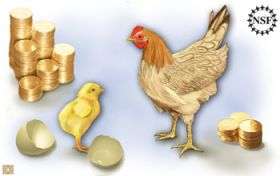
Researchers have found that the faster an animal is growing, the more energy from food it uses. As animals age, their energy use levels out. Credit: Zina Deretsky, National Science Foundation

(PhysOrg.com) -- Ever wonder where all that food your teenager devoured was going? Not only does the food go into the teen's daily activities--running, doing homework, breathing and playing video games, but food converted to energy also fuels growth of new tissues--bones, vessels, cartilage, muscle.

In poorer areas of the world, part of the energy yielded by food might be deflected for the body's defense system in fighting disease. Children and teens in such conditions will not grow as tall or big as their healthy counterparts who were able to allocate more of their energy stores directly to growth.

In the October 31 issue of Science, researchers funded by the National Science Foundation report on a model that shows that the food baby mammals and birds use to grow always stay proportional to how fast they are growing. This relationship stays remarkably stable for all sizes and types of animals.

Chen Hou of the Santa Fe Institute compares the building of an animal to the building of a house: "When you build a house the materials alone are just part of the story. You might pay $1,000 for the bricks, but you will spend much more for the workers and the rest of the overhead. Same with building a body--new muscle and bone are just part of the energy expenditure; laying that new tissue down costs much more."

Previous energy budget models have typically been based on either rates of food consumption or metabolic energy expenditure. Hou and his colleagues are the first to reconcile the two approaches and to highlight the fundamental principles that determine rates of food assimilation and the rate of energy allocation to maintenance of a body and to its growth, activity and storage. They confirmed their model with data from 14 different mammals and birds from the chicken to the fox.

In the future they will be interested to see how the rates of food intake and growth compare in reptiles and insects.

The current modeling work is not only important in agriculture and husbandry, but will lend key insight into child obesity and the relationship of diet control to exercise and weight loss. This research can also shed light on how food restriction can retard aging.

Provided by NSF


print this article email this article download pdf blog this article bookmark this article     Stumble it Digg this share on Facebook retweet share on Reddit add to delicious
Rate this story - 5 /5 (1 vote)


October 30, 2008 all stories

Comments: 0

5 /5 (1 vote)
  • Stumble this up

  • Digg this

  • share this

  • hide
  • Related Stories


Other News

Ecological speciation by sexual selection on good genes: Is speciation adaptive?

Biology / Ecology

created 6 minutes ago | popularity not rated yet | comments 0

Darwin suggested that the action of natural selection can produce new species, but 150 years after the publication of his famous book, 'On the Origin of Species', debate still continues on the mechanisms of speciation. New ...


The six elephants in Sierra Leone were shot and "crudely butchered"

S.Leone elephants 'wiped out' by poachers: official

Biology / Ecology

created 1hour ago | popularity 5 / 5 (2) | comments 0

Poachers "wiped out" the entire elephant herd in Sierra Leone's only wildlife park, wildlife managers said Thursday after police said they had arrested a gang of 10 poachers.


Knockouts in human cells point to pathogenic targets

Knockouts in human cells point to pathogenic targets

Biology / Cell & Microbiology

created 3 hours ago | popularity not rated yet | comments 0

(PhysOrg.com) -- Whitehead researchers have developed a new approach for genetics in human cells and used this technique to identify specific genes and proteins required for pathogens.


Whiteflies sabotage alarm system of plant in distress

Whiteflies sabotage alarm system of plant in distress

Biology / Plants & Animals

created 4 hours ago | popularity 5 / 5 (1) | comments 0

(PhysOrg.com) -- When spider mites attack a bean plant, the plant responds by producing odours which attract predatory mites. These predatory mites then exterminate the spider mite population, thus acting ...


RNA on the move

RNA on the move

Biology / Cell & Microbiology

created 4 hours ago | popularity not rated yet | comments 0

In the fruit fly Drosophila, oskar mRNA, which is involved in defining the animal’s body axes, is produced in the nuclei of nurse cells neighbouring the oocyte, and must be transported to the oocyte and along ...