UC Davis: Troublesome, Non-native Squirrels Will Get Birth-control Shots
(PhysOrg.com) -- Before someone gets bitten, or neighboring farmlands are invaded, UC Davis officials will launch a birth-control research program to curb a campus population explosion of non-native tree squirrels.
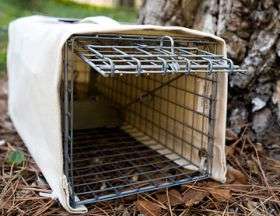
The project will launch in the next week, when faculty wildlife experts and their students will begin placing humane live traps of wire mesh under trees and around lawns to capture eastern fox squirrels (Sciurus niger).
Captured squirrels will quickly be examined, marked with a nontoxic dye, and set free. Through fall and winter, the researchers will study the squirrels' behavior to establish a baseline understanding of the animals' normal activities.
Next summer, the squirrels will be recaptured, and some will be given hormone injections to stop them from having offspring. Other animals will be given a placebo injection (sterile saline) and will serve as scientific controls for comparison. All animals will immediately be set free, and their behavior will be studied again. If the treated animals exhibit different behavior but the control animals do not, this will serve to confirm that any changes were related to the hormone injections.
If all goes well, the population of non-native tree squirrels living at UC Davis will plateau and then, in five to 10 years, decline to a small, sustainable number, with no harm to the animals.
The program has two key objectives: to reduce the campus fox squirrel population before they cause problems, and to test a new birth-control drug that federal wildlife biologists hope will help them manage other mammals that are pests in some places, such as deer and ground squirrels.
Sara Krause is the UC Davis ecology doctoral student leading the project. Her faculty adviser is Douglas Kelt, professor of wildlife, fish and conservation biology, and member of the Graduate Group in Ecology.
"In seven years, we went from having no eastern fox squirrels on the campus to having more than 400, and there is currently no sign that their reproduction is slowing down," Krause said this week.
"This is an introduced species that has demonstrated elsewhere that it is prolific, adaptable, invasive and problematic for many reasons."
Krause, who earned a bachelor of science degree in natural resources at Cornell University (another campus well-populated with Sciurus niger), said the eastern fox squirrels' impacts can include:
-- Injuries to people: More and more eastern fox squirrels are approaching students on the Quad and at Lake Spafford. No one here has been hurt yet. But in other communities, squirrels have become aggressive food-snatchers, especially from children, and people have been scratched and bitten. That's worrisome, Krause said, because eastern fox squirrels, like all wild animals, can carry bacteria that can cause skin infections or stomach and intestinal illness in people.
-- Damage to campus research farms and orchards, and adjacent agricultural operations: Eastern fox squirrels are spreading from cities to rural lands throughout California, Krause said, threatening orchards of almonds and walnuts as well as other crops.
-- Competition with native plants and animals: Eastern fox squirrels eat the same foods, such as oak acorns, as native gray squirrels and native birds. Fox squirrels also eat bird eggs and baby birds.
-- Damage to teaching plant collections: For example, fox squirrels have begun chewing the bark of redwood trees in the UC Davis Arboretum. Bark damage can weaken and even kill a tree.
-- Damage to campus facilities: Fox squirrels have entered campus buildings. Like rats, they have an affinity for chewing on electric wires. On other university campuses, they have crashed the power supply.
At UC Davis, the responsibility for managing campus wildlife problems lies with the Buildings and Grounds Division of Facilities Management. Division director Sal Genito said his team has ongoing management programs for a surprising variety of animals -- mice, rats, bats, feral cats, ground squirrels, rabbits, pigeons, chickens, guinea fowl, peacocks and Canada geese.
"The chief reason we have so many potential pests is that we have 5,300 acres of attractive habitats, from dining halls to woodlands and from student gardens to almond orchards," said Genito. "And it's our obligation to be good property managers, so pest problems do not spill over to our neighbors' homes, parks, restaurants and farms."
The fox-squirrel project will be managed by a collaboration of faculty experts, staff and students. Similar collaborations are under way, Genito said, to solve ongoing problems of herons and egrets damaging the campus' Shields Oak Grove, and of large numbers of mallard ducks in the UC Davis Arboretum.
"Our goal is not to hurt the animals that find our grounds so attractive," Genito said. "It is to limit their ecological and human-health impacts as effectively and humanely as possible."
Provided by UC Davis


