Quiet wind turbine could provide up to 30% of a home's power
October 31, 2008 by Lisa Zyga
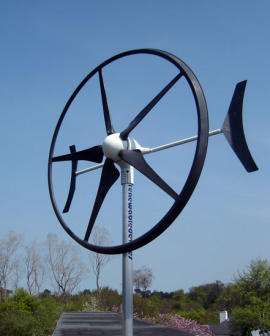
The Swift wind turbine, developed by the Scottish company Renewable Devices, was designed for quiet roof-top performance. Credit: Cascade Engineering.
(PhysOrg.com) -- A quiet wind turbine developed in Scotland is now available in the US and Canada. Its developers say that the roof-based turbine can provide significant power for homes and commercial buildings alike.
Originally designed by Scotland-based Renewable Devices, the Swift wind turbine is being sold in the US by Cascade Engineering of Grand Rapids, Mich.
Unlike many existing small wind turbines, the Swift turbine is designed to reduce noise. At seven feet in diameter, it consists of five thin blades encircled by a ring. The ring reduces vibration and diffuses the noise to a level of less than 35 decibels.
Cascade says that the wind turbine should be positioned at least two feet above the roof line in locations with average wind. Its two fins direct the turbine to face the wind, with the ability to turn 360 degrees. The blades power a generator, which produces about 1.5 kilowatts with a 14-mph wind.
Over a year, the turbine can generate about 2,000 kilowatt-hours of electricity, which is a significant percentage of the 6,500 to 10,000 kilowatt-hours per year that US households typically consume (estimates are from the US Energy Information Administration).
While the installation cost run at around $10,000, state rebates and tax credits could help lower the upfront cost; for example, a renewable energy tax credit gives consumers $1,000 back for residential systems and $4,000 for commercial buildings. Depending on these incentives and performance levels, Cascade estimates that the upfront cost could be made up in as little as three years.
So far, Cascade has installed nine Swift turbines in the US and has a backlog of 25 orders. Orders come from about half residential and half commercial customers. In Scotland, Swift turbines have been installed at 250 sites.
More information: www.swiftwindturbine.com
via: CNet News


I take it that's why it costs so much... Batteries and inverters. I assume you could increase the number of turbines for a higher percentage of the home's power?
If not, at least the inverter to plug it directly into the grid needs to be cheap.
Someone needs to invent an inverter that you can just plug into any outlet, and it just reduces your electric bill.
Does anyone want to bet that the amount of power generated is nowhere near the cost of renting the space on top of a commercial building where the tenets are vying for room to put their antennas and cell phone towers?
With this one though, you don't need a separate poll. So it is less ugly, consumes less space, and creates less noise.
Still not worth the price though. If these were 1000 a pop instead of 10000, people would jump on them.
Cripes but there is some ignorance on PHYSORG.asm, headlines and stupid bloggers.
That is simply not a good investment. However, as I said before, if these were 1/10th the price (1000 instead of 10000), they'd be decent enough. Hopefully they'll be able to bring the price down to a reasonable level.
It's not that simple. Just plugging into the grid runs the risk of electrocuting your local lineman who comes to work on the poles when the electricity goes out.
This is very possible, and already done, with NetMetering. It does require a special cutout box that protects you and protects the grid from your generator.
2,000 / 6,500 = .307 or 30.7% (not "less than" 30%)
Doug Huffman:
1,000 / 6,500 = .1537 or 15.5%
The point Doug was making is that the electrical output from these fans may well be greatly exaggerated (at least that is the way I read it).
Looking at these turbines and the fins, does it run side on to the wind?
That's the way it looks anyway.
Use what you need and throw the rest of the grid! There are special electronics for doing that! Why pay for storage when you can be paid for sharing? In an ideal world, everyone's solar and wind generation will mean we don't need mass produced power in residential areas.
Now then... $10K is rediculous. And how far apart can they be spaced and still work? If I put 4 or 5 up there can I get net-Zero energy usage?
I don't think it will be long before power costs hit a buck per kilowatt. When that happens suddenly all these will start making sense.
If I don't have wind for my turbine, my neighbor probably is also in the short. Until someone comes up with a real high temp superconductor. not a lab test, a manufactuable 140F superconductor "sharing" will be another term for rolling blackout. same with solar only more so, we can't "share" with Russia with current conductors. so for the time being storage is so the Freezer continues to work, the lights come on, the electric car in the garage charges over night so you can go to work.
You still don't need to store it. Do nuclear stations store their power? Do coal stations store their power?
If you and all of your neighbors have a cloudy day with no wind you use more grid power. The electric company will adapt to that in the same way they adapt to a cool summer day when nobody needs their AC vs a hot summer day where all AC machines are running full blast.
Power companies are good at dealing with variable power conditions. They have to be. Renewables aren't the total answer, but they certainly help - a lot. Once they get over about 50% capacity from renewables maybe we need to look at storage. That won't happen for many decades...
It's working in Germany. They seem to be happy as a clam with renewable energy sources. They don't store it at all and they don't have rolling brownouts.
We don't have to. It's already stored in the coal or the Uranium. You can't store the energy from the wind because wind isn't capturable. Once the wind blows, the energy is spent.
Not if they're costing this sort of money. 10k is a hefty investment especially when it would take at least 8 years of no electricity bills whatsoever to pay for itself in my case.
Nuclear doesn't work that way. It takes weeks to start it up and turn it off. Once it's making electricity it has to keep making it. You can't just turn it up when people want power, and you don't store it when people want less.
lets see... at a buck a kilowatt hour, 2000 KWh's will save you $2000 each year. With a purchase price of $10,000, how do you get 8 years to pay for itself?
If you're commercial and you get a 4K rebate, then it will take 3 years. A nice easy return, expecially when it will save you another 2K/year forever.
But.... for that math to work we need power to cost a buck a kilowatt. Give it a few years. I'll bet when we power our cars with electricity it will get close to that.
It's called base load. It doesn't have to fluctuate. That's a good thing. -.-
Here are some real world numbers:
At an average of 920kWh per month and 12 months in a year at 12 cents per kWh. That's $1,324 per year. (12*12*920)
If this device generates 2000 kWh per year that's 18 percent of my usage equivalent to 238 dollars a year.
(2000/(920*12))*1324
If it completely eliminated my 1324 per year then it would be about 8 years.
920*12/1324
Since it will only eliminate about 238 per year it will in effect be 42 years, and that's assuming no maintenance.
10000/238
Where is the cost effectiveness scale again?
Your looking at it all wrong. If 1,000 tree huggers a year buy 2 of these to offset say 40% of the energy that they use every year, plus the cost of replacement parts and service, usually on power generation that'll come out to about the cost again every 5 to 10 years, say ten to be lean and O&M will run about 10% per year. Replace every 10 years. Then figure Then gross income for year progresses at.
$20 mil year 1
$28 mil year 5
$48 mil Year 10
And we're still no close to getting off of conventional plants, but they've pocket over $250 million getting us there.
Sure you pay that now... what did you pay for gasoline 10 years ago...
When did you pay for flour before they started using it to make gasoline?
You go ahead and think electricity will always be 12 cents per kilowatt. You can be the first in line to complain when it hits a buck/kw. The only thing you can't honestly say is "Noone ever warned you"
Are you in the same group that screamed cause noone told you that gas would be 4$/gallon when you were buying your hummer?
1/5 for accurate reading skills...
Yes, it is certainly possible that electrical rates will rise, but that only makes the payback time shorter.
As for the cost of gas 10 years ago, around here it was about $1.75 a gallon.
I'm now paying $1.98 a gallon.
Let's apply that same cost increase, $12. per kWh up to $.13 per kWh. Yep, looks like you're wrong.