Tools give earlier date for 'modern-thinking' humans
(PhysOrg.com) -- An international team, including Oxford University archaeologists, has dated two explosions of sophisticated stone tool making in southern Africa much more precisely than has previously been possible.
The team dated the two events, known as the Still Bay and Howieson’s Poort industries, to around 80,000 and 60,000 years ago respectively.
This provides further evidence that humans (Homo sapiens) in southern Africa were ‘behaviourally modern’ – that is, thought and behaved like modern humans – before any migration of biologically modern humans to the rest of the world: most likely dated at around 60,000 years ago according to the ‘out of Africa 2’ theory. A report of the research is published in this week’s Science.
‘These new findings reinforce the understanding that we have to massively expand the timeframe over which people in southern Africa were no different from people today,’ said Professor Peter Mitchell of Oxford University’s School of Archaeology. ‘We will now have to think much more creatively about the past and what sorts of sophisticated human behaviours were going on in Africa over this vast new landscape of tens of thousands of years.’
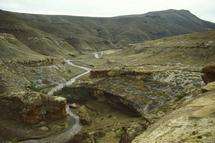
The evidence comes from archaeological sites in Lesotho and South Africa. Characteristic of the older Still Bay objects are generally spearhead-shaped forms with sharp edges that may have seen them function as spear points or knife blades. The younger Howieson’s Poort objects are typically no more than a few centimetres long and have been worked into half-circles or other geometric shapes – they were probably set into bone or wooden shafts as points or barbs for spears and, possibly, even arrows.
‘What is particularly exciting is that recent research is also now suggesting that some of the Howieson’s Poort objects may have been used for arrowheads – if this is correct then our dating would push archery, and the invention of the bow and arrow, back to 60,000 years ago, perhaps even before modern humans left Africa,’ said Professor Peter Mitchell.
As part of the research Professor Mitchell and colleagues from Oxford helped to take samples of sediment from a number of sites in Lesotho where their excavations had revealed Howieson’s Poort objects. These samples, and others, were then analysed by scientists from The University of Wollongong, Australia, and University College London using a luminescence technique that provided the new dates.
Oxford University is the only UK university to specialise in archaeological research in southern Africa. Professor Mitchell has been investigating sites in Lesotho for 25 years and believes these findings will stimulate further research into the neglected history of early modern humans in southern Africa.
Provided by Oxford University


