Magnetic Portals Connect Sun and Earth
October 31, 2008
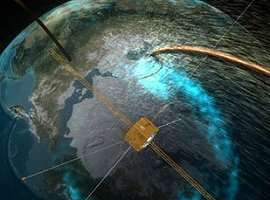
An artist's concept of Earth's magnetic field connecting to the sun's--a.k.a. a "flux transfer event"--with a spacecraft on hand to measure particles and fields.
During the time it takes you to read this article, something will happen high overhead that until recently many scientists didn't believe in. A magnetic portal will open, linking Earth to the sun 93 million miles away. Tons of high-energy particles may flow through the opening before it closes again, around the time you reach the end of the page.
"It's called a flux transfer event or 'FTE,'" says space physicist David Sibeck of the Goddard Space Flight Center. "Ten years ago I was pretty sure they didn't exist, but now the evidence is incontrovertible."
Indeed, today Sibeck is telling an international assembly of space physicists at the 2008 Plasma Workshop in Huntsville, Alabama, that FTEs are not just common, but possibly twice as common as anyone had ever imagined.
Researchers have long known that the Earth and sun must be connected. Earth's magnetosphere (the magnetic bubble that surrounds our planet) is filled with particles from the sun that arrive via the solar wind and penetrate the planet's magnetic defenses. They enter by following magnetic field lines that can be traced from terra firma all the way back to the sun's atmosphere.
"We used to think the connection was permanent and that solar wind could trickle into the near-Earth environment anytime the wind was active," says Sibeck. "We were wrong. The connections are not steady at all. They are often brief, bursty and very dynamic."
Several speakers at the Workshop have outlined how FTEs form: On the dayside of Earth (the side closest to the sun), Earth's magnetic field presses against the sun's magnetic field. Approximately every eight minutes, the two fields briefly merge or "reconnect," forming a portal through which particles can flow. The portal takes the form of a magnetic cylinder about as wide as Earth. The European Space Agency's fleet of four Cluster spacecraft and NASA's five THEMIS probes have flown through and surrounded these cylinders, measuring their dimensions and sensing the particles that shoot through. "They're real," says Sibeck.
Now that Cluster and THEMIS have directly sampled FTEs, theorists can use those measurements to simulate FTEs in their computers and predict how they might behave. Space physicist Jimmy Raeder of the University of New Hampshire presented one such simulation at the Workshop. He told his colleagues that the cylindrical portals tend to form above Earth's equator and then roll over Earth's winter pole. In December, FTEs roll over the north pole; in July they roll over the south pole.
Sibeck believes this is happening twice as often as previously thought. "I think there are two varieties of FTEs: active and passive." Active FTEs are magnetic cylinders that allow particles to flow through rather easily; they are important conduits of energy for Earth's magnetosphere. Passive FTEs are magnetic cylinders that offer more resistance; their internal structure does not admit such an easy flow of particles and fields. (For experts: Active FTEs form at equatorial latitudes when the IMF tips south; passive FTEs form at higher latitudes when the IMF tips north.) Sibeck has calculated the properties of passive FTEs and he is encouraging his colleagues to hunt for signs of them in data from THEMIS and Cluster. "Passive FTEs may not be very important, but until we know more about them we can't be sure."
There are many unanswered questions: Why do the portals form every 8 minutes? How do magnetic fields inside the cylinder twist and coil? "We're doing some heavy thinking about this at the Workshop," says Sibeck.
Meanwhile, high above your head, a new portal is opening, connecting your planet to the sun.
Source: Science@NASA, by Dr. Tony Phillips
-
When worlds collide: Researchers harness supercomputers to understand solar storm, magnetosphere
Feb 07, 2012 |
3 / 5 (1) |
6
-
Diamond light, brighter than the sun
Feb 07, 2012 |
4.3 / 5 (7) |
15
-
Radio stars: Caltech's astronomy professor searches for cosmic radio waves
Feb 03, 2012 |
not rated yet |
0
-
Manipulating the texture of magnetism
Feb 03, 2012 |
5 / 5 (4) |
1
-
Sun delivered curveball of powerful radiation at Earth
Feb 01, 2012 |
4.5 / 5 (4) |
0
-
Engineers build first sub-10-nm carbon nanotube transistor
Feb 01, 2012 |
4.9 / 5 (29) |
30
-
Something old, something new: Evolution and the structural divergence of duplicate genes
Jan 31, 2012 |
4.6 / 5 (7) |
1
-
The hidden nanoworld of ice crystals: Revealing the dynamic behavior of quasi-liquid layers
Jan 30, 2012 |
5 / 5 (3) |
1
-
Stock market network reveals investor clustering
Jan 27, 2012 |
3.9 / 5 (23) |
8
-
Of microchemistry and molecules: Electronic microfluidic device synthesizes biocompatible probes
Jan 26, 2012 |
5 / 5 (1) |
0
-
Real pictures of black hole eating a star?
12 hours ago
-
Hypothetical way to travel faster than light, but not technically exceed lightspeed
Feb 06, 2012
-
How do scientists monitor the Sun's activity?
Feb 05, 2012
-
Search patterns in observational studies
Feb 05, 2012
-
Derivation of Pogson's law
Feb 03, 2012
-
Landing on comet by Rosetta probe in 2014 (YouTube)
Feb 02, 2012
- More from Physics Forums - General Astronomy
More news stories
Bonding out: Making companies pay up front for potential environmental disasters
Whether its building an oil pipeline, drilling for fuel in the ocean or fracking to flush natural gas out of the Earth, were often asked to believe the process is safe, when companies want to do something ...
32 minutes ago |
not rated yet |
1
Astronomy team discovers nearby dwarf galaxy
(PhysOrg.com) -- A team led by UCLA research astronomer Michael Rich has used a unique telescope to discover a previously unknown companion to the nearby galaxy NGC 4449, which is some 12.5 million light years ...
14 hours ago |
4.3 / 5 (4) |
5
|
Amasia: As next supercontinent forms, Arctic Ocean, Caribbean will vanish first
(PhysOrg.com) -- Geologists at Yale University have proposed a new theory to describe the formation of supercontinents, the epic process by which Earths major continental blocks combine into a single ...
Space & Earth / Earth Sciences
14 hours ago |
4.1 / 5 (11) |
4
|
Chandra finds Milky Way's black hole grazing on asteroids
(PhysOrg.com) -- The giant black hole at the center of the Milky Way may be vaporizing and devouring asteroids, which could explain the frequent flares observed, according to astronomers using data from NASA's ...
15 hours ago |
5 / 5 (5) |
6
|
In scientific coup, Russians reach Antarctic lake
After more than two decades of drilling in Antarctica, Russian scientists have reached a gigantic freshwater lake hidden under miles of ice for some 20 million years - a pristine body of water that may hold ...
Space & Earth / Earth Sciences
15 hours ago |
4.8 / 5 (6) |
6
Researchers discover potential key to lowering energy costs of cell phones and data centers
(PhysOrg.com) -- A systematic analysis of power usage in microprocessors could help lower the energy consumption of both small cellphones and giant data centers, report computer science professors from The University of Texas ...
Women who eat fish have lower colon polyp risk
(Medical Xpress) -- Women who eat at least three servings of fish per week have a reduced risk of developing some types of colon polyps according to a new study by Vanderbilt-Ingram Cancer Center investigators.
Log onto Facebook, contribute to scientific research
(PhysOrg.com) -- Logging on to Facebook could soon be a way of contributing to important scientific research, as well as finding out whats going on in your world.
Study shows calories drive earlier puberty
(Medical Xpress) -- Environmental pollutants, eating habits, lack of exercise and genetic traits have all been raised as possible causes of earlier puberty onset in girls in recent years.
Commonly used vitamin could help produce 'good' cholesterol, researchers find
(Medical Xpress) -- Maintaining healthy cholesterol levels can keep heart disease, heart attack and stroke away. And a commonly used vitamin could help by increasing production of good cholesterol in the body, ...
Soraa LED light may dim 50-watt halogen rivals
(PhysOrg.com) -- Soraa, a Fremont, California company founded in 2008, this week launched its first product, a light that uses LEDS (light emitting diodes). The "Soraa LED MR16 lamp" is the "perfect" replacement for traditional ...
Oct 31, 2008
Rank: 4.9 / 5 (15)
My guess is that some kind of EM force is turned on when the magnetic portal opens, and the sun doesn't feel the force until 8 minutes later. This may cause a small, localized perturbation of the Interplanetary Magnetic Field (in the Earth's radial direction), which takes another 8 minutes to reach the earth and manifests itself as the opening of a new magnetic portal. It's a 16 minute (and ~40 second) period, but the resonance could also allow for periodicity in a half-cycle.
Thoughts?
Oct 31, 2008
Rank: 4.8 / 5 (5)
Also, how do these vary with relation to sun spot activity?
Oct 31, 2008
Rank: 5 / 5 (4)
Oct 31, 2008
Rank: 4 / 5 (3)
Oct 31, 2008
Rank: 3 / 5 (4)
Oct 31, 2008
Rank: not rated yet
Oct 31, 2008
Rank: 1.8 / 5 (10)
Nov 01, 2008
Rank: 4 / 5 (2)
Nov 01, 2008
Rank: 2.7 / 5 (3)
or perhaps, if this effect has anything to do with neutrino annihilation as they are in transit, hmmm.
Nov 01, 2008
Rank: 4.5 / 5 (4)
http://www.electricquakes.com
where they have been showing the Sun earth connections from live data sources for years.
Nov 01, 2008
Rank: 3.1 / 5 (8)
They still have it arse over tit tho. Its not magnetic lines that change (they dont exist remember?) its plasma and double-layers that are changing, causing our theoretical lines to alter.
"How do magnetic fields inside the cylinder twist and coil?"
They dont, its classic behavior of plasma, and they are just measuring the magnetic fields created by the moving current and material.
Nov 01, 2008
Rank: 4.2 / 5 (5)
We haven't been told of the estimated energy transfer thats taking place. Climate models etc will need to take this additional energy reception into account.
Its not just HEAT and LIGHT that earth is receiving, its plasma energy too. Tons of it.
Nov 01, 2008
Rank: 2.1 / 5 (10)
Welcome if you can contact me -East West Interaction- I can explain this phenomena through COSMOLOGY_VEDAS INTERLINKS- The subject becomes self-evident and can throw more light for further Research as well- Why not convene a conference and dialogue ?
Vidyardhi Nanduri
Nov 01, 2008
Rank: 5 / 5 (3)
Nov 01, 2008
Rank: 3.8 / 5 (6)
The FTE is the equivalent of a "exploding double layer". OR a wire that too much current flows through and it burns out like a fuse, then the wire is "reconnected", but its not magnetism that is doing the reconnecting, its the electricity. The magnetic field just follows the electricity.
Nov 02, 2008
Rank: 3.7 / 5 (3)
This is like asking how we can benefit from cellular respiration. Life on earth has evolved with this "anomaly" since it began. Just because science knows it's happening now doesn't change a thing. There is a direct line between sun and earth, and in turn, the sun and galactic center. The Mayans( and many others) knew this 2000 years ago.
Nov 02, 2008
Rank: 5 / 5 (3)
Nov 03, 2008
Rank: 4 / 5 (2)
Nov 03, 2008
Rank: 4.8 / 5 (4)
I think it's safe to say that every planet is likely to experience SOMETHING similar to this. Honestly I have no idea of the relationship between a planet's magnetic moment and the energy transfer involved via the magnetic portals.
One of the weakest magnetic fields, Venus's, only has an induced magnetopause... though I'm certain it is still unknown how much energy from these events feed into the atmospheric systems, considering that we just learned of their existence on Earth.
Jupiter offers the other extreme, a strong, massive magnetosphere that can at times be filled with LOTS of energetic particles. It almost seems counter-intuitive to think more energy could be transferred into a stronger magnetic field, but who knows?
I can tell you that for planets with magnetic fields oriented opposite to that of the Earth's (our magnetic north pole lies at our "south" pole), "active" FTE's will occur when the IMF is oriented northwards, and "passive" FTE's for southwards. This is due to magnetic reconnection, as mentioned by another poster.
Nov 03, 2008
Rank: 5 / 5 (3)
This is truly exciting!
Nov 04, 2008
Rank: not rated yet
Now I have to go take a cold shower.
Nov 06, 2008
Rank: 1 / 5 (2)