Mini-laboratory gets megaproductive
October 31, 2008
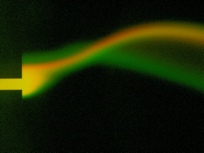
Left: the capillary electrophoresis chip developed by Zalewski. Right: separation of a mixture of rhodamine B and fluorescein. The substances are separated in two dimensions and come out in a wavelike movement.
(PhysOrg.com) -- Dawid Zalewski of the University of Twente, Netherlands, has developed a mini-laboratory on a chip that can purify biological mixtures continuously. This is very different from the usual method that can only process small quantities at a time. In fifteen minutes, the PhD student’s chip processes no less than 25,000 times as much liquid as a ‘normal chip’ in a single cycle. Zalewski was awarded his doctorate on 24 October at the faculty of Science and Technology.
Lab-on-a-chip technology, which involves complete chemical laboratories the size of a chip, is on the rise. Many of these mini-laboratories are able to separate mixtures - of biological substances, for instance. This usually occurs with the aid of capillary electrophoresis; that is, a mixture is led through a thin tube over which a high voltage is applied. The voltage causes the components in the mixture to move through the tube. The size, shape and charge of the molecules affect the speed with which they move. The components that move the fastest are the first to reach the end of the tube and can be collected there - separately from the other molecules.
Dawid Zalewski has developed a new form of capillary electrophoresis that can separate substances continuously: synchronized continuous-flow zone electrophoresis. In a quarter of an hour this method can process around five microlitre of liquid. This does not sound like very much, but a regular capillary electrophoresis chip can only process a couple of hundred picolitre of liquid in a cycle. This tiny quantity is not a problem if, for example, you only want to show whether a certain substance is present in a mixture. But if you want to process the pure substance further, this is a fundamental limitation. Zalewski’s chip is not limited in this way and can process 25,000 times as much liquid as a normal chip in a single cycle, in a quarter of an hour.
No mechanical components
The point of departure in the method developed by Zalewski was that the separation would only take place electrokinetically and that there would be no mechanical components, such as tiny pumps, on the chip. After all, mechanical components break more quickly and, furthermore, pumps are difficult, and therefore expensive, to produce at this scale.
Zalewski’s method uses an additional difference in voltage, perpendicular to the existing electrical field. As a result, the substances are not only separated in the horizontal direction, but also in the vertical direction. Since the additional difference in voltage is not constant but changes in time, the pure substances come out in a wavelike movement. The collector, the part of the chip that collects the pure substance, moves up and down with this wave movement.
Incidentally, the PhD student has already made further modifications to his chip. The improved version has a second collector so that the chip can separate two different pure substances simultaneously.
Provided by Universiteit Twente
-
Genetic fingerprint reveals new efficient maize cultivars
Jan 16, 2012 |
5 / 5 (6) |
0
-
Crystal erbium compound offers superior optical properties, can enhance energy, computer, lighting technologies
Nov 16, 2011 |
4.9 / 5 (8) |
2
-
Physicists develop a method of detecting counterfeit whiskey using spectroscopy
Nov 02, 2011 |
5 / 5 (1) |
3
-
'Watermark ink' device identifies unknown liquids instantly
Aug 04, 2011 |
5 / 5 (4) |
0
-
New lab-on-a-chip technology could improve accuracy of lab tests, deliver results sooner
Feb 04, 2011 |
5 / 5 (1) |
0
-
Engineers build first sub-10-nm carbon nanotube transistor
Feb 01, 2012 |
4.9 / 5 (31) |
30
-
Something old, something new: Evolution and the structural divergence of duplicate genes
Jan 31, 2012 |
4.6 / 5 (7) |
1
-
The hidden nanoworld of ice crystals: Revealing the dynamic behavior of quasi-liquid layers
Jan 30, 2012 |
5 / 5 (3) |
1
-
Stock market network reveals investor clustering
Jan 27, 2012 |
3.9 / 5 (23) |
8
-
Of microchemistry and molecules: Electronic microfluidic device synthesizes biocompatible probes
Jan 26, 2012 |
5 / 5 (1) |
0
More news stories
Hydrogen from acidic water: Researchers develop potential low cost alternative to platinum for splitting water
A technique for creating a new molecule that structurally and chemically replicates the active part of the widely used industrial catalyst molybdenite has been developed by researchers with the Lawrence Berkeley ...
Feb 09, 2012 |
4.8 / 5 (15) |
21
|
Fool's gold may prove an unlikely alternative to overexploited catalytic materials
Catalytic materials, which lower the energy barriers for chemical reactions, are used in everything from the commercial production of chemicals to catalytic converters in car engines. However, with current catalytic materials ...
Feb 10, 2012 |
4.4 / 5 (8) |
8
|
Research provides octagonal window of opportunity for carbon capture
(PhysOrg.com) -- Filtering carbon dioxide, a greenhouse gas, from factory smokestacks is a necessary, but expensive part of many manufacturing processes. However, a collaborative research team from the National ...
Feb 08, 2012 |
5 / 5 (1) |
5
|
Flexible paper robots
(PhysOrg.com) -- These inexpensive robots can stretch, bend and twist under control, and lift objects up to 120 times their own weight. Being soft, they can apply gentle and even pressure, and adapt to varied ...
Feb 09, 2012 |
5 / 5 (5) |
4
|
New form of hafnium oxide developed
(PhysOrg.com) -- A novel material developed by researchers at the University of Cambridge is opening up new possibilities for next generation electronic and optoelectronic devices, and paving the way for further ...
Feb 07, 2012 |
4.6 / 5 (5) |
4
|
Google might launch Drive for cloud storage soon
(PhysOrg.com) -- Google's next big move, according to the Wall Street Journal, is a cloud storage service called Drive. Hardly first to the plate, Google is simply catching up to introducing its cloud reposi ...
Latin America mining boom clashes with conservation
Latin America is experiencing a mining boom as prices rise fuelled by a hike in global demand, but the region is also being hit by a wave of violent protests, strikes and rallies by environmentalists.
Love a click away in Indonesia's Twitter Republic
He was a geeky kid from Yogyakarta, she a glamorous city girl in Jakarta. In a country with one of the world's most vibrant social networking scenes they fell in love on Twitter.
Walney offshore wind farm is world's biggest (for now)
(PhysOrg.com) -- The Walney wind farm on the Irish Sea--characterized by high tides, waves and windy weather--officially opened this week. The farm is treated in the press as a very big deal as the Walney ...
GPS court ruling leaves US phone tracking unclear
A US Supreme Court decision requiring a warrant to place a GPS device on the car of a criminal suspect leaves unresolved the bigger issue of police tracking using mobile phones, legal experts say.
Europeans protest controversial Internet pact
Tens of thousands of people marched in protests in more than a dozen European cities Saturday against a controversial anti-online piracy pact that critics say could curtail Internet freedom.