'Ghost of Mirach' Materializes in Space Telescope Image
October 31, 2008 'Ghost of Mirach' Materializes in Space Telescope Image

Enlarge

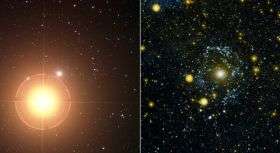
The "Ghost of Mirach" galaxy is shown in visible light on the left, and in ultraviolet on the right. Image credit: NASA/JPL-Caltech/DSS

(PhysOrg.com) -- NASA's Galaxy Evolution Explorer has lifted the veil off a ghost known to haunt the local universe, providing new insight into the formation and evolution of galaxies.

The eerie creature, called NGC 404, is a type of galaxy known as "lenticular." Lenticular galaxies are disk-shaped, with little ongoing star formation and no spiral arms. NGC 404 is the nearest example of a lenticular galaxy, and therefore of great interest. But it lies hidden in the glare from a red giant star called Mirach. For this reason, NGC 404 became known to astronomers as the "Ghost of Mirach."

When the Galaxy Evolution Explorer spied the galaxy in ultraviolet light, a spooky ring materialized.

"We thought this celestial ghost was essentially dead, but we've been able to show that it has an extended ring of new stars. The galaxy has a hybrid character in which the well-known, very old stellar population tells only part of the story," said David Thilker of Johns Hopkins University in Baltimore. "It's like the living dead."

Thilker and members of the Galaxy Evolution Explorer team spotted the Ghost of Mirach in images taken during the space telescope's all-sky survey. The Galaxy Evolution Explorer is a relatively low-cost NASA mission, launched in 2003, with an ambitious charge to survey the entire visible sky in ultraviolet light, a job never before accomplished. Because Earth's atmosphere absorbs ultraviolet photons -- a good thing for us living creatures who are susceptible to the damaging light -- ultraviolet telescopes must operate from space.

The first images of the Ghost of Mirach taken by the Galaxy Evolution Explorer hinted at a surrounding ultraviolet-bright extended structure. Subsequent, longer exposure observations indeed show that the lenticular galaxy is surrounded by a clumpy, never-before-seen ring of stars.

What is this mysterious ultraviolet ring doing around an otherwise nondescript lenticular galaxy? As it turns out, previous imaging with the National Science Foundation's Very Large Array radio telescope in New Mexico had discovered a gaseous ring of hydrogen that matches the ultraviolet ring observed by the Galaxy Evolution Explorer. The authors of this Very Large Array study attributed the gas ring to a violent collision between NGC 404 and a small neighboring galaxy 900 million years ago.

The ultraviolet observations demonstrate that, when the hydrogen from the collision settled into the plane of the lenticular galaxy, stars began to form in a ghostly ring. Young, relatively hot stars forming in stellar clusters sprinkled throughout NGC 404's ring give off the ultraviolet light that the Galaxy Evolution Explorer was able to see.

"Before the Galaxy Evolution Explorer image, NGC 404 was thought to contain only very old and evolved red stars distributed in a smooth elliptical shape, suggesting a galaxy well into its old age and no longer evolving significantly," said Mark Seibert of the Observatories of the Carnegie Institution of Washington in Pasadena, Calif. "Now we see it has come back to life, to grow once again."

"The Ghost of Mirach has been lucky enough to get a new lease on life through the rejuvenating, chance merger with its dwarf companion," added Thilker.

The findings indicate that the evolution of lenticular galaxies might not yet be complete. They may, in fact, continue to form stars in a slow, piecemeal fashion as they suck the raw, gaseous material for stars from small, neighboring galaxies. It seems the Ghost of Mirach might act more like a vampire than a ghost.

Provided by NASA


print this article email this article download pdf blog this article bookmark this article     Stumble it Digg this share on Facebook retweet share on Reddit add to delicious
Rate this story - 4.7 /5 (26 votes)

Rank Filter

Move the slider to adjust rank threshold, so that you can hide some of the comments.


Display comments: newest first

  • gopher65 - Nov 01, 2008
    • Rank: 4 / 5 (1)
    Man. Why do we hear so little about all these other great space telescopes? All we hear about is Hubble Hubble Hubble.

    Anyway, it's nice to finally see an article about the GEE.
  • yyz - Nov 02, 2008
    • Rank: not rated yet
    I believe the paper to which you are referring to in regards to NGC 404's HI excess is 'High-Resolution Observations of the Galaxy NGC 404: A Dwarf S0 with Abundant Interstellar Gas' by MS del Rio et al published in the Astrophysical Journal in 2004 (The paper is available at arXiv:astro-ph/0403467). In this paper, pg 10 has a remarkable side by side view of comparably sized fields around NGC 404 (both containing Mirach, BTW) one from the Palomar Sky Survey and the other from the VLA radio telescope. The radio view is eerily similar to the GALEX UV view! In the paper, the authors propose several explanations for this ring of neutral hydrogen, one being that simply no stars formed from it! (Clearly a moot point now with the GALEX observation). Also mentioned is the possibility of NGC 404 disrupting a nearby gas-rich dwarf galaxy. But clearly the jury is still out on this peculiar finding in a galaxy long thought to have given up the ghost.:)
  • yyz - Nov 02, 2008
    • Rank: not rated yet
    In the 2004 paper mentioned above, the authors found that the mass of the external HI ring was on the order of 38 million solar masses and slightly inclined to the plane of rotation of NGC 404. What I find curious is that if vigorous star & cluster formation is evident in far-UV observations presumably from this HI disk, why are no hydrogen-alpha (H-a) regions observed as would be expected when hi-energy radiation from these young objects should profusely produce H-a star forming regions?

October 31, 2008 all stories

Comments: 3

4.7 /5 (26 votes)
  • Stumble this up

  • Digg this

  • share this

  • hide
  • Related Stories

  • The Ring Nebula
    created Nov 02, 2009 | popularity not rated yet | comments 0
  • Herschel first images promise bright future
    created Jul 10, 2009 | popularity not rated yet | comments 0
  • New stars from old gas surprise astronomers
    created Feb 18, 2009 | popularity not rated yet | comments 0
  • Hubble's sweeping view of the Coma Galaxy Cluster
    created Jun 10, 2008 | popularity not rated yet | comments 0
  • Rethinking last century's closest, brightest supernova
    created Jan 09, 2007 | popularity not rated yet | comments 0


  • hide
  • Relevant PhysicsForums posts

  • Help with Images and Optical Instrument Question..
    created 8 hours ago
  • Redshift as a distance indicator
    created 15 hours ago
  • Question about 2-body gravity
    created Nov 24, 2009
  • life on Mars
    created Nov 24, 2009
  • More from Physics Forums - General Astronomy

Other News

Past regional cold and warm periods linked to natural climate drivers

Space & Earth / Earth Sciences

created 13 hours ago | popularity 3.7 / 5 (10) | comments 13

Intervals of regional warmth and cold in the past are linked to the El Niņo phenomenon and the so-called "North Atlantic Oscillation" in the Northern hemisphere's jet stream, according to a team of climate scientists. These ...


Russia: no space for space tourists (AP)

Russia: no space for space tourists

Space & Earth / Space Exploration

created 20 hours ago | popularity 2.7 / 5 (3) | comments 2

(AP) -- A top Russian space official says there is no space for tourists wishing to fly to the International Space Station.


Astronauts surprised by holiday turkey dinners (AP)

Astronauts surprised by holiday turkey dinners

Space & Earth / Space Exploration

created 16 hours ago | popularity 5 / 5 (1) | comments 0

(AP) -- Space shuttle Atlantis' astronauts thought they were going to give thanks with pantry leftovers Thursday as their mission drew to a close, but found turkey dinners awaiting them.


Gullies and Flow Features on Crater Wall

Gullies and Flow Features on Crater Wall

Space & Earth / Space Exploration

created 16 hours ago | popularity 5 / 5 (1) | comments 0

(PhysOrg.com) -- This image from the High Resolution Imaging Science Experiment (HiRISE) camera on NASA's Mars Reconnaissance Orbiter shows a sample of the variety and complexity of processes that may occur ...


Thanksgiving last full day in space for shuttle (AP)

Thanksgiving last full day in space for shuttle

Space & Earth / Space Exploration

created 20 hours ago | popularity not rated yet | comments 0

(AP) -- Space shuttle Atlantis' astronauts will spend Thanksgiving checking their ship for the ride home.