It's relative: Contrasting hurricane theories heat up
October 31, 2008 Atlantic Hurricane Activity and Ocean Temperatures

Enlarge

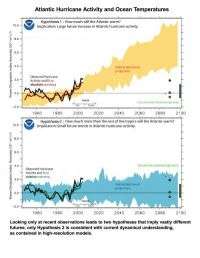
Looking at recent observations leads to two hypothesize that imply vastly different futures; only hypothesis two is consistent with current dynamical understanding, as contained in high-resolution models. Credit: NOAA GFDL

In a paper published in the journal Science today, scientists Gabriel A. Vecchi of NOAA's Geophysical Fluid Dynamics Laboratory, Kyle L. Swanson of the University of Wisconsin - Milwaukee Atmospheric Sciences Group and Brian J. Soden from the University of Miami's Rosenstiel School of Marine and Atmospheric Science teamed up to study hurricane data observed over more than 50 years.

The study explores the relationship between sea surface temperature (SST) and seasonal hurricane activity, and show how differing interpretations of the observational record can imply vastly different futures for Atlantic hurricane activity due to global warming. The two interpretations arise from assumptions of whether it is the local SST in the Atlantic in isolation, or whether it is the SST in the Atlantic 'relative' to the rest of the tropics, that drives variations in Atlantic hurricane activity.

If one assumes the former (the local SST hypothesis), then by 2100, the lower bound on Atlantic hurricane activity is comparable to that of 2005, when four major hurricanes struck the continental United States, causing more than $100 billion in damage. The upper bound exceeds 2005 levels by more than a factor of two. However, if one assumes the latter (the relative SST hypothesis), then the future is similar to the recent past, with periods of higher and lower hurricane activity relative to present-day conditions due to natural climate variability, but with little long-term trend.

The statistical relationship between either interpretation of the SST/hurricane activity link is ambiguous over the period 1946-2007 (they are statistically indistinguishable, though both are significant), but they imply fundamentally different projections for the future and interpretations of the past. The team further argues that the consistency between theory, numerical models, and historical observations offers compelling evidence that the 'relative' SST hypothesis is more accurate and provides a better framework for projections of future changes in hurricane activity.

Source: University of Miami


print this article email this article download pdf blog this article bookmark this article     Stumble it Digg this share on Facebook retweet share on Reddit add to delicious
Rate this story - 3.7 /5 (9 votes)

Rank Filter

Move the slider to adjust rank threshold, so that you can hide some of the comments.


Display comments: newest first

  • GrayMouser - Oct 31, 2008
    • Rank: 5 / 5 (1)
    There is a problem with the recent data. If they did it based on hurricanes making landfall the older data (going back even farther) would be comparable to hurricanes making landfall now.

    But satellites mean that we can now track storms that don't make landfall and assign a category to them that may not match their strength on landfall.

    Modern data can be filtered to remove storms that don't make landfall and to only use the strength of the storm on hitting land but the data presented doesn't state what was done.

October 31, 2008 all stories

Comments: 1

3.7 /5 (9 votes)
  • Stumble this up

  • Digg this

  • share this

  • hide
  • Related Stories

  • Larger Pacific Climate Event Helps Current La Nina Linger
    created Apr 22, 2008 | popularity not rated yet | comments 0
  • Frequency of Atlantic hurricanes doubled over last century
    created Jul 30, 2007 | popularity not rated yet | comments 0
  • NASA Satellites Record A Month For The Hurricane History Books
    created Sep 08, 2005 | popularity not rated yet | comments 0
  • Cyclone Anja hits wind shear, weakens drastically
    created Nov 17, 2009 | popularity not rated yet | comments 0
  • Noise Evidence Could Expand Hurricane Record
    created Nov 10, 2009 | popularity not rated yet | comments 0


  • hide
  • Relevant PhysicsForums posts

  • The IPCC and the term "most"
    created Nov 23, 2009
  • Is global warming a fact?
    created Nov 23, 2009
  • Random variability of wind patterns
    created Nov 23, 2009
  • Record precipitation in the UK
    created Nov 22, 2009
  • More from Physics Forums - Earth

Other News

Past regional cold and warm periods linked to natural climate drivers

Space & Earth / Earth Sciences

created 15 hours ago | popularity 3.8 / 5 (11) | comments 18

Intervals of regional warmth and cold in the past are linked to the El Niņo phenomenon and the so-called "North Atlantic Oscillation" in the Northern hemisphere's jet stream, according to a team of climate scientists. These ...


Russia: no space for space tourists (AP)

Russia: no space for space tourists

Space & Earth / Space Exploration

created 23 hours ago | popularity 2.7 / 5 (3) | comments 2

(AP) -- A top Russian space official says there is no space for tourists wishing to fly to the International Space Station.


Astronauts surprised by holiday turkey dinners (AP)

Astronauts surprised by holiday turkey dinners

Space & Earth / Space Exploration

created 19 hours ago | popularity 5 / 5 (1) | comments 0

(AP) -- Space shuttle Atlantis' astronauts thought they were going to give thanks with pantry leftovers Thursday as their mission drew to a close, but found turkey dinners awaiting them.


Gullies and Flow Features on Crater Wall

Gullies and Flow Features on Crater Wall

Space & Earth / Space Exploration

created 19 hours ago | popularity 5 / 5 (1) | comments 0

(PhysOrg.com) -- This image from the High Resolution Imaging Science Experiment (HiRISE) camera on NASA's Mars Reconnaissance Orbiter shows a sample of the variety and complexity of processes that may occur ...


Thanksgiving last full day in space for shuttle (AP)

Thanksgiving last full day in space for shuttle

Space & Earth / Space Exploration

created 23 hours ago | popularity not rated yet | comments 0

(AP) -- Space shuttle Atlantis' astronauts will spend Thanksgiving checking their ship for the ride home.