STAR TRAK for November
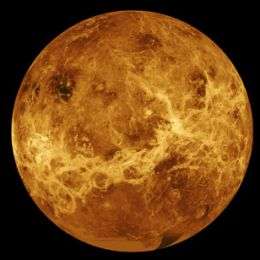
November 3rd, 2008 Venus

Enlarge

Venus

(PhysOrg.com) -- Venus and Jupiter, the brightest planets in the sky, will steadily approach each other during November as if drawn by their mutual brillliance. Finally they will have a spectacular encounter low in the southwest at month's end, against the background of the constellation Sagittarius the Archer.

Jupiter will be low in the southwest at dusk, getting lower each week. Our turbulent atmosphere will obscure much of its detail, but its four bright moons will still be visible with binoculars.

Far to Jupiter's lower right (west) at the beginning of the month will be Venus, a dazzling white "evening star." Each day the two will be closer as evening twilight fades, with Venus rising to meet the descending giant. Their meeting on Nov. 29 will be higher in the sky and much easier to see than their previous encounter in February.

Saturn followed the bright star Regulus up into the eastern sky around 3 a.m. local time on Nov. 1 and almost three hours earlier by month's end. Saturn's famous rings are now tilted closer to edgewise than they have been in more than a decade, considerably reducing its brightness.

Mars and Mercury will be out of sight during November, hidden in the glare of the sun.

Meteor showers

The annual Leonid meteor shower will peak on the nights of Nov. 17-18, just four days past full moon. The combination of bright moonlight and light pollution will eliminate all but the brightest Leonid fireballs this time. These meteors appear to radiate from the constellation Leo the Lion. They are actually caused by streams of fast-moving dust particles from Comet Tempel-Tuttle.

Watch for meteors after midnight local time as sickle-shaped Leo gets higher in the east. The farther Leo climbs above the horizon, the more meteors there will be all over the sky. The bright star Regulus is part of Leo and can serve as a marker for the radiant, the point from which the meteors appear to come.

Another meteor shower, the Southern Taurids, will peak before dawn on Nov. 5. These meteors will seem to come from the constellation Taurus the Bull, whose bright orange star Aldebaran is easy to spot. Watch to the west between midnight and dawn, after the moon has set.

More information about meteor showers is available from the American Meteor Society at: http://www.amsmeteors.org/showers.html .

Light pollution

Satellite imagery showing the extent of light pollution can be viewed at http://earth.google.com , which has a free program called Google Earth that can be downloaded. You can locate patches of darker sky nearest your home, as well as the roads to reach them.

Moon phases

The moon will be at first quarter on Nov. 5, full on Nov. 13, at third quarter on Nov. 19 and new on Nov. 27.

Provided by


print this article email this article download pdf blog this article bookmark this article     Digg this Stumble it share on Facebook share on Reddit add to delicious save to Yahoo! bookmarks
4/5 after 10 votes

Rank Filter

Move the slider to adjust rank threshold, so that you can hide some of the comments.


Display comments: newest first

  • TheEnd2 - Nov 03, 2008
    • Rank: not rated yet
    What happened to the forums?
  • magpies - Nov 03, 2008
    • Rank: not rated yet
    What forums??? They never existed.
  • Quantum_Conundrum - Nov 04, 2008
    • Rank: not rated yet
    What happened to the forums?


    I think the admins got tired of all the arguments and basicly just a waste of space.

November 3rd, 2008 all stories
Space & Earth / Space Exploration

Comments: 3
Rank: 4/5 after 10 votes

  • Stumble this up

  • Digg this

  • Share it:
  • share on Facebook
  • share on MySpace
  • share on Slashdot
  • rss-newsfeed
  • share on Google
  • share on Reddit
  • add to delicious
  • save to Yahoo! bookmarks
  • share on Windows Live
  • Add to Mixx!
Rating: 4/5 after 10 votes

  • Related Stories

  • Return of the Leonids
    created Dec 05, 2008 | popularity not rated yet | comments 0
  • December: Ursid meteor shower out-performs the Geminids
    created Dec 01, 2008 | popularity not rated yet | comments 0
  • Mars makes a special appearance
    created Nov 01, 2007 | popularity not rated yet | comments 0
  • Venus, Saturn and Regulus cluster before dawn in October
    created Oct 01, 2007 | popularity not rated yet | comments 0
  • Lunar Leonid Strikes
    created Dec 04, 2006 | popularity not rated yet | comments 0


  • Physicists Demonstrate Quantum Memory with Matter Qubits
    Physicists Demonstrate Quantum Memory with Matter Qubits
    Physics / General Physics
    created Jul 03, 2009 | popularity 4.4 / 5 (17) | comments 1
  • 'Holey' Nanosheets for Wastewater Dye Removal
    Nanotechnology / Nanomaterials
    created Jul 01, 2009 | popularity 5 / 5 (5) | comments 1
  • Jellyfish Robot Swims Like its Biological Counterpart
    Jellyfish Robot Swims Like its Biological Counterpart
    Electronics / Robotics
    created Jun 26, 2009 | popularity 4.4 / 5 (8) | comments 1
  • Could Maxwell's Demon Exist in Nanoscale Systems?
    Could Maxwell's Demon Exist in Nanoscale Systems?
    Physics / General Physics
    created Jun 24, 2009 | popularity 4.4 / 5 (18) | comments 29
  • Living Safely with Robots, Beyond Asimov's Laws
    Living Safely with Robots, Beyond Asimov's Laws
    Electronics / Robotics
    created Jun 22, 2009 | popularity 4.6 / 5 (52) | comments 40
  • Other News

    Steam billows from the cooling towers at a nuclear power generating station in Byron

    Tropical zone expanding due to climate change: study

    Space & Earth / Earth Sciences

    created 17 minutes ago | popularity 5 / 5 (1) | comments 0

    Climate change is rapidly expanding the size of the world's tropical zone, threatening to bring disease and drought to heavily populated areas, an Australian study has found.


    US ambitions to send astronauts back to the moon as a prelude to missions to Mars have been put in doubt

    Forty years ago man first walked on the moon

    Space & Earth / Space Exploration

    created 21 hours ago | popularity 4.3 / 5 (4) | comments 2

    Forty years ago on July 20, 1969, American astronaut Neil Armstrong realized the oldest dream of human civilizations when he became the first man to walk on the moon.


    The least sea ice in 800 years

    The least sea ice in 800 years

    Space & Earth / Earth Sciences

    created Jul 01, 2009 | popularity 4.1 / 5 (64) | comments 60

    New research, which reconstructs the extent of ice in the sea between Greenland and Svalbard from the 13th century to the present indicates that there has never been so little sea ice as there is now. The ...


    Gas around young galaxy

    Intense heat killed the Universe's would-be galaxies, researchers say

    Space & Earth / Astronomy

    created Jul 01, 2009 | popularity 3.4 / 5 (21) | comments 27

    (PhysOrg.com) -- Our Milky Way galaxy only survived because it was already immersed in a large clump of dark matter which trapped gases inside it, scientists led by Durham University's Institute for Computational ...


    Scientists' Drill Hits Magma: Only Third Time on Record

    Scientists' Drill Hits Magma: Only Third Time on Record

    Space & Earth / Earth Sciences

    created Jun 29, 2009 | popularity 4.7 / 5 (22) | comments 20

    (PhysOrg.com) -- Scientists drilling a borehole deep into Iceland’s rocky crust to explore new methods of using geothermal energy hit a major roadblock on Thursday: Their drill ran into molten rock at a depth ...