Native birds might restock poultry industry's genetic stock
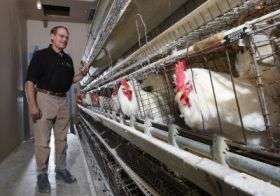
As concerns such as avian flu, animal welfare and consumer preferences impact the poultry industry, the reduced genetic diversity of commercial bird breeds increases their vulnerability and the industry's ability to adapt, according to a genetics expert.
Purdue University animal sciences professor Bill Muir was part of an international research team that analyzed the genetic lines of commercial chickens used to produce meat and eggs around the world. Researchers found that commercial birds are missing more than half of the genetic diversity native to the species, possibly leaving them vulnerable to new diseases and raising questions about their long-term sustainability.
"Just what is missing is hard to determine," Muir said. "But recent concerns over avian flu point to the need to ensure that even rare traits, such as those associated with disease resistance, are not totally missing in commercial flocks."
He said it's also important to preserve non-commercial breeds and wild birds for the purpose of safeguarding genetic diversity and that interbreeding additional species with commercial lines might help protect the industry.
The research, led by Hans Cheng of the U.S. Department of Agriculture, is the cover story in Monday's (Nov. 3) early online edition of the Proceedings of the National Academy of Sciences at http://www.pnas.org/papbyrecent.shtml. This is the first study to investigate the genetic diversity of basically an entire agricultural commodity.
Historically, chicken producers selected birds for breeding based on certain desirable traits. Size was important for broilers, while egg production was critical for layers. Despite the fact that hundreds of chicken breeds exist, Muir said today's commercial broilers descend from about three lines of chickens, and poultry used in egg production come from only one specialized line.
The research team included government, university and industrial scientists who conducted the study using the recently sequenced chicken genome. Obtaining DNA from commercial birds, they identified the number of alleles found throughout. Alleles are the genes that pair up to produce specific traits such as eye color. By comparing the commercial breeds with native and non-commercial birds, they found that commercial lines had lost up to 90 percent of alleles in some cases.
"We suggest interbreeding some experimental commercial poultry lines with native or standard breeds as a backup plan, or ace in the hole, to help the industry meet future challenges, as traits such as disease resistance may be found among the rare alleles of other birds," he said.
Muir said maintaining a healthy genetic reservoir in food-producing animals is crucial in order to protect the nutritional demands of a growing global society. Poultry is the leading meat consumed in the United States and in most other countries, with chicken meat production increasing by 436 percent since 1970, he said.
Muir also is project co-leader in a $10 million international effort to test a breeding strategy called whole-genome selection that could be used to improve the accuracy and efficiency of breeding methods. He said companies could use this technique to select for important parts of the DNA of donor birds from the standard or ancestral breeds and integrate those into commercial lines without dragging bad DNA into industrial populations. The approach selects breeding poultry based on specific traits such as bone density, animal well-being, feed efficiency and disease resistance
Source: Purdue University


