Rainforest fungus makes diesel
November 3rd, 2008 New type of fuel in Patagonia fungus

Enlarge

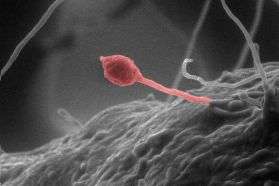
Colorized environmental scanning electron microscope photo of Gliocladium roseum, an endophtic fungus that produces myco-diesel hydrocarbons. (Photo courtesy of Gary Strobel.)

(PhysOrg.com) -- A unique fungus that makes diesel compounds has been discovered living in trees in the rainforest, according to a paper published in the November issue of Microbiology. The fungus is potentially a totally new source of green energy and scientists are now working to develop its fuel producing potential.

"This is the only organism that has ever been shown to produce such an important combination of fuel substances," said Professor Gary Strobel from Montana State University. "The fungus can even make these diesel compounds from cellulose, which would make it a better source of biofuel than anything we use at the moment."

The fungus, which has been named Gliocladium roseum, produces a number of different molecules made of hydrogen and carbon that are found in diesel. Because of this, the fuel it produces is called "myco-diesel".

"Gliocladium roseum lives inside the Ulmo tree in the Patagonian rainforest. We were trying to discover totally novel fungi in this tree by exposing its tissues to the volatile antibiotics of the fungus Muscodor albus. Quite unexpectedly, G. roseum grew in the presence of these gases when almost all other fungi were killed. It was also making volatile antibiotics. Then when we examined the gas composition of G. roseum, we were totally surprised to learn that it was making a plethora of hydrocarbons and hydrocarbon derivatives. The results were totally unexpected and very exciting and almost every hair on my arms stood on end!"

Many microbes produce hydrocarbons. Fungi that live in wood seem to make a range of potentially explosive compounds. In the rainforest, G. roseum produces lots of long chain hydrocarbons and other biological molecules. When the researchers grew it in the lab, it produced fuel that is even more similar to the diesel we put in our cars.

"When crops are used to make biofuel they have to be processed before they can be turned into useful compounds by microbes," said Professor Strobel. "G. roseum can make myco-diesel directly from cellulose, the main compound found in plants and paper. This means if the fungus was used to make fuel, a step in the production process could be skipped."

Cellulose, lignin and hemicellulose make up the cell walls in plants. Lignin is the glue that holds the cellulose fibres together and makes the plant stand up. These compounds form the part of the plant that most animals cannot digest. They makes up non-foodstuffs like stalks, sawdust and woodchip. Nearly 430 million tonnes of plant waste are produced from just farmland every year; a huge amount to recycle. In current biofuel production, this waste is treated with enzymes called cellulases that turn the cellulose into sugar. Microbes then ferment this sugar into ethanol that can be used as a fuel.

"We were very excited to discover that G. roseum can digest cellulose. Although the fungus makes less myco-diesel when it feeds on cellulose compared to sugars, new developments in fermentation technology and genetic manipulation could help improve the yield," said Professor Strobel. "In fact, the genes of the fungus are just as useful as the fungus itself in the development of new biofuels."

"The discovery also questions our knowledge of the way fossil fuels are made. The accepted theory is that crude oil, which is used to make diesel, is formed from the remains of dead plants and animals that have been exposed to heat and pressure for millions of years," said Professor Strobel. "If fungi like this are producing myco-diesel all over the rainforest, they may have contributed to the formation of fossil fuels."

Source: Society for General Microbiology


print this article email this article download pdf blog this article bookmark this article     Digg this Stumble it share on Facebook share on Reddit add to delicious save to Yahoo! bookmarks
4.6/5 after 74 votes

Rank Filter

Move the slider to adjust rank threshold, so that you can hide some of the comments.


Display comments: newest first

  • jeffsaunders - Nov 03, 2008
    • Rank: 5 / 5 (2)
    "The discovery also questions our knowledge of the way fossil fuels are made. The accepted theory is that crude oil, which is used to make diesel, is formed from the remains of dead plants and animals that have been exposed to heat and pressure for millions of years," said Professor Strobel. "If fungi like this are producing myco-diesel all over the rainforest, they may have contributed to the formation of fossil fuels."


    I think this should be a major branch in research. Just how much crude is being produced all the time and seeping through the soils?

    We do know there are microbes that will eat this crude too, so much may be consumed, but still a lot of crude oil may have been produced a lot more recently than heretofore assumed.

    Couple this with the production of oil from anaerobic life forms living on algae that has sunk to the sea floor from rivers and streams flowing into the ocean.

    A lot of the die-offs in the ocean caused by algae blooms which are themselves caused by pollution of nitrogen and phosphates that has been washed into the oceans, may be producing larger quantities of oil in shorter time spans than one would expect without all that pollution.
  • Jayman - Nov 03, 2008
    • Rank: 5 / 5 (2)
    How many such miracle fuel sources have I read about over the last 5 years? Plenty. This and the most energy efficient solar panels. They just make a splash and fade away into obscurity.
  • Roach - Nov 04, 2008
    • Rank: 2 / 5 (1)
    Hmmm, FGW? Fungalgenic Global Warming? or FMGW Fungus Made Global Warming? Either way I hope they really do pursue this one. Some people have been argueing with the "accepted theory" for years.
  • denijane - Nov 25, 2008
    • Rank: not rated yet
    There is so much about life as a whole we have to learn. This kind of discoveries fill me with optimism, because they remind me how splendid our Universe is and how many way to survive we have. Or something like this.
    I don't think this should revive the not-dead use of fossil fuels. It's more to do with biology and the way we can use biology in technology. It's so thrilling...

November 3rd, 2008 all stories
Biology /

Comments: 4
Rank: 4.6/5 after 74 votes

  • Stumble this up

  • Digg this

  • Share it:
  • share on Facebook
  • share on MySpace
  • share on Slashdot
  • rss-newsfeed
  • share on Google
  • share on Reddit
  • add to delicious
  • save to Yahoo! bookmarks
  • share on Windows Live
  • Add to Mixx!
Rating: 4.6/5 after 74 votes

  • Related Stories

  • Sequencing effort to chart ants and their ecosystem
    created Jun 26, 2009 | popularity not rated yet | comments 0
  • Scientists create new enzymes for biofuel production
    created Mar 23, 2009 | popularity not rated yet | comments 0
  • Unlocking wood's energy
    created Mar 01, 2009 | popularity not rated yet | comments 0
  • Genome sequencing of fungus with biotechnological applications
    created Feb 27, 2009 | popularity not rated yet | comments 0
  • Team Visits Chile on Quest for Rare Fuel-Producing Microorganism
    created Feb 20, 2009 | popularity not rated yet | comments 0

Tags

fungus

  • Physicists Demonstrate Quantum Memory with Matter Qubits
    Physicists Demonstrate Quantum Memory with Matter Qubits
    Physics / General Physics
    created Jul 03, 2009 | popularity 4.4 / 5 (17) | comments 1
  • 'Holey' Nanosheets for Wastewater Dye Removal
    Nanotechnology / Nanomaterials
    created Jul 01, 2009 | popularity 5 / 5 (5) | comments 1
  • Jellyfish Robot Swims Like its Biological Counterpart
    Jellyfish Robot Swims Like its Biological Counterpart
    Electronics / Robotics
    created Jun 26, 2009 | popularity 4.4 / 5 (8) | comments 1
  • Could Maxwell's Demon Exist in Nanoscale Systems?
    Could Maxwell's Demon Exist in Nanoscale Systems?
    Physics / General Physics
    created Jun 24, 2009 | popularity 4.4 / 5 (18) | comments 29
  • Living Safely with Robots, Beyond Asimov's Laws
    Living Safely with Robots, Beyond Asimov's Laws
    Electronics / Robotics
    created Jun 22, 2009 | popularity 4.6 / 5 (52) | comments 40
  • Other News

    California water plan aims to save Puget Sound orcas

    Biology / Ecology

    created 10 hours ago | popularity not rated yet | comments 0

    A plan to restore salmon runs on California's Sacramento River also could help revive killer whale populations 700 miles to the north in Puget Sound, as federal scientists struggle to protect endangered species in a complex ...


    Scientists 'rebuild' giant moa using ancient DNA

    Biology / Plants & Animals

    created Jul 01, 2009 | popularity 5 / 5 (10) | comments 12

    (PhysOrg.com) -- Scientists have performed the first DNA-based reconstruction of the giant extinct moa bird, using prehistoric feathers recovered from caves and rock shelters in New Zealand.


    Pacific Giant Salamander (Dicamptodon tenebrosus)

    Salamanders, regenerative wonders, heal like mammals, people

    Biology / Microbiology

    created Jul 01, 2009 | popularity 5 / 5 (20) | comments 11

    The salamander is a superhero of regeneration, able to replace lost limbs, damaged lungs, sliced spinal cord -- even bits of lopped-off brain. But it turns out that remarkable ability isn't so mysterious after ...


    Genetically modified trees

    Anti-biotech groups obstruct forest biotechnology

    Biology / Biotechnology

    created Jun 30, 2009 | popularity 3.7 / 5 (7) | comments 5

    The potential of forest biotechnology to help address significant social and environmental issues is being "strangled at birth" by the rigid opposition of some groups and regulations that effectively preclude ...


    Super-sleepers could help super-sizers!

    Super-sleepers could help super-sizers!

    Biology / Plants & Animals

    created Jun 29, 2009 | popularity 5 / 5 (2) | comments 4

    Burrowing frogs can survive buried for several years without food or water. Scientists have discovered that the metabolism of their cells changes radically during the dormancy period allowing the frogs to ...