Clicking knees are antelopes' way of saying 'back off'
November 3, 2008 Clicking knees are antelopes' way of saying 'back off'

Enlarge

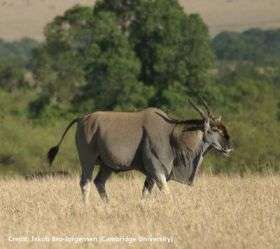
An old eland bull. Credit: Jakob Bro-Jorgensen

Knee clicking can establish mating rights among antelopes. A study of eland antelopes, published in the open access journal BMC Biology, has uncovered the dominance displays used by males to settle disputes over access to fertile females, without resorting to genuine violence.

Jakob Bro-Jørgensen from the Zoological Society of London and Torben Dabelsteen from the University of Copenhagen studied antelopes within a 400km2 area of Kenya. They found that the males (bulls) use a selection of signals to make competitors aware of their fighting ability, based on three different factors, body size, age and aggression. According to Bro-Jørgensen, "Rivals often use signals to broadcast their fighting ability and thereby settle conflicts without incurring the high costs associated with actual fighting".

As well as the knee clicks, which are shown to be a reliable indicator of body size, the researchers found that the size of a bull's dewlap is related to age. The authors said, "Age is a good proxy for fighting experience and may also demonstrate that a bull has 'nothing to lose' and will therefore be a more risk-prone and dangerous adversary". Finally, hair darkness reflects yet another underlying variable, most likely androgen-related aggressiveness. All of these indicators serve the useful purpose of facilitating assessment by a bull's rivals and avoiding wasteful conflict.

The antelopes' knee clicks, which can be heard several hundred metres away, are thought to be produced by a tendon slipping over one of the leg bones and, according to the authors, this can explain why they correlate with body size, "The tendon in this case behaves like a string being plucked, and the frequency of the sound from a string correlates negatively with both its length and diameter. Thus, most importantly, depth of the sound is predicted to increase with skeletal measures".

Citation: Knee-clicks and visual traits indicate fighting ability in eland antelopes: multiple messages and back-up signals, Jakob Bro-Jørgensen and Torben Dabelsteen, BMC Biology (in press)

Source: BioMed Central


print this article email this article download pdf blog this article bookmark this article     Stumble it Digg this share on Facebook retweet share on Reddit add to delicious
Rate this story - 5 /5 (1 vote)


November 3, 2008 all stories

Comments: 0

5 /5 (1 vote)
  • Stumble this up

  • Digg this

  • share this

  • hide
  • Related Stories

  • Study shows that some malignant tumors can be shut down after all
    created Nov 09, 2009 | popularity not rated yet | comments 0
  • Crayfish win by cheating
    created Mar 25, 2009 | popularity not rated yet | comments 0
  • Network turns soldiers' helmets into sniper location system
    created Mar 24, 2009 | popularity not rated yet | comments 0
  • '2-headed' antibody poses a double threat to breast cancer cells
    created Nov 13, 2008 | popularity not rated yet | comments 0
  • Traits produced by melanin may signal the bearer's capacity to combat free radicals
    created Oct 03, 2008 | popularity not rated yet | comments 0


Other News

Computational microscope peers into the working ribosome

Computational microscope peers into the working ribosome (w/ Video)

Biology / Cell & Microbiology

created 10 hours ago | popularity 4.8 / 5 (6) | comments 0

Two new studies reveal in unprecedented detail how the ribosome interacts with other molecules to assemble new proteins and guide them toward their destination in biological cells. The studies used molecular ...


Spider secrets decoded in world-first database

Biology / Plants & Animals

created 5 hours ago | popularity not rated yet | comments 0

(PhysOrg.com) -- Queensland scientists have developed a world-first database that catalogues the venom components from hundreds of spiders.


Bioengineers succeed in producing plastic without the use of fossil fuels

Biology / Biotechnology

created 18 hours ago | popularity 4.8 / 5 (11) | comments 0

A team of pioneering South Korean scientists have succeeded in producing the polymers used for everyday plastics through bioengineering, rather than through the use of fossil fuel based chemicals. This groundbreaking research, ...


New chameleon species discovered in East Africa

New chameleon species discovered in East Africa (w/ Podcast)

Biology / Plants & Animals

created 13 hours ago | popularity 5 / 5 (1) | comments 0

A new species of chameleon has been discovered in Tanzania by a team of scientists.


A year after discovery, Congo's 'mother lode' of gorillas remains vulnerable

A year after discovery, Congo's 'mother lode' of gorillas remains vulnerable

Biology / Plants & Animals

created 8 hours ago | popularity not rated yet | comments 0

A new study by the Wildlife Conservation Society says that western lowland gorillas living in a large swamp in the Republic of Congo—part of the "mother lode" of more than 125,000 gorillas discovered last ...