Engineers design self-stabilizing electric bicycle
November 4, 2008 By Lisa Zyga Engineers design self-stabilizing electric bicycle

Enlarge

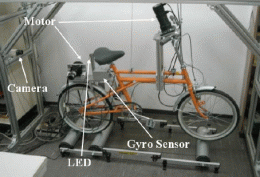
In the experimental set-up, the bicycle ran on rollers. The motor on the handlebars controlled steering, while the motor in the back drove the rear wheel. The gyro sensor, LED, and camera detected the bicycle’s position, which gave feedback to a control system that adjusted the motors to maintain bicycle stabilization. Image credit: Yasuhito Tanaka and Toshiyuki Murakami. ©2008 IEEE.

(PhysOrg.com) -- As every five-year-old knows, balancing on a bicycle is not as easy as it looks. But, as engineers know, getting a bicycle to balance by itself – without a human riding it – is even more difficult.

Despite the challenge, engineers from Keio University in Yokohama, Japan, are developing a self-stabilizing electric bicycle, one that can stay upright by itself while being propelled and steered by electric motors. Their ultimate goal is to create a sophisticated, high-performance bicycle that could serve as a convenient alternative to a small car.

Yasuhito Tanaka and Toshiyuki Murakami, both with the Department of System Design Engineering at Keio University, will publish their study in an upcoming issue of IEEE Transactions on Industrial Electronics.

“The bicycle is a comfortable vehicle that is safe and can offer more familiarity with nature compared with the car,” Murakami told PhysOrg.com. “Especially, the bicycle is a convenient vehicle that can be useful as an activity for elderly people. However, it is thought that a lot of bicycle falling accidents occur with elderly people, and it is very useful to achieve a safer bicycle.”

As the first step toward their goal, the researchers designed an electric bicycle that maintains its balance and follows a straight path. In simulations and experiments, they tested three different strategies that combine stability control and trajectory control. The researchers found that a combination of the “posture controller” (for stability) and “steering function controller” (for trajectory) could enable the bicycle to drive by itself continuously.

In the experimental set-up, a conventional bicycle was placed on three rollers – two underneath the rear wheel and one underneath the front wheel. When the rear rollers rotated, the front roller rotated through a wire. Two motors controlled the motion of the bicycle – the motor on the handlebars controlled steering, and the motor in the back drove the rear wheel at an average speed of 2.5 meters per second.

To monitor the bicycle’s position and stability, the engineers attached an LED to the back side of the bicycle, and used a camera mounted behind the bike to monitor the LED’s movement. A gyro sensor attached to the bicycle also detected changes in the bicycle’s direction angle.

The researchers could control the bicycle in real time using feedback from these sensors with an RTLinux operating system. As the researchers explained, adjustments to the acceleration (back motor) and steering (front motor) were straightforward because the feedback could be interpreted to have a clear physical meaning. The control system then calculated the necessary motor adjustments.

“Because the posture response of the bicycle is passive, it is not possible to control directly,” Murakami explained. “Therefore, it is necessary to do the stabilization control indirectly by using the bicycle steering control. This is one reason why bicycle stabilization becomes difficult.”

While the optimal stabilization strategy allowed the bicycle to run on a straight path on the rollers, the other strategies could stabilize the bike’s posture, but had position errors that resulted in the bicycle diverging from its straight path.

One key to achieving these results was developing a simplified dynamic model for a bicycle, a modification of the more complicated but widely studied Sharp dynamic model developed by R. S. Sharp in 1971. The researchers’ simplified version enabled them to develop a bicycle controller that fused stability and trajectory control. While these experiments tested the bicycle’s ability to ride in a straight line, the researchers predict that the control strategy could also extend to curved trajectories.

The team plans to make improvements to the model to account for road irregularities and tire characteristics, which weren’t accounted for in this study. By confirming the feasibility of bicycle stability unassisted by a human rider, the researchers hope to continue making bicycles increasingly sophisticated and safe.

“Our final goal is to stabilize the bicycle at zero speed,” Murakami said. “Many bicycle falling accidents happen when elderly people stop a bicycle in a crosswalk, and so on.”

More information: Tanaka, Yasuhito, and Murakami, Toshiyuki. “A Study on Straight Line Tracking and Posture Control in Electric Bicycle.” IEEE Transaction on Industrial Electronics. To be published.

Copyright 2008 PhysOrg.com.
All rights reserved. This material may not be published, broadcast, rewritten or redistributed in whole or part without the express written permission of PhysOrg.com.


print this article email this article download pdf blog this article bookmark this article     Stumble it Digg this share on Facebook retweet share on Reddit add to delicious
Rate this story - 4.1 /5 (40 votes)

Rank Filter

Move the slider to adjust rank threshold, so that you can hide some of the comments.


Display comments: newest first

  • magpies - Nov 04, 2008
    • Rank: 1 / 5 (2)
    I guess but what happens if hill?
  • bmcghie - Nov 04, 2008
    • Rank: 3 / 5 (2)
    %u201COur final goal is to stabilize the bicycle at zero speed,%u201D Murakami said. %u201CMany bicycle falling accidents happen when elderly people stop a bicycle in a crosswalk, and so on.%u201D

    ^ How old ARE these people?! Sounds like they shouldn't be getting out of bed, let alone riding a bike!
  • zbarlici - Nov 04, 2008
    • Rank: 3 / 5 (2)
    Now we can all drink and bike!
  • A_Paradox - Nov 04, 2008
    • Rank: 2.5 / 5 (4)
    ... Many bicycle falling accidents happen when elderly people stop a bicycle in a crosswalk, and so on.%u201D

    ^ How old ARE these people?! Sounds like they shouldn't be getting out of bed, let alone riding a bike!


    Now that is perhaps a little unkind :) but, as a commuting cyclist of many decades, I agree that it is an important issue. I think the answer for the old, young, frail or infirm lies more with having three wheels, because a tripod doesn't wobble.

    An alternative is to have stabiliser wheels - like "trainer wheels" which come down at near zero speed but retract at self stabilising speed.
    NB: bicycles stay upright by always falling -slowly- into a curve so that the path of the wheels is always a pair of curving lines and the centre of mass follows a lesser curve above these.
  • matelot - Nov 05, 2008
    • Rank: 1 / 5 (1)
    Anonymous bugmenot user posted:
    With the motor and sophisticated stuff they are throwing on this, wouldn't it make much more sense to try this with something like a 125 or 250cc motorcycle or scooter first?

    Old one: "Sonny boy, I just love my new Oldster-Deluxe Neverfall electric bicycle! It only cost me $10,000!"

    Dude: "Wow that sounds cool. Let's leave this interior setting and go check it out in the parking lot."
    ...
    Old man: "Drat, somebody has walked off with my $10,000 bicycle."
  • etcetera - Nov 05, 2008
    • Rank: 2.3 / 5 (3)
    This news reminds me a joke about Russians and Americans. Americans spent millions to develop a pen that can write without gravity to use in space. Russians were simply using pencil :)
    Of course this is a scientific research that can lead to different usage areas. But I think the stability of a bike can be achieved simply by some support wheels or by another mechanical way as suggested above.
  • matelot - Nov 05, 2008
    • Rank: 3 / 5 (2)
    And hey, why hasn't Dean Kamen already done this?

    This news reminds me a joke about Russians and Americans. Americans spent millions to develop a pen that can write without gravity to use in space. Russians were simply using pencil :)


    It's a great joke, but from the wiki:

    "There exists a common urban legend claiming that because a standard ballpoint pen would not work in zero gravity, NASA spent $11 million developing the zero-g capable Space Pen, with the humorous note that the Russians used a pencil.[1] In fact, NASA programs have used pencils (for example a 1965 order of mechanical pencils[1]) but because of the danger that a broken-off pencil tip poses in zero gravity and the high flammability of both the graphite and wood present in pencils[1] a better solution was needed."

    The Fisher Space Pen is farking awesome, unbeatable performance in all survivable environments! It even saved their lives once.

    Like would happen with this bicycle, somebody stole mine :(
  • TJ_alberta - Nov 05, 2008
    • Rank: 2.3 / 5 (3)
    This is something people do not need. what we need are bike paths where people (of any age) can ride safely. Elderly people with fragile bones should not be on bicycles. Overweight couch potatoes should be on bikes, not in pick up trucks and SUVs.

    My $35 garage sale bike is just fine for getting around for errands. Low tech, low cost servicable, reliable and maintainable. [Learned to ride when I was 5, got my first 10 speed road bike in 1966 currently have a racing quality road bike and mid-range "mountain" bike.]
  • Biker - Nov 05, 2008
    • Rank: 1 / 5 (1)
    A recumbent bicycle solves the problem of the high center of gravity found on a standard bike; and when stopping, both feet can easily reach the ground for stability.
  • Rory - Nov 07, 2008
    • Rank: not rated yet
    The forward sloping fork of the front wheel enables the rider to continuously stabilise a bike by turning into any fall.
  • RAF4 - Nov 09, 2008
    • Rank: not rated yet
    I believe the bicycle is a good alternative for transportation in the future and presently. I think that instead of making a bicycle stablized that you should be able to hook it up to a stationary dock where you can peddle infront of the televsion set and the energy you use to make the wheel goes to power your house. How about that? RAF

November 4, 2008 all stories

Comments: 11

4.1 /5 (40 votes)
  • Stumble this up

  • Digg this

  • share this

  • hide
  • Related Stories

  • 5 exercises can reduce neck, shoulder pain of women office workers
    created Nov 18, 2009 | popularity not rated yet | comments 0
  • Scientists solve decade-long mystery of nanopillar formations
    created Oct 22, 2009 | popularity not rated yet | comments 0
  • Campus camera network part of new study
    created Oct 20, 2009 | popularity not rated yet | comments 0
  • Study identifies which children do not need CT scans after head trauma
    created Sep 15, 2009 | popularity not rated yet | comments 0
  • Calif. region is epicenter of U.S. nano-revolution
    created Aug 27, 2009 | popularity not rated yet | comments 0


  • hide
  • Relevant PhysicsForums posts

  • Aspiring Engineering major looking for general answers
    created 22 hours ago
  • Calculating max load of square tube (steel)
    created Nov 19, 2009
  • Passive Chemical Heating
    created Nov 19, 2009
  • Shortening Boat Trailer
    created Nov 18, 2009
  • Strain Gage Test Advice
    created Nov 17, 2009
  • How Could I do This? Motor to open and close doors on a timer??
    created Nov 17, 2009
  • More from Physics Forums - General Engineering

Other News

Suit over search-engine keywords tries new angle

Technology / Internet

created 6 hours ago | popularity 2.5 / 5 (2) | comments 0

(AP) -- A lawsuit in Wisconsin is bringing a fresh challenge to the practice of paying for keywords on Google and other search engines to boost one company's link over a rival's.


Screen of a computer featuring a search of the word "edition" on the home page of Google's website

Google books hearing set for February 18

Technology / Internet

created 8 hours ago | popularity not rated yet | comments 0

A US judge set February 18 for a hearing on the revised legal settlement between Google and US authors and publishers that would allow the Internet giant to scan and sell millions of books online.


Trust Linux!

Trust Linux!

Technology / Software

created 12 hours ago | popularity 4.3 / 5 (3) | comments 0

(PhysOrg.com) -- A team of researchers has implemented support for 'trusted computing' in a commercially available version of the open source operating system Linux, breaking new ground in the global drive ...


Newspapers are displayed at a newsstand

US newspaper ad revenue down nearly 28 percent

Technology / Business

created 6 hours ago | popularity not rated yet | comments 0

US newspaper advertising revenue fell by nearly 28 percent in the third quarter, continuing a slide which has led to layoffs, bankruptcies and the closure of several dailies.


Cisco has released a Web security app for iPhone

Cisco releases Web security app for iPhone

Technology / Software

created 8 hours ago | popularity 4.5 / 5 (2) | comments 0

Cisco on Friday announced the release of a free iPhone application for anyone who wants to stay on top of the latest trojans, worms, or other threats marauding on the Internet.