NOAA-N prime satellite arrives at Vandenberg for launch
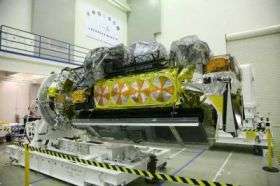
November 4, 2008 NOAA-N Prime Spacecraft

Enlarge

Technicians work on the NOAA-N Prime spacecraft at the Lockheed Martin Space Systems, Sunnyvale, Calif. in October 2008. Credit: Lockheed Martin Space Systems

The latest polar-orbiting operational environmental weather satellite developed by NASA for the National Oceanic and Atmospheric Administration, or NOAA, called NOAA-N Prime, arrived Tuesday by C-5A military cargo aircraft at Vandenberg Air Force Base, Calif., in preparation for a February 4, 2009 launch. NOAA-N Prime, built by Lockheed Martin, is similar to NOAA-N launched on May 20, 2005.

The satellite will be launched from the Western Range at Vandenberg AFB by a United Launch Alliance two-stage Delta II rocket managed by NASA's Launch Service Program at the Kennedy Space Center, Fla.

NOAA-N Prime is the latest satellite in the Advanced Television Infrared Observational Satellites –N series built by Lockheed Martin Space Systems Company. NOAA-N Prime will provide a polar-orbiting platform to support environmental monitoring instruments for imaging and measuring the Earth's atmosphere, its surface and cloud cover, including Earth radiation, atmospheric ozone, aerosol distribution, sea surface temperature, and vertical temperature and water profiles in the troposphere and stratosphere. The satellite will assist in measuring proton and electron fluxes at orbit altitude, collecting data from remote platforms and will assist the Search and Rescue Satellite-Aided Tracking system.

NOAA-N Prime will be prepared for launch in a NASA payload processing facility located on north Vandenberg AFB. On Nov. 5, the satellite will be removed from its shipping container and rotated from the horizontal to vertical position. Spacecraft systems testing and launch preparations will then begin, which will take about a month.

Meanwhile, at the launch pad, the rocket that will launch NOAA-N Prime is a Delta II 7320 manufactured and prepared for launch by the United Launch Alliance. The first stage is scheduled to be erected on Space Launch Complex 2 on Dec. 2. The three strap-on solid rocket boosters will be raised and attached to the booster the following day. The second stage which burns hypergolic propellants will be hoisted atop the first stage on Dec. 4. The fairing which will surround the spacecraft will then be hoisted into the clean room of the mobile service tower.

The following week, as a leak check, the first stage will be loaded with liquid oxygen during a simulated countdown. The following day, a simulated flight test will be performed simulating the vehicle's post-liftoff flight events without fuel aboard. The electrical and mechanical systems of the entire Delta II will be exercised during this test.

In mid-January, the NOAA-N Prime spacecraft will be hoisted atop the Delta II at the launch pad. The following week, a final major test is then ready to be conducted, which will involve the Delta II and NOAA-N Prime working together. This will be a combined minus count and plus count, simulating all events as they will occur on launch day, but without propellants aboard the vehicle. Finally during the last week of January, the fairing will be installed around the spacecraft.

NOAA manages the polar-orbiting operational environmental weather satellite program and establishes requirements, provides all funding and distributes environmental satellite data for the United States. NASA's Goddard Space Flight Center in Greenbelt, Md., procures and manages the development and launch of the NOAA satellites for NOAA on a cost reimbursable basis.

Source: NASA's Goddard Space Flight Center


print this article email this article download pdf blog this article bookmark this article     Stumble it Digg this share on Facebook retweet share on Reddit add to delicious
Rate this story - 4 /5 (4 votes)


November 4, 2008 all stories

Comments: 0

4 /5 (4 votes)
  • Stumble this up

  • Digg this

  • share this

  • hide
  • Related Stories

  • Hylas payload shipped to India
    created Nov 06, 2009 | popularity not rated yet | comments 0
  • Th17 cells summon an immune system strike against cancer (w/ Video)
    created Oct 29, 2009 | popularity not rated yet | comments 0
  • Algae may be secret weapon in climate change war
    created Oct 22, 2009 | popularity not rated yet | comments 0
  • NASA puts new Ares I-X rocket on launch pad for test flight
    created Oct 20, 2009 | popularity not rated yet | comments 0
  • NASA Tests Load Limits for Ares I Rocket Main Parachute
    created Oct 09, 2009 | popularity not rated yet | comments 0


  • hide
  • Relevant PhysicsForums posts

  • The shape of our solar system's orbits.
    created Nov 07, 2009
  • Above or Below the Line of Nodes
    created Nov 07, 2009
  • Supernova vs. Nova?
    created Nov 07, 2009
  • Supernova's Gamma Rays and Comets
    created Nov 06, 2009
  • More from Physics Forums - General Astronomy

Other News

Making Climate Forecasts More Useful to Farmers

Making Climate Forecasts More Useful to Farmers

Space & Earth / Environment

created 1hour ago | popularity not rated yet | comments 0

(PhysOrg.com) -- Climate forecasts are becoming more useful to farmers and ranchers, thanks to research by Agricultural Research Service (ARS) scientists and their cooperators.


L-R: Chiwetel Ejiofor, Amanda Peet and John Cusack at the premiere of "2012"

NASA on crusade to debunk 2012 apocalypse myths

Space & Earth / Space Exploration

created 3 hours ago | popularity not rated yet | comments 0

The world is not coming to an end on December 21, 2012, the US space agency insisted Monday in a rare campaign to dispel widespread rumors fueled by the Internet and a new Hollywood movie.


NASA satellites make a movie and get rainfall, wind info on Ida

NASA satellites make a movie and get rainfall, wind info on Ida (w/ Video)

Space & Earth / Earth Sciences

created 3 hours ago | popularity not rated yet | comments 0

NASA satellites are amazing examples of technology. The TRMM satellite peers into tropical cyclones and can tell how much rain is falling per hour and where. QuikScat uses microwave technology to measure Ida's ...


Antarctica glacier retreat creates new carbon dioxide store

Antarctica glacier retreat creates new carbon dioxide store

Space & Earth / Earth Sciences

created 8 hours ago | popularity 4.3 / 5 (3) | comments 0

Large blooms of tiny marine plants called phytoplankton are flourishing in areas of open water left exposed by the recent and rapid melting of ice shelves and glaciers around the Antarctic Peninsula. This ...


NASA's TRMM Satellite sees most of Ida's heaviest rain stayed off coasts

NASA's TRMM Satellite sees most of Ida's heaviest rain stayed off coasts

Space & Earth / Earth Sciences

created 4 hours ago | popularity not rated yet | comments 0

NASA and the Japanese Space Agency's Tropical Rainfall Measuring Mission (TRMM) satellite flew over Ida and captured her rainfall when she passed by Nicaragua, Honduras and Belize this weekend. TRMM data revealed ...