DNA provides 'smoking gun' in the case of the missing songbirds
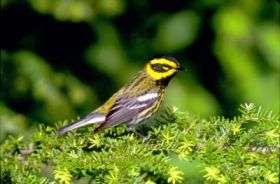
It sounds like a tale straight from "CSI": The bully invades a home and does away with the victim, then is ultimately found out with the help of DNA evidence.
Except in this instance the bully and the victim are two species of songbirds in northwest North America, and the DNA evidence shows conclusively that one species once occupied the range now dominated by the other.
The case started about 400,000 years ago when encroaching glaciers split a single warbler species into two separate groups that eventually became distinct species, with hermit warblers living in coastal areas from northern California to Alaska and Townsend's warblers living farther inland in Oregon, Washington, Idaho and Montana.
When the glaciers melted, the Townsend's warblers gradually expanded their range northward into British Columbia and Alaska before spilling over to the Pacific Coast into territory occupied by hermit warblers.
That's when things got tough for the hermit warblers, said Meade Krosby, a University of Washington doctoral student in biology who has found genetic evidence of the struggle between the two species. She cited previous studies showing Townsend's males with higher testosterone levels and superior fighting ability than hermit males.
"The Townsend's were brutes and they just smacked the hermit warblers out of the way," Krosby said.
Townsend's males dominated hermit males and mated with hermit females. The result was that the hermits gradually retreated southward from their original range. Today hermits occupy only California, Oregon and Washington. The two species overlap in hybrid zones in Oregon and Washington, and Townsend's occupy coastal areas from northern Washington into Alaska, as well as their original inland range.
The Townsend's warblers that now live along the coast are identical to those in the interior, Krosby said, except for one telling difference – those on the coast carry in their genes the mitochondrial DNA of hermit warblers.
Mitochondria are the parts of cells that convert food to energy, and DNA contained in the mitochondria is distinct from DNA in the rest of an organism. Mitochondrial DNA is passed from one generation to the next through the mother, so the only way that genetic material from hermits could end up in Townsend's is for Townsend's males to breed with hermit females.
"There is a genetic skeleton in the closet of the Townsend's warbler," Krosby said. "This is a genetic smoking gun of what they have done to their sister species."
Her findings are published in the Nov. 5 Proceedings of the Royal Society B. The Royal Society is the United Kingdom's national academy of science. Sievert Rohwer, a UW professor emeritus of biology, is the co-author. The National Science Foundation, the ARCS Foundation and the Burke Museum of Natural History and Culture at the UW funded the work.
Krosby noted that when a single species is divided into two groups by barriers such as glaciers, when they encounter each other again they could simply merge once more into a single species. Or they could have become so significantly different that they would not recognize each other and would not interbreed, having become two separate species.
But the two groups also could fall somewhere in between, she said, having become different but not different enough to prevent them from interbreeding. One might even have changed in a way that would allow it to dominate the other – precisely what happened in the case of hermit and Townsend's warblers.
But there still are two possibilities for how the mitochondrial DNA of hermit warblers ended up in Townsend's. The hermit genetic material could have been so robust that when the birds interbred in the hybrid zones the hermit genes spread north through the Townsend's population by natural selection. Or the hermits could have been driven south out of their range, leaving their genetic fingerprints behind.
To see which was most likely, Krosby examined the hermit mitochondrial DNA found in coastal Townsend's warblers. If natural selection had caused the genetic material to move northward, there would be very little variation in the mitochondrial DNA among individuals, she said. But if the hermits were driven out of their range, the mitochondrial DNA left behind should show substantial variation among individuals.
"That variation is what I found, and there is no way that could happen if the genes had moved," she said. "It took a lot to convince me this is what happened, but it became clear as day."
Source: University of Washington


