Skeleton of 12,000-year-old shaman discovered buried with leopard, 50 tortoises and human foot
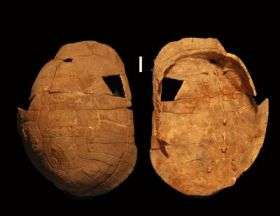
The skeleton of a 12,000 year-old Natufian Shaman has been discovered in northern Israel by archaeologists at the Hebrew University of Jerusalem. The burial is described as being accompanied by "exceptional" grave offerings - including 50 complete tortoise shells, the pelvis of a leopard and a human foot. The shaman burial is thought to be one of the earliest known from the archaeological record and the only shaman grave in the whole region.
Dr. Leore Grosman of the Institute of Archaeology at the Hebrew University, who is heading the excavation at the Natufian site of Hilazon Tachtit in the western Galilee, says that the elaborate and invested interment rituals and method used to construct and seal the grave suggest that this woman had a very high standing within the community. Details of the discovery were published in the PNAS journal on November 3, 2008.
What was found in the shaman's grave?
The grave contained body parts of several animals that rarely occur in Natufian assemblages. These include fifty tortoises, the near-compete pelvis of a leopard, the wing tip of a golden eagle, tail of a cow, two marten skulls and the forearm of a wild boar which was directly aligned with the woman's left humerus.
A human foot belonging to an adult individual who was substantially larger than the interred woman was also found in the grave.
Dr. Grosman believes this burial is consistent with expectations for a shaman's grave. Burials of shamans often reflect their role in life (i.e., remains of particular animals and contents of healing kits). It seems that the woman was perceived as being in close relationship with these animal spirits.
Method of burial
The body was buried in an unusual position. It was laid on its side with the spinal column, pelvis and right femur resting against the curved southern wall of the oval-shaped grave. The legs were spread apart and folded inward at the knees.
According to Dr. Grosman, ten large stones were placed directly on the head, pelvis and arms of the buried individual at the time of burial. Following decomposition of the body, the weight of the stones caused disarticulation of some parts of the skeleton, including the separation of the pelvis from the vertebral column.
Speculating why the body was held in place in such a way and covered with rocks, Dr. Grosman suggests it could have been to protect the body from being eaten by wild animals or because the community was trying to keep the shaman and her spirit inside the grave.
Analysis of the bones show that the shaman was 45 years old, petite and had an unnatural, asymmetrical appearance due to a spinal disability that would have affected the woman's gait, causing her to limp or drag her foot.
Fifty tortoises
Most remarkably, the woman was buried with 50 complete tortoise shells. The inside of the tortoises were likely eaten as part of a feast surrounding the interment of the deceased. High representation of limb bones indicates that most tortoise remains were thrown into the grave along with the shells after consumption.
The recovery of the limb bones also indicates that entire tortoises, not only their shells, were transported to the cave for the burial. The collection of 50 living tortoises at the time of burial would have required a significant investment, as these are solitary animals. Alternatively, these animals could have been collected and confined by humans for a period preceding the event.
Shaman graves in archaeology
According to Dr. Grosman, the burial of the woman is unlike any burial found in the Natufian or the preceding Paleolithic periods. "Clearly a great amount of time and energy was invested in the preparation, arrangement, and sealing of the grave." This was coupled with the special treatment of the buried body.
Shamans are universally recorded cross-culturally in hunter-gatherer groups and small-scale agricultural societies. Nevertheless, they have rarely been documented in the archaeological record and none have been reported from the Paleolithic of Southwest Asia.
The Natufians existed in the Mediterranean region of the Levant 15,000 to 11,500 years ago. Dr. Grosman suggests this grave could point to ideological shifts that took place due to the transition to agriculture in the region at that time.
Natufian grave site
Hilazon Tachtit is a small cave site next to Carmiel that functioned first and foremost as a Natufian burial ground for at least 28 individuals representing an array of ages.
The collective graves found at the site likely served as primary burial areas that were later re-opened to remove skulls and long bones for secondary burial – a practice common to the Natufian and the following Neolithic cultures.
Only three partially complete primary burials were recovered at Hilazon Tachtit. One was a skeleton of a young adult (sex unknown) reposed in a flexed position on its right side with both hands under his face. The scattered bones of a newborn were found in the area of the missing pelvis and it appears that the newborn and the young adult, possibly the mother, were buried together.
Source: The Hebrew University of Jerusalem


