Extreme weather postpones the flowering time of plants
November 5, 2008
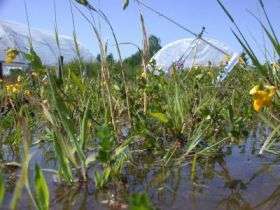
Extreme weather events have a greater effect on flora than previously presumed. Using experimental plots in Bayreuth the researchers generated artificial heavy rain and drought in their experiment and the effects on ten different plant species were observed accordingly over a two-year period. Credit: Dr. Juergen Kreyling /Universitaet Bayreuth
Extreme weather events have a greater effect on flora than previously presumed. A one-month drought postpones the time of flowering of grassland and heathland plants in Central Europe by an average of 4 days. With this a so-called 100-year drought event equates to approx. a decade of global warming.
The flowering period of an important early flowerer, the common Birds-foot Trefoil (Lotus corniculatus) was even shortened by more than a month due to heavy rain and started flowering early by almost one month. In a study conducted by the University of Bayreuth and the Helmholtz-Centre for Environmental Research (UFZ) researchers came to this conclusion. Using experimental plots in Bayreuth the researchers generated artificial heavy rain and drought in their experiment and the effects on ten different plant species were observed accordingly over a two-year period.
With climate change it is expected that such extreme weather events will increase in frequency and intensity, which entails a risk for animal-plant interactions and ecological services. In this respect it is conceivable that the synchronisation between flowering plants and pollinating insects could be uncoupled and the rhythm of evolution lost due to extreme weather events. For example, the activity of pollinating insects is determined more so by temperatures as opposed to changes in rainfall, as researchers have reported in the scientific journal Global Change Biology.
Changes to the flowering time of plants are regarded as one of the most evident signs of global warming. Other studies have already shown that since 1960 the beginning of Spring has been postponed in the northern hemisphere by an average of 2.5 days per decade. Although forecasts like the IPCC-Report 2007 reckon with a more considerable increase in extreme weather events, the effects of such events on ecology have previously been researched very little. Scientists working with Prof.
Anke Jentsch have therefore set up an experimental site in the ecological botanical garden in Bayreuth, to investigate the effects of extreme weather events such as droughts or heavy rains. The investigation area with an average annual temperature of 8.2º C and 724 millimeters annual rainfall is situated in a transitional zone between the Atlantic and Continental climates. One hundread plants of each widely distributed species like for example Yorkshire Fog (Holcus lanatus), Ribwort Plantain (Plantago lanceolata) and Heather (Calluna vulgaris) were planted on each of 30 4m2 experimental plots. Using plastic tarpaulin covers the researchers were able to simulate an extreme dry period of 32 days and a period of extreme rain using artificial rain with 170 millimeters of rainfall lasting 14 days, corresponding to a local 100-year extreme weather event.
Both simulations correspond to the historical highest values that were recorded in Bayreuth in the summer of 1976 and 1977. The sites were observed over two years and the flowering time of all plants recorded. During this period it transpired that two weeks of heavy rain shortened the flowering period by 3 to 5 days, and in the case of an important spring-time the flowering period was even shortened by 37 days and started 26 days earlier. Conversely with a long drought period of one month: on average the plants flowered in total for four days longer and also four days earlier than usual.
"A single extreme drought can therefore have similar effects on flowering as a decade of global warming", explains Anke Jentsch. "The climate change with more frequent extreme weather events will have extensive consequences for ecosystems and interactions between species."
Citaton: Anke Jentsch, Juergen Kreyling, Jegor Boettcher-Treschkow and Carl Beierkuhnlein (2008): Beyond gradual warming: extreme weather events alter flower phenology of European grassland and heath species. Global Change Biology doi: 10.1111/j.1365-2486.2008.01690.x
http://www3.inters … 202/abstract
Source: Helmholtz Association of German Research Centres
-
Unexpected ice-formation mechanism
Jan 18, 2012 |
3.5 / 5 (4) |
2
-
Rose torture: severe heat in Texas yields better varieties for research
Dec 12, 2011 |
4 / 5 (1) |
0
-
Is climate change altering humans' vacation plans?
Dec 06, 2011 |
5 / 5 (2) |
0
-
Climate change: South Africa has much to lose
Nov 24, 2011 |
5 / 5 (1) |
1
-
Reserve saves trees but not monarch butterflies
Nov 27, 2010 |
5 / 5 (3) |
0
-
Engineers build first sub-10-nm carbon nanotube transistor
Feb 01, 2012 |
4.9 / 5 (33) |
30
-
Something old, something new: Evolution and the structural divergence of duplicate genes
Jan 31, 2012 |
4.6 / 5 (7) |
1
-
The hidden nanoworld of ice crystals: Revealing the dynamic behavior of quasi-liquid layers
Jan 30, 2012 |
5 / 5 (5) |
1
-
Stock market network reveals investor clustering
Jan 27, 2012 |
3.9 / 5 (23) |
8
-
Of microchemistry and molecules: Electronic microfluidic device synthesizes biocompatible probes
Jan 26, 2012 |
5 / 5 (2) |
0
-
Do some geologists actually act a lot like Randy Marsh?
Feb 11, 2012
-
Discrepancy between oxygen and carbon-dioxide levels
Feb 09, 2012
-
where gems are found in the world
Feb 09, 2012
-
Wind Waves in Reservoir ~ Wind run-up and Wind set-up
Feb 08, 2012
-
Balance of oxygen in the atmosphere
Feb 01, 2012
-
The case for a methanol-based economy
Jan 30, 2012
- More from Physics Forums - Earth
More news stories
Climate change causes harmful algal blooms in North Atlantic: study
Warming oceans and increases in windiness could be causing of an abundance of harmful algal blooms in the North Atlantic Ocean and North Sea, according to new research.
2 hours ago |
not rated yet |
0
New European rocket lifts off on maiden flight
A new lightweight rocket, Vega, lifted off from Europe's space base Monday carrying nine satellites on its inaugural flight, mission control said.
Space & Earth / Space Exploration
55 minutes ago |
5 / 5 (2) |
1
Salvage workers begin pumping fuel from Italian shipwreck
Salvage workers Sunday began pumping fuel from the shipwrecked Italian cruise liner Costa Concordia, a day ahead of schedule, officials said.
17 hours ago |
5 / 5 (2) |
0
NASA budget will axe Mars deal with Europe: scientists
US President Barack Obama's budget proposal to be submitted next week for 2013 will cut NASA's budget by 20 percent and eliminate a major partnership with Europe on Mars exploration, scientists said Thursday.
Space & Earth / Space Exploration
Feb 10, 2012 |
5 / 5 (4) |
59
Humans may have helped the decline of African rainforests 3000 years ago
(PhysOrg.com) -- Large areas of rainforests in Central Africa mysteriously disappeared over three thousand years ago, to be replaced by savannas. The prevailing theory has been that the cause was a change ...
New molecule has potential to help treat genetic diseases and HIV
(PhysOrg.com) -- Chemists at The University of Texas at Austin have created a molecule that's so good at tangling itself inside the double helix of a DNA sequence that it can stay there for up to 16 days before ...
Social psychologist: Lust makes you smarter and evidence that seven deadly sins are good for you
(Medical Xpress) -- Good news for lovers on Valentine’s Day - the seven deadly sins, including Lust, are good for you. University of Melbourne social psychologist Dr Simon Laham uses modern research to make a compelling ...
The joy of cheques
An electronic cheque which eliminates the need for costly processing by banks but preserves the simplicity and ease of a traditional cheque book has been designed by a team of academics in the UK.
Research finds injuries to professional athletes from routine play or practice often reported as 'freak accidents' in me
(Medical Xpress) -- A new report from the Johns Hopkins Center for Injury Research and Policy finds injuries to professional athletes from routine play or practice are often characterized as freak accidents in ...
Researchers' paper wins Best Paper Award for 2011
A paper written by Dr. Paul Gratz and his graduate student, Reena Panda, from the Department of Electrical and Computer Engineering at Texas A&M University was selected as one of the best papers from IEEE Computer Architecture ...
Low levels of amplitude-modulated electromagnetic fields elicit therapeutic responses cancer patients
Ryne Ramaker, a senior UALR Donaghey Scholar and University Science Scholar with a double major in biology and chemistry, is a co-author of a cancer research paper creating excitement among other researchers. The article ...
Nov 05, 2008
Rank: 5 / 5 (3)
But the planet has gone through this, many many times. It's a primary driver of evolution, how exactly would it curtail evolution?
Especially with the example quoted above. If the flowering process starts later then the cross polinating insects that start later will have an evolutionary advantage. Conversely plants with earlier flowering processes will reap a huge benefit by being more closely tied with current polinating insect trends.
Nov 10, 2008
Rank: 5 / 5 (2)
Nov 10, 2008
Rank: 5 / 5 (2)
So? You can't understand how earlier springs (due to global warming) could delay blooms? Your supposed to just accept what they say.