Chandrayaan-1 now in lunar transfer trajectory
November 5, 2008 Chandrayaan-1 now in lunar transfer trajectory

Enlarge

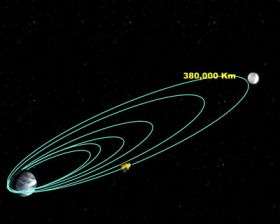
After launch on 22 October, ISRO’s Chandrayaan-1 spacecraft was first injected into a highly elliptical 7-hr orbit around Earth, reaching between 255 km and 22 860 km above our planet. The spacecraft then spiralled outwards in increasingly elongated ellipses around Earth, until it reached its lunar transfer orbit on 4 November at 00:26 CET (04:56 Indian standard time). This transfer orbit’s farthest point from Earth is about 380 000 km. Credits: ISRO

Yesterday, following a fifth orbit-raising manoeuvre, the Chandrayaan-1 spacecraft successfully settled into a trajectory that will take it to the Moon.

After launch on 22 October, the spacecraft was first injected into an elliptical 7-hr orbit around Earth, between 255 km and 22 860 km above our planet. After five engine firings, Chandrayaan-1 spiralled outwards in increasingly elongated ellipses around Earth, until it reached its lunar transfer orbit on 4 November at 00:26 CET (04:56 Indian standard time).

In the fifth and last orbit-raising manoeuvre, the spacecraft's 440 Newton liquid-fuel propelled engine was fired for about two and a half minutes. The lunar transfer orbit's farthest point from Earth is about 380 000 km.

The spacecraft, which is being monitored from the Spacecraft Control Centre at the Indian Space Research Organisation's ISRO Telemetry, Tracking and Command Network (ISTRAC) in Bangalore, is working very well. Chandrayaan-1's Terrain Mapping camera (TMC) was successfully tested on 29 October and provided its first images, depicting Earth.

Chandrayaan-1 will approach the Moon on 8 November 2008 when the spacecraft's liquid-fuel propelled engine will be fired again. This manoeuvre, called lunar orbit insertion, will decelerate the spacecraft to allow the Moon's gravity to capture it into an elliptical lunar orbit. A series of further manoeuvres will then progressively lower the altitude of Chandrayaan-1 around the Moon until it reaches its final 100 km circular orbit.

Source: European Space Agency


print this article email this article download pdf blog this article bookmark this article     Stumble it Digg this share on Facebook retweet share on Reddit add to delicious
Rate this story - 4.2 /5 (6 votes)


November 5, 2008 all stories

Comments: 0

4.2 /5 (6 votes)
  • Stumble this up

  • Digg this

  • share this

  • hide
  • Related Stories

  • New computer-developed map shows more extensive valley network on Mars
    created Nov 23, 2009 | popularity not rated yet | comments 0
  • LCROSS Impact Finds Water on the Moon
    created Nov 13, 2009 | popularity not rated yet | comments 0
  • NASA and X Prize Announce Winners of Lunar Lander Challenge
    created Nov 03, 2009 | popularity not rated yet | comments 0
  • Detecting Life-Friendly Moons
    created Oct 26, 2009 | popularity not rated yet | comments 0
  • LCROSS Captures All Phases of Centaur Impact
    created Oct 18, 2009 | popularity not rated yet | comments 0


  • hide
  • Relevant PhysicsForums posts

  • Question about 2-body gravity
    created Nov 24, 2009
  • life on Mars
    created Nov 24, 2009
  • Semi-major axis from cartesian co-ordinates
    created Nov 23, 2009
  • Primary Mirror grinding
    created Nov 23, 2009
  • More from Physics Forums - General Astronomy

Other News

Monster Waves on the Sun are Real

Monster Waves on the Sun are Real (w/ Video)

Space & Earth / Astronomy

created 6 hours ago | popularity 5 / 5 (8) | comments 0

Sometimes you really can believe your eyes. That's what NASA's STEREO (Solar Terrestrial Relations Observatory) spacecraft are telling researchers about a controversial phenomenon on the sun known as the "solar ...


Cosmic 'dig' reveals vestiges of the Milky Way's building blocks

Cosmic 'Dig' Reveals Vestiges of the Milky Way's Building Blocks

Space & Earth / Astronomy

created 10 hours ago | popularity 4.9 / 5 (13) | comments 1

(PhysOrg.com) -- Peering through the thick dust clouds of our galaxy's "bulge" (the myriads of stars surrounding its center), a team of astronomers has unveiled an unusual mix of stars in the stellar grouping ...


No Wheel Stall in Diagnostic Drive

Spirit Mars Rover: No Wheel Stall in Diagnostic Drive

Space & Earth / Space Exploration

created 6 hours ago | popularity 5 / 5 (1) | comments 0

(PhysOrg.com) -- On Sol 2095 (Tuesday, Nov. 24), Spirit performed a set of diagnostic actions related to a stall of the right-rear wheel on the previous drive, three days earlier.


Climate experts debate strategies for reducing atmospheric carbon and future warming

Climate experts debate strategies for reducing atmospheric carbon and future warming

Space & Earth / Environment

created 6 hours ago | popularity 2.6 / 5 (5) | comments 5

(PhysOrg.com) -- Reducing carbon dioxide to safe levels may require extracting carbon from the air, says Cornell climate researcher.


Oceanic crust formation is dynamic after all

Oceanic crust formation is dynamic after all

Space & Earth / Earth Sciences

created 9 hours ago | popularity 4.5 / 5 (4) | comments 0

Imagine the Earth's crust as the planet's skin: Some areas are old and wrinkled while others have a fresher, more youthful sheen, as if they had been regularly lathered with lotion.