Electron pairs precede high-temperature superconductivity
November 5, 2008 Electron pairs precede high-temperature superconductivity

Enlarge

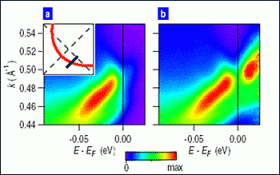
Map of the spectral intensity of photoelectrons emitted from a high-Tc superconductor in the superconducting state as a function of energy and momentum. a) The spectral intensity as measured and b) the spectral intensity after analysis showing states both above and below the Fermi level (vertical line).

(PhysOrg.com) -- Like astronomers tweaking images to gain a more detailed glimpse of distant stars, physicists at the U.S. Department of Energy's (DOE) Brookhaven National Laboratory have found ways to sharpen images of the energy spectra in high-temperature superconductors — materials that carry electrical current effortlessly when cooled below a certain temperature. These new imaging methods confirm that the electron pairs needed to carry current emerge above the transition temperature, before superconductivity sets in, but only in a particular direction.

"Our findings rule out certain explanations for the development of superconductivity in these materials, and lend support to other, competing theories," said Brookhaven physicist Peter Johnson, leader of the group whose work is described in the November 6, 2008, issue of Nature. Homing in on the mechanism for high-temperature (high-Tc) superconductivity may help scientists engineer new materials to make use of the current-carrying phenomenon in transformative applications such as high-efficiency transmission lines in the U.S. power grid.

Scientists already know that electrons in a superconducting material must pair up to carry the current. But whether these pairs form at or above the transition temperature has been a mystery, until now.

To search for pre-formed electron pairs, the Brookhaven team bombarded a copper-oxide material, held at temperatures above and below the transition temperature, with beams of light from the National Synchrotron Light Source, and analyzed the energy spectrum of electrons emitted from the sample. This method, known as angle-resolved photoemission spectroscopy (ARPES), ordinarily gives a clear picture of only half of the energy spectrum — all the levels electrons can occupy below the so-called Fermi level. To glimpse the other half, above the Fermi level, the scientists employed methods of analysis similar to those used by astronomers to increase the resolution of celestial images.

"If you look through a telescope with poor resolution, you'll see the moon, but the stars are lost," Johnson said. "But if you improve your resolution you see the stars and everything else. By improving our resolution we can use ARPES to see the few electrons that occasionally occupy levels above the Fermi level. We have devised ways to sharpen our images so we can look at the weak signals from above the Fermi level in finer and finer detail."

Seeing both sides of the Fermi level is important because, when a material becomes a superconductor, there is an energy gap surrounding the Fermi level. A perfectly symmetrical gap — equally spaced above and below the Fermi level — is a strong indication that electrons are paired up. That superconducting gap exists at and below the transition temperature, as long as a material acts as a superconductor.

But Johnson's team and other scientists had previously observed a second gap, or pseudogap, in some high-Tc materials, well above the transition temperature. If this pseudogap exhibited the same symmetry around the Fermi level, Johnson reasoned, it would be definitive evidence of paired electrons above the transition temperature. Using their new image-enhancing techniques, Johnson's team demonstrated that the pseudogap does indeed exhibit this same symmetry.

"We can now say for certain that electrons are forming pairs above the transition temperature, before the material becomes a superconductor," Johnson said.

The scientists made another interesting observation: The pairing occurs only along certain directions in the crystalline lattice of atoms making up the material — only along the directions in which copper atoms are bonded with oxygen atoms.

Together, the existence of preformed electron pairs and their directional dependence should help clarify the picture of high-Tc superconductivity, Johnson said. For example, the findings rule out some theories to explain the high-Tc phenomenon (e.g. certain "spin density wave" and "charge density wave" derived theories). But the new findings are consistent with theories that consider the pre-superconducting state to be derived from a "Mott insulator," as well as theories in which "charge stripes," previously discovered at Brookhaven Lab, might play a role in electron pairing.

"It's still a very complicated picture and one of the great mysteries of modern science," Johnson said. "With something like 150 theorists working in the field, we have 150 theories of how these materials work. But as we develop new techniques, we are making progress narrowing down the mechanism."

Provided by Brookhaven National Laboratory


print this article email this article download pdf blog this article bookmark this article     Stumble it Digg this share on Facebook retweet share on Reddit add to delicious
Rate this story - 4.5 /5 (30 votes)

Rank Filter

Move the slider to adjust rank threshold, so that you can hide some of the comments.


Display comments: newest first

  • Alizee - Nov 05, 2008
    • Rank: 1.7 / 5 (6)
    By AWT interpretation the HT superconductivity is result of high mutual compression of electrons near hole stripes within the structure of superconductors, which are behaving like pipes/tramlines of highly compressed electrons (compare the C. Humphreys's theory, which is the most relevant description of HTC by my understanding so far ).

    http://superstrun...evel.gif

    The compression level of electrons depends on the level of doping. In underdoped materials, the stripes cannot form a continuous phase, so that the movability of electrons manifests only locally as so called pseudogap. Because of high level of compression of electrons in mutualy isolated holes, the pseudogap can manifest itself even in quite elevated temperatures.
  • Alizee - Nov 05, 2008
    • Rank: 1.8 / 5 (5)
    The anisotropy in geometrical distribution of hole stripes follows from Humphreys's theory as well - compare the picture of isolate hole stripes, as they really appears in pseudogap state under increased level of doping. Note the gradual formation of paired stripes serving for balistic spreading of Cooper pairs.

    http://superstrun...real.gif
  • hudres - Nov 05, 2008
    • Rank: 2 / 5 (4)
    Superconductivity in the power grid is a really bad plan. If a transmission line goes normal it blows up. The resulting blackout would last several days to weeks. While power can sometimes be routed around a blown line, this is not always the case. Keeping the line in a superconducting state under adverse weather conditions in remote areas is likely to be extremely difficult. The refrigeration systems can be fickle. In non-critical applications, where public safety is not affected by a loss of power, this technology, but in power systems, it is not a wise idea. I speak with some authority as I was Director of Engineering of a major superconducting corporation and am very familiar with the technology. Just because you can do something doesn't mean that you should.
  • physpuppy - Nov 05, 2008
    • Rank: 3 / 5 (2)
    Superconductivity in the power grid is a really bad plan. If a transmission line goes normal it blows up.


    I'm wouldn't be surprised that it could be designed to handle the power if the wire loses its superconductivity. For example in superconducting magnets (which has 200 Amps circulating in the wire core), one design has the superconducting section in the center of the wire surrounded by a copper/normal conductor coating, so if the inner core loses supercondictivity, the outer part handles the load and the magnet core doesn't self destruct.

    Is there something that would prevent something like that being applied to power lines?
  • johanfprins - Nov 06, 2008
    • Rank: 1 / 5 (1)
    These results only prove that there is a gap around the Fermi-level with electrons above and below the gap. This will also be the case within ANY small-gap semiconductor and A semi-metal. Although the Cooper-pair afficionados would like to imterpret this data as proof of the presence of Cooper pairs, it is most definietly not the case. The same spectrum is possible WITHOUT ANY ELECTRON PAIRS FORMING OVER THE GAP. This is most probably just another illustration where scientits come the conclusion they want to come to, while the experimental data do not necessarily support the conclusion. What has happenned to REAL PHYSICS?
  • Alexa - Nov 06, 2008
    • Rank: 5 / 5 (1)
    ..it is most definietly not the case. The same spectrum is possible without any electrons pairs forming over the gap..
    This "spectrum" was measured first time.
  • johanfprins - Nov 06, 2008
    • Rank: 4 / 5 (1)
    This "spectrum" was measured first time.

    What has "the first time" got to do with it? The fact that electronic charge can separate over a energy gap is NOT incontrovertible proof that this happens because electron-pairs are forming!

    Consider the following: According to BCS there is NO GAP at the critical temperature of a low temperature metal superconductor: i.e. the "binding energy" between the "Cooper pairs" is exactly zero: So why does one get a large "jump" in the electronic heat capacity? The electron-spectrum above and at the critical temperature should be exactly the same. A gap is necessary to have superconduction and it must already be present at the critical temperature; also in the low temperature metals. It is easy to show that superconduction do not require pair formation; only coherent movement of localised charge-carriers (within the gap) by means of quantum fluctuations: This is possible for either bosons and fermions.
  • Alizee - Nov 06, 2008
    • Rank: 1 / 5 (1)
    superconduction do not require pair formation
    Yes, but this mechanism becomes dominating for higher doping levels.

    http://superstrun...real.gif
  • johanfprins - Nov 07, 2008
    • Rank: not rated yet
    superconduction do not require pair formation
    Yes, but this mechanism becomes dominating for higher doping levels.


    There is no direct experimental proof for the existence of Cooper pairs. In fact the mechanism derived by Cooper was done for a spherical Fermi-surface. Superconduction has NEVER been demonstrated in such metals. The measurement of a double-charge during flux quantization does not prove that the charge-carriers MUST be Cooper pairs: At best it proves that the charge-carriers, whatever they are, might be doubly-charged: In reality the factor 2 comes from Heisenberg's uncertainty relationship for energy and time, which is responsible for driving singly-charged charge-carriers within the low-temperature metals by means of quantum fluctuations. The charge-carriers all have the same ground-state energy because they are localised states; not because they are a Bose-Einstein condensate!
  • Alizee - Nov 22, 2008
    • Rank: not rated yet
    By my understanding the HT superconductivity is collective effect, but the dimerization would make the things easier here, too. After all, this is why Humphreys's theory considers the existence of DOUBLE stripes - and such stripes were really observed.

November 5, 2008 all stories

Comments: 10

4.5 /5 (30 votes)
  • Stumble this up

  • Digg this

  • share this

  • hide
  • Related Stories

  • Physical reality of string theory demonstrated
    created Jul 06, 2009 | popularity not rated yet | comments 0
  • Observing the Quantum Hall Effect in 'Real' Space
    created Jan 12, 2009 | popularity not rated yet | comments 0
  • Scientists create first dense gas of ultracold 'polar' molecules
    created Sep 18, 2008 | popularity not rated yet | comments 0
  • Computing Grid Helps Get to the Heart of Matter
    created May 21, 2007 | popularity not rated yet | comments 0
  • Using silicon chips to trap ultra-cold atoms
    created Jun 26, 2006 | popularity not rated yet | comments 0


  • hide
  • Relevant PhysicsForums posts

  • Some Explanation with Rigid Rotator
    created 3 hours ago
  • How to Make a Ferrofluid?
    created 6 hours ago
  • avoidance of admitting that we dont know somethin
    created 12 hours ago
  • Speed of light : missing energy
    created 15 hours ago
  • Can light produce darkness and can noise procude quiteness 4
    created 18 hours ago
  • Magnetic Oscillation Equations
    created Nov 21, 2009
  • More from Physics Forums - General Physics

Other News

Restored machine to explore mysteries of Big Bang (AP)

Restored machine to explore mysteries of Big Bang

Physics / General Physics

created 16 hours ago | popularity 4.5 / 5 (15) | comments 9

(AP) -- Scientists are preparing the world's largest atom smasher to explore the depths of matter after successfully restarting the $10 billion machine following more than a year of repairs.


nuclear power plant

Doubts raised on nuclear industry viability

Physics / General Physics

created Nov 19, 2009 | popularity 3.1 / 5 (20) | comments 19

(PhysOrg.com) -- The investment in nuclear power has been growing around the world over the last few years, being viewed as a means for countries to control their energy security, avoid the price fluctuations ...


Researchers Find Innate Correlations Among Different Power Law Phenomena

Researchers Find Innate Correlations Among Different Power Law Phenomena

Physics / General Physics

created Nov 17, 2009 | popularity 4.3 / 5 (15) | comments 14

(PhysOrg.com) -- Studying the patterns that emerge in natural and social phenomena is a popular area of research, although usually individual phenomena are studied separately from each other. In a recent study, ...


Scientists demonstrate 'universal' programmable quantum processor

Scientists demonstrate 'universal' programmable quantum processor

Physics / Quantum Physics

created Nov 15, 2009 | popularity 4.6 / 5 (21) | comments 11

Physicists at the National Institute of Standards and Technology have demonstrated the first "universal" programmable quantum information processor able to run any program allowed by quantum mechanics -- th ...


Proton's party pals may alter its internal structure

Proton's party pals may alter its internal structure

Physics / General Physics

created Nov 18, 2009 | popularity 4.6 / 5 (20) | comments 9

A recent experiment at the DOE's Thomas Jefferson National Accelerator Facility has found that a proton's nearest neighbors in the nucleus of the atom may modify the proton's internal structure.