Wanted: A Viable Arizona Biofuel Crop
(PhysOrg.com) -- Researchers at The University of Arizona are considering various crops for bioenergy production that could be grown in Arizona. Bioenergy is the name given to renewable energy made available from materials derived from biological sources.
Dazzled by the gold-rush mentality promising U.S. farmers wealth by growing corn for ethanol production, an article in the March 26, 2007, edition of Inside Tucson Business began with, "Amber fields of corn growing, as far as the eye can see...in Southern Arizona? It's possible, say industry and agricultural research specialists, and it could happen sooner than anyone expects."
Whatever role Arizona may play in the promising field of biofuel production, corn is not likely to be the crop to enable farmers and others in the state to cash in on the developing biofuel market. Water and climate, especially water, limits what grows and thrives in the state; therefore, Arizona is not a big corn-growing state.
In addition, corn alone will not be able to do the job; it is expected to meet only 10 percent of the U.S. transportation needs.
What then is the biofuel future of the state? What can be grown in semi-arid Arizona for use in biofuel production?
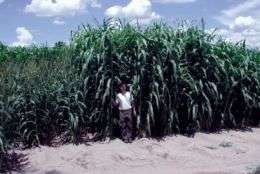
Don Slack, UA department head of agricultural and biosystems engineering, formed an ethanol group and "We started looking and thinking about crops we might grow. We narrowed it rather quickly on sorghum, then we narrowed it further to sweet sorghum as opposed to grain or milo sorghum."
Slack said, "Sorghum loves heat and loves drought and so is a perfect crop for Arizona." Water quality is less of a problem when growing sorghum. Since sorghum is grown as an industrial plant and not a food crop, effluent can be used for irrigation. Further sorghum is salt-tolerant, able to use marginal waters. "It is the kind of crop you can grow in an arid climate where you have water of poor quality.
"We are intending to harvest the sweet sorghum and produce the juice from the canes. Pinal Energy will run a batch through its fermentation and distillation process to get an idea of the yield of ethanol per gallon of juice and ultimately, gallons of ethanol per acre," he added.
Stalks of sweet sorghum contain fermentable sugars in the sap equal to 400-600 gallons of ethanol per acre. This is about twice that from corn grain. Sorghum holds promise for American Indian farmers who have rights to a fairly significant amount of CAP (Central Arizona Project) water. The San Carlos Apaches and the Yaqui tribes have expressed interest in growing sorghum.
Slack thinks sorghum may interest Arizona cotton growers and said, "If the U.S. is going to get beat up by the World Trade Organization on cotton subsidies, farmers will be looking for an alternative to cotton. Sorghum might be a good alternative."
Some work remains to be done before sorghum becomes a viable Arizona crop. Slack said, "There is no question that we can grow it and it grows like crazy here. Getting it harvested and the juice fermented are the two big things now. If we can get a food or animal fodder out of it, that would be another plus. It would have the same appeal as corn. I'd say we are a couple of years out before we are producing much of this."
Another possibility, although it does not present a very picturesque image, is single-celled pond scum called algae covering pools and ponds. UA researcher Joel Cuello's main research interest is using algae to produce oil – biodiesel as well as jet fuel.
Algae has been getting very good publicity lately as the most promising, environmentally-friendly way to produce biofuel. Its production may be a new bio-farming industry for Arizona, with commercial-scale microalgae becoming an up-and-coming crop for Arizona farmers.
Algae, a single cell organism, only requires sunlight, water and carbon dioxide to grow and can quadruple in biomass in just one day. Depending upon the species, algae can produce oil for use as a biodiesel, or starch that can be converted to ethanol by fermentation and hydrogen gas.
Cuello, from the UA agricultural and biosystems engineering department, said the desert is very well suited for growing algae. The desert's abundant wastelands or marginally arable lands can be fertile fields to grow algae. This means that unproductive lands can be put into production. Growing algae does not raise the prickly issue of using land that could be cultivated to grow crops, as does growing corn.
In addition, Algae provides a bigger payoff than higher crops. Whereas an acre of corn produces about 300 gallons of ethanol annually, an acre of soybeans about 60 gallons of biodiesel, an acre of algae could produce more than 5,000 gallons of biofuel each year.
Growing algae does not require abundant, high-quality water. Water not suited for other uses without additional treatment, such as domestic uses or conventional agriculture, is suitable for algae growth. Secondary treated wastewater, rich in hydrogen and phosphorus nutrients, is excellent for growing algae. Irrigation runoff and dairy wastewater can be used. Also of special interest to Arizona, some algae can thrive on non-potable saline and brackish waters.
Water savings are significant when growing algae. "If you are growing higher plants like corn or even sorghum you have to water them regularly. Not only is water consumption lower with algae, but there is less of a problem with evaporation," said Cuello. Further water savings result since water not taken up by the algae cells is recycled.
Cuello notes another advantage to growing algae in Arizona. "We have a lot of sunlight here as opposed to, say the Northeast. Algae are photosynthesizing organisms so sunlight ultimately is their source of energy."
Along with research conducted at the UA, researchers at Arizona State University also are focused on algae, with work being done to develop industrial bioreactors to mass culture microalgae for biofuel production. Cuello says, "There are lots of different types of algae – myriads, thousands, millions. It is the matter of identifying the ones that are going to be the most productive for biofuels." He added, "And most likely that is going to be proprietary information for companies."
How soon will production plants be up and operating in Arizona to convert algae into biofuels? "I would say it is within striking distance. It is very close," Cuello said.
Another option being considered is cellulosic ethanol, a biofuel made from plants or plant waste. Cellulosic ethanol can be produced from agricultural waste, sugar cane residue, timbering slash, wood chips and prairie grasses such as buffalo grass and switchgrass. Some analysts contend that if ethanol is ever to replace gasoline it will have to be produced from these abundant sources.
A recent USDA report on cellulosic ethanol acknowledges that cellulosic fuel holds "some longer-term promise," but maintains that "much research is needed to make it commercially economical." The challenge therein lies in developing an efficient and economic way to produce ethanol from cellulosic materials.
Research on growing switchgrass in Arizona for a cellulosic biofuel is just getting started. UA researcher Mike Ottman of the plant sciences department will be working on a research project next year to study six different types of perennial grasses including switchgrass at different levels of evapotransporation. The same research will be replicated at Washington State University, with the USDA funding both projects.
"What we are trying to do is look at the water requirements for perennial grasses in the western United States, Washington and Arizona. We are covering a range of possible environments," Ottman said.
The intent of the research is to determine whether switchgrass and other types of grasses are viable as a biofuel when weighed against water use and availability in the West. Ottman says it remains to be seen whether cellulosic ethanol production will be a viable option for Arizona agriculture. He says, "I imagine we can get pretty good yield because of our sunshine and warm weather conditions; our disadvantages is our production cost. A big part of the production cost with irrigated agriculture is the water."
Ottman sees agriforestry possibilities in the state, with fast growing trees such as the poplar planted for use in ethanol production. In fact, U.S. forests are being seen lately as the good source of wood for ethanol. Forest Service Chief Abigail Kimbell recently proposed replacing 15 percent of the nation's gasoline with ethanol made from wood from forests. She said much of this material would be small-diameter trees and underbrush, with most of it obtained during forest thinning efforts to remove underbrush to prevent wildfires.
Forest thinning for bioenergy could result in a water advantage to the state. Along with providing wood for ethanol, the thinning of forested areas would increase the amount of water flowing from watersheds, thus adding to available water supplies.
Provided by University of Arizona


