Rocks could be harnessed to sponge vast amounts of CO2 from air, says study
November 5, 2008
Reactive Rock

Enlarge

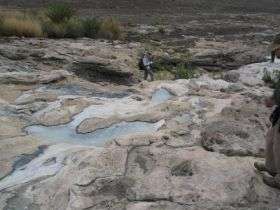
Large areas of Omani desert are covered with carbonate minerals that have reacted with bedrock. Credit: Lamont-Doherty Earth Observatory

Scientists say that a type of rock found at or near the surface in the Mideast nation of Oman and other areas around the world could be harnessed to soak up huge quantities of globe-warming carbon dioxide. Their studies show that the rock, known as peridotite, reacts naturally at surprisingly high rates with CO2 to form solid minerals—and that the process could be speeded a million times or more with simple drilling and injection methods. The study appears in this week's early edition of the Proceedings of the National Academy of Sciences.

Peridotite comprises most or all of the rock in the mantle, which undergirds earth's crust. It starts some 20 kilometers or more down, but occasionally pieces are exhumed when tectonic plates collide and push the mantle rock to the surface, as in Oman. Geologists already knew that once exposed to air, the rock can react quickly with CO2, forming a solid carbonate like limestone or marble.

However, schemes to transport it to power plants, grind it and combine it with smokestack gases have been seen as too costly and energy intensive. The researchers say that the discovery of previously unknown high rates of reaction underground means CO2 could be sent there artificially, at far less expense. "This method would afford a low-cost, safe and permanent method to capture and store atmospheric CO2," said the lead author, geologist Peter Kelemen.

Kelemen and geochemist Juerg Matter, both at Columbia University's Lamont-Doherty Earth Observatory, made the discovery during field work in the Omani desert, where they have worked for years. Their study area, a Massachusetts-size expanse of largely bare, exposed peridotite, is crisscrossed on the surface with terraces, veins and other formations of whitish carbonate minerals, formed rapidly in recent times when minerals in the rock reacted with CO2-laden air or water. Up to 10 times more carbonates lie in veins belowground; but the subterranean veins were previously thought to be formed by processes unconnected to the atmosphere, and to be nearly as old as the 96-million-year-old rock itself.

However, using conventional carbon isotope dating, Kelemen and Matter showed that the underground veins are also quite young— 26,000 years on average—and are still actively forming as CO2-rich groundwater percolates downward. Many underground samples were conveniently exposed in newly constructed road cuts. All told, Kelemen and Matter estimate that the Omani peridotite is naturally absorbing 10,000 to 100,000 tons of carbon a year--far more than anyone had thought. Similarly large exposures of peridotite are known on the Pacific islands of Papua New Guinea and Caledonia, and along the coasts of Greece and the former Yugoslavia; smaller deposits occur in the western United States and many other places.

The scientists say that the process of locking up carbon in the rocks could be speeded 100,000 times or more simply by boring down and injecting heated water containing pressurized CO2. Once jump-started in this way, the reaction would naturally generate heat—and that heat would in turn hasten the reaction, fracturing large volumes of rock, exposing it to reaction with still more CO2-rich solution. Heat generated by the earth itself also would help, since the further down you go, the higher the temperature. (The exposed Omani peridotite extends down some 5 kilometers.)

The scientists say that such a chain reaction would need little energy input after it was started. Accounting for engineering challenges and other imperfections, they assert that Oman alone could probably absorb some 4 billion tons of atmospheric carbon a year—a substantial part of the 30 billion sent into the atmosphere by humans, mainly through burning of fuels. With large amounts of new solids forming underground, cracking and expansion would generate micro-earthquakes—but not enough to be readily perceptible to humans, says Kelemen.

"It's fortunate that we have these kinds of rocks in the Gulf region," said Matter. Much of the world's oil and gas is produced there, and Oman is constructing new gas-fired electric plants that could become large sources of CO2 could be pumped down.

Matter has been working on a separate project in Iceland, where a different kind of rock, volcanic basalt, also shows promise for absorbing CO2 produced by power plants. Trials there are set to begin n spring 2009, in partnership with Reykjavik Energy, and the universities of Iceland and Toulouse (France).

According to the scientists, Petroleum Development Oman, the state oil company, is interested in a pilot program.

Kelemen said: "We see this as just one of a whole suite of methods to trap carbon. It's a big mistake to think that we should be searching for one thing that will take care of it all."

The paper, "In situ carbonation of peridotite for CO2 storage," is available at http://www.pnas.or … ull.pdf+html

Source: The Earth Institute at Columbia University

4.1 /5 (38 votes)  

Filter


Move the slider to adjust rank threshold, so that you can hide some of the comments.


Display comments: newest first

GrayMouser
Nov 05, 2008

Rank: 3.3 / 5 (8)
Would they get carbon credits for having this rock exposed to the air in their countries?
wawadave
Nov 05, 2008

Rank: 2.7 / 5 (7)
ok only one problem how do you capture the co2 from the air?
humanist
Nov 05, 2008

Rank: 3.3 / 5 (7)
1. If you don't know what you're doing, don't do it!

2. If you don't want to do it forever, don't start.
Sirussinder
Nov 05, 2008

Rank: 3.5 / 5 (8)

Al Gore's head is probably worth quite a few carbon credits.
Arikin
Nov 05, 2008

Rank: 2.4 / 5 (7)
Humanist:
1. If you don't know what you're doing, don't do it!
--> You will never know unless you try!

2. If you don't want to do it forever, don't start.
--> This shouldn't be done forever. It is at best a stop-gap while we get off our fossil fuel addiction.
magpies
Nov 06, 2008

Rank: 2 / 5 (6)
And what happens if it fails?
DGBEACH
Nov 06, 2008

Rank: 3.2 / 5 (5)
Isn't anyone else here a little nervous about the possibility of causing bigger earthquakes than what they're describing?
With large amounts of new solids forming underground, cracking and expansion would generate micro-earthquakes%u2014but not enough to be readily perceptible to humans, says Kelemen.

Somehow I don't think he really knows just how extensive the cracking and expansion would be.
Velanarris
Nov 06, 2008

Rank: 4 / 5 (6)
Isn't anyone else here a little nervous about the possibility of causing bigger earthquakes than what they're describing?
With large amounts of new solids forming underground, cracking and expansion would generate micro-earthquakes%u2014but not enough to be readily perceptible to humans, says Kelemen.

Somehow I don't think he really knows just how extensive the cracking and expansion would be.


How much you want to bet that this occurs naturally on the seafloor where there is a lot more exposed mantle rock.
Lord_jag
Nov 06, 2008

Rank: 3 / 5 (6)
So... what do we do with these "solid minerals" when they're spent?

Thow them in the ocean?
RFC
Nov 06, 2008

Rank: 4 / 5 (4)
"Geologists already knew that once exposed to air, the rock can react quickly with CO2, forming a solid carbonate like limestone or marble."

Pantheons for everyone!
tkjtkj
Nov 06, 2008

Rank: 3.8 / 5 (4)
Would they get carbon credits for having this rock exposed to the air in
their countries?


Would that be akin to myself
garnering extra cash in my bank
account by glueing my credit
card to my forehead??
MrPhysOrg
Nov 06, 2008

Rank: 3.3 / 5 (4)
Would they get carbon credits for having this rock exposed to the air in
their countries?


Would that be akin to myself
garnering extra cash in my bank
account by glueing my credit
card to my forehead??


You aren't doing anything for the climate by having them exposed as they are in nature, so no credit. If you expose them beyond their natural levels, then they should get credit for the difference.
THEY
Nov 06, 2008

Rank: 3.8 / 5 (5)
So, instead of REDUCING EMISSIONS globally, or maybe even planting trees, we are going to crack open some rocks hoping to make a better carbon sink? Uh, hello?
GIR
Nov 06, 2008

Rank: 3.5 / 5 (4)
So, instead of REDUCING EMISSIONS globally, or maybe even planting trees, we are going to crack open some rocks hoping to make a better carbon sink?


Who said anything about not reducing emissions or planting trees?

Uh, hello?


Hi
GrayMouser
Nov 06, 2008

Rank: 2.6 / 5 (5)
And what happens if it fails?


Ask Al Gore so he can make a disaster film?
E_L_Earnhardt
Nov 06, 2008

Rank: 3 / 5 (4)
GRATE IDEA! GO TO IT!!!
out7x
Nov 07, 2008

Rank: 2.6 / 5 (5)
It will work in a few thousands of years. Marble is a metamorphic.
MrPhysOrg
Nov 07, 2008

Rank: 5 / 5 (2)
It will work in a few thousands of years. Marble is a metamorphic.

So? Any stable carbonate should be adequate. It does beg the question, though: if it's forming a solid carbonate "like limestone or marble", then which one? Limestone-marble require calcium, which does not seem to be a big participant here.
Velanarris
Nov 08, 2008

Rank: 5 / 5 (2)
It will work in a few thousands of years. Marble is a metamorphic.

So? Any stable carbonate should be adequate. It does beg the question, though: if it's forming a solid carbonate "like limestone or marble", then which one? Limestone-marble require calcium, which does not seem to be a big participant here.
Calcium is very present in the Earth's mantle and outer crust, quartz and etc.

out7x, limestone can form within months. It's a feasable idea.
GrayMouser
Nov 12, 2008

Rank: 5 / 5 (3)
ok only one problem how do you capture the co2 from the air?


And the second problem is what to do with all the dead plants after the CO2 is removed from the atmosphere? Maybe we can genetically engineer them to use oxygen instead...
MikeB
Nov 13, 2008

Rank: 4 / 5 (4)
Off topic but interesting about oceans, rocks and CO2.

http://jenniferma...-plimer/
robertg222
Nov 14, 2008

Rank: 4 / 5 (4)
Now why would we want waste money to do this sense the earth has gone into a cooling cycle without any help from man. Temps have been dropping sense 1998. It's time to abandon the global warming scam, the world economy can't afford the cost to accomplish nothing.
denijane
Nov 18, 2008

Rank: 1 / 5 (1)
Nice....it sounds doable, though, we can't cover the whole Earth with this rocks-it would look little impracticable.As well as pumping CO2 from the whole world, there. Though an occasional mountain from that material could be fun way of solving the problem.
But it won't work until we don't decrease our emissions and improve our efficiency.
http://tothefutur...spot.com
Rank 4.1 /5 (38 votes)
Tags

Relevant PhysicsForums posts
  • Discrepancy between oxygen and carbon-dioxide levels
    created22 hours ago
  • where gems are found in the world
    createdFeb 09, 2012
  • Wind Waves in Reservoir ~ Wind run-up and Wind set-up
    createdFeb 08, 2012
  • Balance of oxygen in the atmosphere
    createdFeb 01, 2012
  • The case for a methanol-based economy
    createdJan 30, 2012
  • Weather in a rotating cylinder
    createdJan 25, 2012
  • More from Physics Forums - Earth

More news stories

NASA sees wide-eyed cyclone Jasmine

Cyclone Jasmine's eye has opened wider on NASA satellite imagery, as it moves through the Southern Pacific Ocean.

Space & Earth / Earth Sciences

created 3 hours ago | popularity not rated yet | comments 1

NASA sees Giovanna reach cyclone strength, threaten Madagascar

Tropical Storm 12S built up steam and became a cyclone on February 10, 2012 as NASA's Terra satellite passed overhead. Residents of east-central Madagascar should prepare for this cyclone to make landfall ...

Space & Earth / Earth Sciences

created 3 hours ago | popularity not rated yet | comments 0

Humans may have helped the decline of African rainforests 3000 years ago

(PhysOrg.com) -- Large areas of rainforests in Central Africa mysteriously disappeared over three thousand years ago, to be replaced by savannas. The prevailing theory has been that the cause was a change ...

Space & Earth / Environment

created 15 hours ago | popularity 4.2 / 5 (9) | comments 10 | with audio podcast report

Could Venus be shifting gear?

(PhysOrg.com) -- ESA’s Venus Express spacecraft has discovered that our cloud-covered neighbour spins a little slower than previously measured. Peering through the dense atmosphere in the infrared, the ...

Space & Earth / Space Exploration

created 11 hours ago | popularity 5 / 5 (7) | comments 7 | with audio podcast

Mars Science Laboratory computer issue resolved

(PhysOrg.com) -- Engineers have found the root cause of a computer reset that occurred two months ago on NASA's Mars Science Laboratory and have determined how to correct it.

Space & Earth / Space Exploration

created 12 hours ago | popularity 4.7 / 5 (6) | comments 3 | with audio podcast


Google users warned of threat to smartphone wallets

Users of Google smartphone wallets were being warned on Friday that there is a way to crack pass codes intended to thwart thieves from going on illicit shopping sprees.

Anonymous knocks CIA website offline (Update)

The website of the Central Intelligence Agency was inaccessible on Friday after the hacker group Anonymous claimed to have knocked it offline.

Complex wiring of the nervous system may rely on a just a handful of genes and proteins

Researchers at the Salk Institute have discovered a startling feature of early brain development that helps to explain how complex neuron wiring patterns are programmed using just a handful of critical genes. ...

New error-correcting codes guarantee the fastest possible rate of data transmission

Error-correcting codes are one of the triumphs of the digital age. They’re a way of encoding information so that it can be transmitted across a communication channel — such as an optical fiber o ...

Putting the squeeze on planets outside our solar system

(PhysOrg.com) -- Using high-powered lasers, scientists at Lawrence Livermore National Laboratory and collaborators discovered that molten magnesium silicate undergoes a phase change in the liquid state, abruptly ...

The power of estrogen -- male snakes attract other males

A new study has shown that boosting the estrogen levels of male garter snakes causes them to secrete the same pheromones that females use to attract suitors, and turned the males into just about the sexiest ...