Scientists create tiny backpacks for cells
November 5, 2008 By Anne Trafton
Tiny backpacks for cells

Enlarge

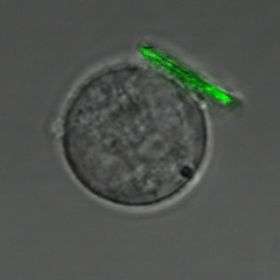
MIT researchers have developed a technique to attach tiny polymer "backpacks" to cells. This immune system cells, a B lymphocyte sports one. The scale bar is 10 micrometers. Image courtesy / American Chemical Society

(PhysOrg.com) -- MIT engineers have outfitted cells with tiny “backpacks” that could allow them to deliver chemotherapy agents, diagnose tumors or become building blocks for tissue engineering.

Michael Rubner, director of MIT’s Center for Materials Science and Engineering and senior author of a paper on the work that appeared online in Nano Letters on Nov. 5, said he believes this is the first time anyone has attached such a synthetic patch to a cell.

The polymer backpacks allow researchers to use cells to ferry tiny cargoes and manipulate their movements using magnetic fields. Since each patch covers only a small portion of the cell surface, it does not interfere with the cell’s normal functions or prevent it from interacting with the external environment.

“The goal is to perturb the cell as little as possible,” said Robert Cohen, the St. Laurent Professor of Chemical Engineering at MIT and an author of the paper.

The researchers worked with B and T cells, two types of immune cells that can home to various tissues in the body, including tumors, infection sites, and lymphoid tissues — a trait that could be exploited to achieve targeted drug or vaccine delivery.

“The idea is that we use cells as vectors to carry materials to tumors, infection sites or other tissue sites,” said Darrell Irvine, an author of the paper and associate professor of materials science and engineering and biological engineering.

Cellular backpacks carrying chemotherapy agents could target tumor cells, while cells equipped with patches carrying imaging agents could help identify tumors by binding to protein markers expressed by cancer cells.

Another possible application is in tissue engineering. Patches could be designed that allow researchers to align cells in a certain pattern, eliminating the need for a tissue scaffold.

The polymer patch system consists of three layers, each with a different function, stacked onto a surface. The bottom layer tethers the polymer to the surface, the middle layer contains the payload, and the top layer serves as a “hook” that catches and binds cells.

Once the layers are set up, cells enter the system and flow across the surface, getting stuck on the polymer hooks. The patch is then detached from the surface by simply lowering the temperature, and the cells float away, with backpacks attached.

“The rest of the cell is untouched and able to interact with the environment,” said Albert Swiston, lead author of the paper and a graduate student in materials science and engineering.

The researchers found that T cells with backpacks were able to perform their normal functions, including migrating across a surface, just as they would without anything attached.

By loading the backpacks with magnetic nanoparticles, the researchers can control the cells’ movement with a magnetic field.

Because the polymer synthesis and assembly takes place before the patches are attached to cells, there is plenty of opportunity to tweak the process to improve the polymers’ effectiveness and ensure they won’t be toxic to cells, the researchers say.

Other authors of the paper are Soong Ho Um, a postdoctoral associate in the Departments of Materials Science and Engineering and Biological Engineering, and Connie Cheng, a recent Harvard graduate.

The research was funded by the National Science Foundation Materials Research Science and Engineering Center and an NSF Graduate Research Fellowship.

Provided by NIT

Filter


Move the slider to adjust rank threshold, so that you can hide some of the comments.


Display comments: newest first

bmcghie
Nov 05, 2008

Rank: not rated yet
picture picture picture please! :) Sounds awesome. I would love to know how big, relative to common lymphocytes, these backpacks are. They say it doesn't impede movement... but what about diapedesis?
ajs
Nov 06, 2008

Rank: not rated yet
We can adjust the size using the lithography step, and using the current technique can get down to ~7micron diameter backpacks. There should be images posted to the MIT News site soon...
Rank 4 /5 (22 votes)
Relevant PhysicsForums posts
  • polymer nanocomposites
    created11 hours ago
  • Corrosion Tests on Magnesium
    createdFeb 09, 2012
  • polyethylene copper nanocomposite
    createdFeb 09, 2012
  • Output of xrd analysis
    createdFeb 08, 2012
  • Transport phenomena problem based on problems 18.B11 and 19B.6 from Bird, stewart, lw
    createdFeb 06, 2012
  • Help with material selection - Car Piston
    createdFeb 05, 2012
  • More from Physics Forums - Materials & Chemical Engineering

More news stories

What lies beneath: Mapping hidden nanostructures

The ability to diagnose and predict the properties of materials is vital, particularly in the expanding field of nanotechnology. Electron and atom-probe microscopy can categorize atoms in thin sheets of material, ...

Nanotechnology / Nanophysics

created 4 hours ago | popularity 5 / 5 (1) | comments 1

'Dark plasmons' transmit energy

Microscopic channels of gold nanoparticles have the ability to transmit electromagnetic energy that starts as light and propagates via "dark plasmons," according to researchers at Rice University.

Nanotechnology / Nanophysics

created 20 hours ago | popularity 5 / 5 (6) | comments 1 | with audio podcast

New kind of solar cell could capture significantly more energy than current cells

New solar cells could increase the maximum efficiency of solar panels by over 25%, according to scientists from the University of Cambridge.

Nanotechnology / Nanophysics

created Feb 08, 2012 | popularity 4.5 / 5 (12) | comments 14 | with audio podcast

Nanoshell whispering galleries improve thin solar panels

Visitors to Statuary Hall in the U.S. Capitol Building may have experienced a curious acoustic feature that allows a person to whisper softly at one side of the cavernous, half-domed room and for another on ...

Nanotechnology / Nanomaterials

created Feb 07, 2012 | popularity 4.3 / 5 (6) | comments 6 | with audio podcast

Nanotube therapy takes aim at breast cancer stem cells

Wake Forest Baptist Medical Center researchers have again proven that injecting multiwalled carbon nanotubes (MWCNTs) into tumors and heating them with a quick, 30-second laser treatment can kill them.

Nanotechnology / Bio & Medicine

created Feb 09, 2012 | popularity 5 / 5 (1) | comments 0 | with audio podcast


Putting the squeeze on planets outside our solar system

(PhysOrg.com) -- Using high-powered lasers, scientists at Lawrence Livermore National Laboratory and collaborators discovered that molten magnesium silicate undergoes a phase change in the liquid state, abruptly ...

India probes Google over 'forex transactions'

Indian authorities are probing whether online giant Google broke domestic foreign-exchange transactions rules while shifting funds abroad, the Press Trust of India reported on Friday.

Germany freezes signing of disputed Internet pact

Germany on Friday halted the signing of a controversial international accord billed as a way to beat online piracy that has sparked angry protests, saying it needed more time to consider it.

Health experts, scientists to discuss bird flu studies

The World Health Organization said Friday it will meet next week to determine whether scientists can publish research on a bird flu virus that may be easily passed among humans.

Employers feel no love for unscrupulous practice of 'service sweethearting'

A new study led by two Florida State University marketing professors finds that some frontline service employees who are rewarded for hikes in customer loyalty and satisfaction also may engage in "service ...

Obama forges compromise birth control plan

US President Barack Obama Friday announced a compromise to defuse a row over access to birth control which prompted election-year Republican critics to claim he was waging a war on religion.