Gold nanostar shape of the future
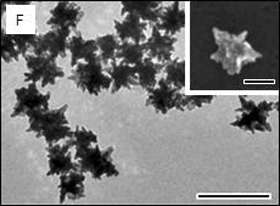
Rods, cones, cubes and spheres – move aside. Tiny gold stars, smaller than a billionth of a meter, may hold the promise for new approaches to medical diagnoses or testing for environmental contaminants.
While nanoparticles have been the rage across a wide spectrum of sciences, a new study by Duke University bioengineers indicates that of all the shapes studied to date, stars may shine above all the rest for certain applications.
The key is light, and how that light reflects off the particles. Compared to the other shapes, nanostars can dramatically enhance the reflected light, the Duke scientists found. This increases their potential usefulness as a tracer, label, or contrast agent.
Since the researchers also found that the size and shape of the nanostars affect the spectrum of reflected light, they believe that these tiny nanostars can also be "tuned" to identify particular molecules or chemicals.
"To our knowledge, this is the first report of the development and use of gold nanostars as labels for molecular detection and description of their controlled synthesis with different sizes and shapes" said Chris Khoury, lead author of a paper published on-line in the Journal of Physical Chemistry. Khoury is a graduate student in biomedical engineering working in the laboratory of senior researcher Tuan Vo-Dinh, R. Eugene and Susie E. Goodson Distinguished Professor of Biomedical Engineering and director of The Fitzpatrick Institute for Photonics at Duke.
In the Duke experiments, the nanostars were used in conjunction with a phenomena first described in the 1970s known as surface-enhanced Raman scattering (SERS). When light, usually from a laser, is shined on a sample, the target molecule vibrates and scatters back in its own unique light, often referred to as the Raman scatter. However, this Raman response is extremely weak. When the target molecule is coupled with a metal nanoparticle or nanostructure, the Raman response is greatly enhanced by the SERS effect –often by more than a million times, Vo-Dinh said.
In the early 1980s, while at the Oak Ridge National Laboratory, Tenn., Vo-Dinh and colleagues were among the first to demonstrate that SERS could be put into practical use to detect chemicals including carcinogens, environmental pollutants, and early markers of disease. Now at Duke, Vo-Dinh is pushing the boundaries of the SERS technology by designing a variety of unique types and shapes of metal nanoparticles that can be used as SERS labels for chemical and biomedical detection.
"We are trying to understand which type of nanostructures will give us the optimal signal so we can use them to monitor trace amounts of pollutants or detect diseases in their earliest stage" Vo-Dinh said. "This study is the first demonstration that these nanostars can enhance the effect of SERS to produce strong and unique signatures, like 'optical fingerprints.'"
Khoury "grew" the nanostars by mixing miniscule gold particle seeds in a growth solution. As more gold was added to the solution, protrusions began to sprout from the central core. Additional gold increased the size of the entire particle.
"These experiments demonstrate that it is possible to vary the size and shape of the nanostars in a controlled fashion by adjusting the volume of gold seeds added to the growth solution," Khoury said. "We found that variations in star size changed the reflected light, which hints toward the tuning capabilities that can be exploited by SERS technology."
For such studies, or those involving environmental contaminants, a dye would be attached to the nanostars and mixed with the sample to be tested. The sample would then be placed under a microscope and hit with a burst of laser energy. Sensors would pick up the Raman scattering and interpret the unique optical fingerprint.
Khoury said that nanostars are small enough to pass through cell walls into the interior of the cell, which would make them an effective method for molecular diagnostics. Nanostars could be attached to an antibody to search for antigens, or coupled with a dye to improve the effectiveness of different imaging tests.
While silver enhances the Raman scattering more effectively, gold was chosen as the metallic base of the current nanoparticle because it is a stable metal that doesn't cause immune system reactions within the body. Unlike silver, it also does not oxidize in samples.
Vo-Dinh research group at Duke is currently developing novel techniques for chemical detection and medical diagnostics using SERS. Vo-Dinh said that since each SERS label molecule has its own unique optical fingerprint, theoretically a single probe could be created that could detect an array of different cancers, for example, or different environmental toxins.
Source: Duke University


