The beauty machine
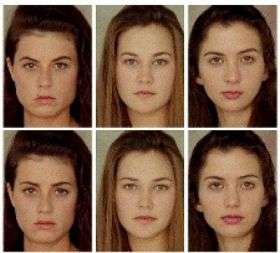
Our mothers told us that true beauty is more than skin deep — but researchers from Tel Aviv University are now challenging Mom.
They've built a beauty machine that, with the press of a button, turns a picture of your own ordinary face into that of a cover model. While its output is currently limited to digitized images, the software may be able to guide plastic surgeons, aid magazine cover editors, and even become a feature incorporated into all digital cameras.
"Beauty, contrary to what most people think, is not simply in the eye of the beholder," says lead researcher Prof. Daniel Cohen-Or of the Blavatnik School of Computer Sciences at Tel Aviv University. With the aid of computers, attractiveness can be objectified and boiled down to a function of mathematical distances or ratios, he says. This function is the basis for his beauty machine.
In the Eyes of a Majority of Beholders
The research has attracted interest and controversy. Beauty is, after all, a quality that has captivated artists since time immemorial, and its definition has eluded even the world's greatest philosophers. Prof. Cohen-Or sees things more scientifically.
"Beauty can be quantified by mathematical measurements and ratios. It can be defined as average distances between features, which a majority of people agree are the most beautiful," says Prof. Cohen-Or. "I don't claim to know much about beauty. For us, every picture in this research project is just a collection of numbers."
In his study, published recently in the proceedings of Siggraph, an annual computer graphics conference, Prof. Cohen-Or and his graduate student Tommer Leyvand –– together with two colleagues –– surveyed 68 Israeli and German men and women, aged 25 to 40, asking them to rank the beauty of 93 different men's and women's faces on a scale of 1 to 7. These scores were then entered into a database and correlated to 250 different measurements and facial features, such as ratios of the nose, chin and distance from ears to eyes. From this, the scientists created an algorithm that applies desirable elements of attractiveness to a fresh image.
True to the Real You
Unlike heavily processed Photoshop images that can make magazine cover models and celebrities unrecognizable, Tel Aviv University's "beautification engine" is much more subtle. Observers say that the final image it produces retains an unmistakable similarity to the original picture.
Well — in most cases. There is one circumstance where Prof. Cohen-Or's beauty machine doesn't work like a charm: when a celebrity's face is changed.
"We've run the faces of people like Brigitte Bardot and Woody Allen through the machine and most people are very unhappy with the results," he admits. "But in unfamiliar faces, most would agree the output is better." Prof. Cohen-Or now plans on developing the beauty machine further -- to add the third dimension of depth.
Source: American Friends of Tel Aviv University


