Can Nintendo Wii Tackle Child Obesity?
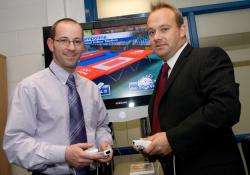
Millions of people around the world jump around their living room as they wrestle with the controls of a Nintendo Wii. But can playing a simulated sport on the computer actually be GOOD for your health?
Sports science experts at the University of Derby are embarking on research to see if such video games could help tackle obesity.
Dr Michael Duncan, a Senior Lecturer in Exercise Physiology at the University, is appealing for primary schools in the region to take part in the study.
And he has been awarded £5,000 funding from the TANITA Healthy Weight Community Trust to carry out the work.
The trust is a non-profit, public fund established in 1994 by TANITA in cooperation with the government of Japan. TANITA is a leading manufacturer of professional and home-use body fat and body composition monitors/scales.
Michael said: “This study aims to see if young children can lose weight or improve their health by using the Nintendo Wii.
“There is a lot of discussion that video games are bad for your health and we hope this research will determine if playing on this equipment could actually have physical benefits for children.”
Trials will see a six-week period where half of a participating school’s pupils will play on the Wii game during their lunch hour and half of them will take part in their normal lunch hour activities – whether it is football, socialising or just eating lunch.
Pupils taking part in the study will be asked to wear a tri-axial accelerometer – a pedometer style device which also monitors energy use from more than one angle – so not just running on the spot but also recording movements from all jumps, side turns and other body movements a pedometer would not pick up.
Dr Duncan then hopes to provide TANITA with his results in the next year. The organisation only awards eight such grants each year. The firm’s UK Key Accounts Manager, David Hutchinson, met Mr Duncan earlier this month to hand over a certificate of the grant and to see the University’s Games Development Suite, at our Kedleston Road site.
The mission of the TANITA Healthy Weight Community Trust has been to support scientific study aimed at combating obesity and other weight and body composition-related problems in Japan and across the globe.
Research grants are awarded annually to people or organisations conducting studies on the epidemiology of fatness, with the goal of combating obesity worldwide.
TANITA UK Ltd spokesman, Kim Ramessa, explained why the Derby bid for funding was successful. She said: “This research project was particularly creative in encouraging children to be active in a fun and engaging manner.
“It highlighted one of the Trust’s key objectives of preventing obesity through increasing physical activity and education.”
The University has also informed Nintendo Wii about the research project and plans to make its research findings available to the company afterwards.
Dr Duncan has a strong background in this research area having carried out studies in areas including body dissatisfaction, body fat and physical activity in primary school children and using pedometers to determine pupils’ physical activity. He is also a BASES (British Association of Sport and Exercise Science) accredited exercise physiologist.
Dr Duncan needs to hear from schools interested in taking part by November 20. He hopes around ten will get involved in the study. To get involved, contact Dr Duncan via email on m.duncan(at)derby.ac.uk.
Provided by University of Derby


