'Unprecedented' warming drives dramatic ecosystem shifts in North Atlantic
November 6, 2008 By Krishna Ramanujan 'Unprecedented' warming drives dramatic ecosystem shifts in North Atlantic

Enlarge

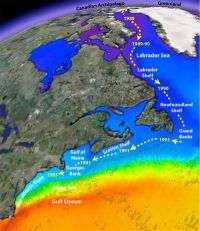
This graphic shows the path of low-salinity water discharged from the Arctic Ocean in 1989 as it progresses along the continental shelf of eastern North America.

(PhysOrg.com) -- While the planet has experienced numerous changes in climate over the past 65 million years, the most significant climate change of the last 5,000 years has been in recent decades. That change is global warming.

A Cornell study reports that as a result of this warming, which has caused Arctic freshwater ice to melt and flow southward, the ranges of some cold-water, northern marine species have been moving down the North American coast -- a counterintuitive finding.

The paleo-climate record shows very rapid periods of cooling in the past, when temperatures have dropped by as much as 18 degrees Fahrenheit (10 degrees Celsius) in a matter of years to decades, but "the rate of warming we are seeing [now] is unprecedented in human history," said Cornell oceanographer Charles Greene, the lead author of the study, published in the November issue of the journal Ecology (Vol. 89, No. 11).

During the past 50 years, melting Arctic ice sheets and glaciers have periodically released cold, low-salt water from the Arctic Ocean into the North Atlantic. This has led to dramatic ecosystem shifts as far south as North Carolina and extensive geographic range shifts of many plant and animal species, he said. One microscopic algal species from the Pacific Ocean, not seen in the North Atlantic for over 800,000 years, has reinvaded the North Atlantic from the Arctic Ocean during the past decade.

By reviewing climate changes in the past, the researchers were able to more clearly observe how this influx of fresher water has led to changes in ecosystems as well as the geographic distributions of species, said Greene.

Interestingly, the study's findings run counter to the expectations of most ecologists: They expected that the distributions of southern species would move north and that northern species would lose habitat as the climate warms. Instead, Greene found that as colder, fresher Arctic waters flow south along the Northwest Atlantic shelf, from the Labrador Sea south of Greenland all the way to North Carolina, the distributions of many northern species have actually moved southward.

In addition, the periodic freshening of shelf waters has extended the growing seasons of phytoplankton and tiny drifting animals, like copepods, which make up the base of the marine food chain.

Furthermore, climate changes may have played a role in the decline of cod, a top predator. As cod have declined, populations of prey species have increased.

"While it is true that cod stocks never rebounded from 20th-century overfishing, part of their failure to recover can be attributed to the climate bringing colder waters to Newfoundland since the 1990s," said Greene. Cod don't grow and reproduce as rapidly in the colder water. The decline of cod, combined with the ocean's colder temperatures, has enabled populations of cold-water crustacean species, like snow crab and shrimp, to increase.

"As climate changes, there are going to be winners and losers, both in terms of biological species and different groups of people," said Greene. "The cod fishermen are out of luck, but the fishermen that have decided to go after snow crab and shrimp are very successful now." He added that adapting to climate change is partly being able to predict what we can expect.

The study was funded by the National Science Foundation.

Provided by Cornell University


print this article email this article download pdf blog this article bookmark this article     Stumble it Digg this share on Facebook retweet share on Reddit add to delicious
Rate this story - 3.6 /5 (16 votes)

Rank Filter

Move the slider to adjust rank threshold, so that you can hide some of the comments.


Display comments: newest first

  • agg - Nov 06, 2008
    • Rank: 3.5 / 5 (11)
    So what they are saying is the oceanographers don't have a solid understanding of currents?
    (Well known). But the global climate computer models have an ocean current component. Which means they (gasp) could have been mislead? Oh no. What if someone finds out that atmospheiric turbulent mixing is a shot in the dark as well?
    Uh oh, what if they find out the understanding of the flux of EM radiation on the planet is poorly understood. It will be ok if we can stop them from thinking critically by releasing so much drivel no one can shout above the cacophony.
    Whoever shouts the loudest speaks the truth!!!
  • jeffsaunders - Nov 06, 2008
    • Rank: 3 / 5 (5)
    It is a good thing when reality and models diverge. It means that we don't know as much as we thought we did. It means after a long time of fiddling with the models they (the models) might improve for the future.

    This story is pretty good over all. Except for those poor over fished Cod. That don't like cold or warm water. Perhaps their range has reduced because there is an increased gradient between cold and warm?

    Now there are a few more shrimp, one would think the Cod and other species, would be living better, but no we are going to send in more shrimp trawlers to see that doesn't happen.

  • Velanarris - Nov 06, 2008
    • Rank: 3.5 / 5 (11)
    While the planet has experienced numerous changes in climate over the past 65 million years, the most significant climate change of the last 5,000 years has been in recent decades. That change is global warming.


    That is if you ignore the medieval warm period, the roman warm period, the little ice age, and the drought of 1920.
  • deatopmg - Nov 07, 2008
    • Rank: 5 / 5 (5)
    "There is always an easy solution to every human problem --
    neat, plausible, and wrong." -- H.L. Mencken.
  • GrayMouser - Nov 07, 2008
    • Rank: 3 / 5 (8)
    While the planet has experienced numerous changes in climate over the past 65 million years, the most significant climate change of the last 5,000 years has been in recent decades. That change is global warming.


    That is if you ignore the medieval warm period, the roman warm period, the little ice age, and the drought of 1920.


    There's always somebody trying to obscure things with facts! ;-)
  • Noein - Nov 09, 2008
    • Rank: 1.6 / 5 (7)
    This article doesn't shake my deep religious faith in global warming denialism at all. My lord and savior, big oil, has declared that there is no global warming. Therefore, there is no global warming. I am safe and secure in my bubble of delusional fantasies.
  • rubberman - Nov 09, 2008
    • Rank: 4 / 5 (2)
    Nice.
  • MikeB - Nov 09, 2008
    • Rank: 4.2 / 5 (5)
    This unprecedented warming is SO unprecedented that it somehow is showing up as cooling on the temperature graphs of the last seven years!
    See this:
    http://scienceand...pped.pdf
    Also, there is more ice in the Arctic than in the last seven years: (see the red line)
    http://www.ijis.i...tent.htm

    Man, that really IS unprecedented. If it gets any hotter we may all freeze to death.
  • MikeB - Nov 12, 2008
    • Rank: 4 / 5 (4)
    Also this from Nansen ROOS shows that Arctic Sea Ice Area is precisely average for the satellite record:
    http://eva.nersc....area.png
  • bobwinners - Nov 15, 2008
    • Rank: not rated yet
    This unprecedented warming is SO unprecedented that it somehow is showing up as cooling on the temperature graphs of the last seven years!
    See this:
    http://scienceand...pped.pdf
    Also, there is more ice in the Arctic than in the last seven years: (see the red line)
    http://www.ijis.i...tent.htm

    Man, that really IS unprecedented. If it gets any hotter we may all freeze to death.


    First, it would be much better to see a chart of the past 100 years, with a moving average of say 10 years.
    Second, attention should be drawn to the September values in the chart in the second link. The chart does not indicate depth of midwinter sea ice, only the extent. Is clearly shows that that extent is diminishing, almost consistently, over the past 7 years, at the warm season limit.

November 6, 2008 all stories

Comments: 10

3.6 /5 (16 votes)
  • Stumble this up

  • Digg this

  • share this

  • hide
  • Related Stories

  • Newly Discovered Fat Molecule: An Undersea Killer with an Upside
    created Nov 05, 2009 | popularity not rated yet | comments 0
  • Climate Change, Nitrogen Loss Threaten Plant Life in Arid Desert Soils
    created Nov 05, 2009 | popularity not rated yet | comments 0
  • North Atlantic fish populations shifting as ocean temperatures warm
    created Nov 02, 2009 | popularity not rated yet | comments 0
  • Iron controls patterns of nitrogen fixation in the Atlantic
    created Nov 02, 2009 | popularity not rated yet | comments 0
  • Life's Ancient Island in the Ice
    created Oct 29, 2009 | popularity not rated yet | comments 0


  • hide
  • Relevant PhysicsForums posts

  • cycles
    created 9 hours ago
  • The Origin of the term 'fossil' fuels
    created Nov 05, 2009
  • co2
    created Nov 03, 2009
  • Early Earths Sulfidic Ocean Conditions
    created Oct 30, 2009
  • More from Physics Forums - Earth

Other News

Deep creep means milder, more frequent earthquakes along Southern California's San Jacinto fault

Deep creep means milder, more frequent earthquakes along Southern California's San Jacinto fault

Space & Earth / Earth Sciences

created 8 hours ago | popularity 4.7 / 5 (3) | comments 0

With an average of four mini-earthquakes per day, Southern California's San Jacinto fault constantly adjusts to make it a less likely candidate for a major earthquake than its quiet neighbor to the east, the ...


Success in 'space elevator' competition (AP)

Success in 'space elevator' competition (Update 3)

Space & Earth / Space Exploration

created Nov 05, 2009 | popularity 4.3 / 5 (33) | comments 50

(AP) -- A robot powered by a ground-based laser beam climbed a long cable dangling from a helicopter on Wednesday to qualify for prize money in a $2 million competition to test the potential reality of the ...


In a Galaxy Far, Far Away...

In a Galaxy Far, Far Away...

Space & Earth / Astronomy

created Nov 06, 2009 | popularity 4.8 / 5 (5) | comments 15

(PhysOrg.com) -- Astronomers have published the discovery of the farthest known object in the cosmos: a star that exploded when the universe was only 630 million years old -- only 4.6% of its current age. ...


'Dropouts' pinpoint earliest galaxies

'Dropouts' pinpoint earliest galaxies

Space & Earth / Astronomy

created Nov 06, 2009 | popularity 4.2 / 5 (10) | comments 13

Astronomers, conducting the broadest survey to date of galaxies from about 800 million years after the Big Bang, have found 22 early galaxies and confirmed the age of one by its characteristic hydrogen signature ...


Space hotel taking bookings for 2012 opening

Space hotel taking bookings for 2012 opening

Space & Earth / Space Exploration

created Nov 05, 2009 | popularity 4.4 / 5 (20) | comments 11

(PhysOrg.com) -- The first orbiting space hotel is on track to open for its first customers in 2012, but hurry, as bookings are filling fast.