Tropical Storm Paloma Forms Quickly in the Caribbean Sea
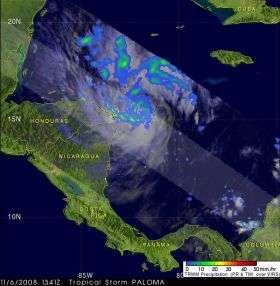
November 6, 2008 Tropical Storm Paloma Forms Quickly in the Caribbean Sea

Enlarge

Credit: NASA/SSAI, Hal Pierce

A hurricane watch has been posted for the Cayman Islands. A Hurricane watch means that hurricane conditions are possible within the watch area...generally within 36 hours.

At 1 p.m. EST, Nov. 6, Tropical Storm Paloma, located in the western Caribbean near the Honduras/Nicaragua border, has continued to strengthen. Paloma's maximum sustained winds have increased to near 60 mph with higher gusts. Steady strengthening is forecast during the next couple of days and Paloma could become a hurricane tonight or tomorrow. Paloma was near latitude 15.9 north and longitude 81.9 west or about 105 miles northeast of Cabo Gracias a Dios on the Nicaragua/Honduras border and about 235 miles south of Grand Cayman.

Paloma is moving toward the north near 7 mph...11 km/hr. This general motion is expected today with a gradual turn toward the Northeast forecast late on Friday or on Saturday. Minimum central pressure is now 997 millibars.

The image above shows a rainfall analysis of tropical storm Paloma using data from the Tropical Rainfall Measuring Mission (TRMM) satellite as it passed above on November 6 at 1341 UTC (8:41 AM EST). At that time Paloma was increasing in strength with wind speeds between 35 to 40 knots (40 to 46 miles per hour). Paloma was already a well organized storm with precipitation particularly heavy in a feeder band in Paloma's southwest quadrant. The center of Paloma's circulation was clearly revealed by TRMM's Precipitation Radar (PR) instrument.

TRMM can gauge the rainfall generated by a storm. Paloma is expected to produce total rainfall accumulations of 2 to 4 inches over eastern Honduras and northeastern Nicaragua. Four to eight inches of rain over the Cayman Islands is expected with isolated maximum totals of 12 inches possible.

Tropical Storm Paloma formed in the Caribbean Sea northeast of Nicaragua on the morning of 6 November 2008. Paloma is predicted by the National Hurricane Center to intensify as it moves through the Caribbean and possibly become a category 2 hurricane before hitting central Cuba in the next three or four days.

Provided by NASA, Hal Pierce/Rob Gutro/SSAI and Goddard Space Flight Center


print this article email this article download pdf blog this article bookmark this article     Stumble it Digg this share on Facebook retweet share on Reddit add to delicious
Rate this story - 5 /5 (3 votes)


November 6, 2008 all stories

Comments: 0

5 /5 (3 votes)
  • Stumble this up

  • Digg this

  • share this

  • hide
  • Related Stories


  • hide
  • Relevant PhysicsForums posts

  • cycles
    created 22 hours ago
  • The Origin of the term 'fossil' fuels
    created Nov 05, 2009
  • co2
    created Nov 03, 2009
  • Early Earths Sulfidic Ocean Conditions
    created Oct 30, 2009
  • More from Physics Forums - Earth

Other News

Antarctica glacier retreat creates new carbon dioxide store

Antarctica glacier retreat creates new carbon dioxide store

Space & Earth / Earth Sciences

created 18 minutes ago | popularity not rated yet | comments 0

Large blooms of tiny marine plants called phytoplankton are flourishing in areas of open water left exposed by the recent and rapid melting of ice shelves and glaciers around the Antarctic Peninsula. This ...


Deep creep means milder, more frequent earthquakes along Southern California's San Jacinto fault

Deep creep means milder, more frequent earthquakes along Southern California's San Jacinto fault

Space & Earth / Earth Sciences

created 21 hours ago | popularity 4.5 / 5 (4) | comments 0

With an average of four mini-earthquakes per day, Southern California's San Jacinto fault constantly adjusts to make it a less likely candidate for a major earthquake than its quiet neighbor to the east, the ...


Success in 'space elevator' competition (AP)

Success in 'space elevator' competition (Update 3)

Space & Earth / Space Exploration

created Nov 05, 2009 | popularity 4.3 / 5 (33) | comments 51

(AP) -- A robot powered by a ground-based laser beam climbed a long cable dangling from a helicopter on Wednesday to qualify for prize money in a $2 million competition to test the potential reality of the ...


In a Galaxy Far, Far Away...

In a Galaxy Far, Far Away...

Space & Earth / Astronomy

created Nov 06, 2009 | popularity 4.8 / 5 (5) | comments 15

(PhysOrg.com) -- Astronomers have published the discovery of the farthest known object in the cosmos: a star that exploded when the universe was only 630 million years old -- only 4.6% of its current age. ...


'Dropouts' pinpoint earliest galaxies

'Dropouts' pinpoint earliest galaxies

Space & Earth / Astronomy

created Nov 06, 2009 | popularity 4.2 / 5 (10) | comments 13

Astronomers, conducting the broadest survey to date of galaxies from about 800 million years after the Big Bang, have found 22 early galaxies and confirmed the age of one by its characteristic hydrogen signature ...