Watching Electrons with Lasers
November 6, 2008
Watching Electrons with Lasers

Enlarge

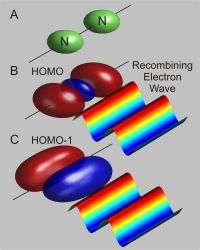
A) Sketch of the positions of the nitrogen nuclei in the gas molecule (green). B and C) Electron recombining with the HOMO and HOMO-1. The returning electron is presented as a wave. The orbitals are shown as red and blue balloons.

(PhysOrg.com) -- A team of researchers from the Stanford PULSE Institute for Ultrafast Energy Science at SLAC National Accelerator Laboratory has recently moved a step closer to visualizing the motions of electrons in molecules using a technique called high harmonic generation, or HHG.

Understanding these movements may help scientists better understand the early stages of chemical reactions. Electrons fuel chemical reactions. When chemicals react, electrons move between the molecules, building and breaking the connections, or bonds, that link atoms.

But in the world of quantum mechanics, electrons aren't easy to pin down. Physicists and chemists create mathematical descriptions called orbitals to illustrate the chance of finding an electron at a specific location of a molecule. Representations of these orbitals look like balloons attached to an atom's nucleus, the center of the atom.

"Orbitals are mathematical constructs," said SLAC researcher Markus Guehr, a member of the PULSE team. "They help us to understand how all of the processes work in there."

Guehr and the PULSE team used HHG to learn about the electron orbitals of nitrogen gas molecules. In an HHG experiment, the researchers use molecules as tiny accelerator light sources. A laser beam is focused onto a stream of cooled nitrogen gas. The electric field of the laser tears an electron from a nitrogen molecule. As the laser field oscillates, the electron is accelerated back into the molecule and recombines with its orbital. Once the electron returns to the molecule, its energy is converted into light in the extreme ultraviolet range.

The spectrum of the light emanating from the molecule depends on the nature of the orbital the electron hits. By analyzing the number of photons at particular energies produced by this molecular laser, the team can characterize a specific orbital in the molecule.

But to understand how electrons move within a molecule over time, physicists need to characterize multiple orbitals.

In a report published in Science Express on October 30, the PULSE team, which also included Brian McFarland, Joseph Farrell and PULSE director Philip Bucksbaum, described the first evidence of HHG light signals from two different orbitals. Before these experiments, scientists had observed only light generated from electrons colliding with an orbital called the highest occupied molecular orbital, or HOMO. This orbital is the highest energy orbital that contains an electron. Physicists had theorized that detecting other orbitals was possible, but no one had observed multiple signals in an experiment.

The PULSE team reported detecting light from another orbital called the HOMO-1, which is one energy level lower than the HOMO. To detect light from the HOMO-1, the researchers had to align the nitrogen molecules perpendicular to the laser's electric field, to produce more efficient collisions between electrons and the orbital.

"The really important thing is that you get this multi-orbital contribution to high harmonic generation, which changes the way you think about it," Guehr said. By imaging two orbitals at once, Guehr hopes they can begin to observe how electrons race around in molecules.

Science article: http://www.science … /1162780.pdf

Provided by Michael Torrice, SLAC Today

3.8 /5 (12 votes)  

Filter


Move the slider to adjust rank threshold, so that you can hide some of the comments.


Display comments: newest first

TheProdigyPunk
Nov 12, 2008

Rank: not rated yet
Mmm... people annoy me.

Velvetpink, I don't think you understand the possible applications of this new technology. In fact, neither do I. But I think it would be best to get a grasp on them before bashing the PULSE team or the author of this article.

out7x, glad you understand what an orbital is. (Somehow I got the feeling that velvetpink has no idea...) I believe the report is trying to emphasize the significance of not the ability to *predict* the location of an electron, but to actually be able to tell which orbital a specific electron is occupying at a given time.

What I don't understand is the... hmm... the "time frame," as it were, of the HHG. Is the laser only determining the orbital with which the electron first makes contact upon its reentry, or does it track that electron over a period of time? One would think that that would be the real challenge; tracking its movement over a given interval... But then, in order to produce readings corresponding to other orbitals, such as HOMO-1, wouldn't the electron have to travel from HOMO into this other orbital? What type of time frame is that?
Rank 3.8 /5 (12 votes)
Relevant PhysicsForums posts
  • How to calculate theoretical initial velocity?
    created1 hour ago
  • Question about Gravity?
    created2 hours ago
  • Wearing black in a desert
    created3 hours ago
  • Did space exist before mass?
    created3 hours ago
  • How can E&M Waves be polarized?
    created3 hours ago
  • Does light travel for ever?
    created4 hours ago
  • More from Physics Forums - General Physics

More news stories

Putting the squeeze on planets outside our solar system

(PhysOrg.com) -- Using high-powered lasers, scientists at Lawrence Livermore National Laboratory and collaborators discovered that molten magnesium silicate undergoes a phase change in the liquid state, abruptly ...

Physics / Condensed Matter

created 11 hours ago | popularity 4.3 / 5 (7) | comments 0 | with audio podcast

Hovering not hard if you're top-heavy, researchers find

Top-heavy structures are more likely to maintain their balance while hovering in the air than are those that bear a lower center of gravity, researchers at New York University's Courant Institute of Mathematical Sciences ...

Physics / General Physics

created 12 hours ago | popularity 5 / 5 (1) | comments 1 | with audio podcast

SLAC, Stanford team focuses on high-energy electrons to treat cancer

Accelerator physicists at SLAC and cancer specialists from Stanford are working on a new technology that could dramatically reduce the time needed for cancer radiation treatments. The team ran an initial experiment ...

Physics / General Physics

created 15 hours ago | popularity 5 / 5 (2) | comments 0

Measurements from high-energy collisions lead to better understanding of why meson particles disappear

For several years, physicists at the Relativistic Heavy Ion Collider (RHIC) at Brookhaven National Laboratory (BNL), USA, have studied an unusual state of matter called the quark–gluon plasma, which they ...

Physics / General Physics

created 15 hours ago | popularity 4.5 / 5 (4) | comments 0

Explained: Sigma

It's a question that arises with virtually every major new finding in science or medicine: What makes a result reliable enough to be taken seriously? The answer has to do with statistical significance -- but ...

Physics / General Physics

created Feb 09, 2012 | popularity 5 / 5 (16) | comments 53


Google users warned of threat to smartphone wallets

Users of Google smartphone wallets were being warned on Friday that there is a way to crack pass codes intended to thwart thieves from going on illicit shopping sprees.

Anonymous knocks CIA website offline (Update)

The website of the Central Intelligence Agency was inaccessible on Friday after the hacker group Anonymous claimed to have knocked it offline.

New error-correcting codes guarantee the fastest possible rate of data transmission

Error-correcting codes are one of the triumphs of the digital age. They’re a way of encoding information so that it can be transmitted across a communication channel — such as an optical fiber o ...

Humans may have helped the decline of African rainforests 3000 years ago

(PhysOrg.com) -- Large areas of rainforests in Central Africa mysteriously disappeared over three thousand years ago, to be replaced by savannas. The prevailing theory has been that the cause was a change ...

New power source discovered

(PhysOrg.com) -- Researchers at the Massachusetts Institute of Technology (MIT) and RMIT University have made a breakthrough in energy storage and power generation.

Complex wiring of the nervous system may rely on a just a handful of genes and proteins

Researchers at the Salk Institute have discovered a startling feature of early brain development that helps to explain how complex neuron wiring patterns are programmed using just a handful of critical genes. ...