A pool of distant galaxies -- the deepest ultraviolet image of the universe yet
November 7, 2008 A Pool of Distant Galaxies

Enlarge

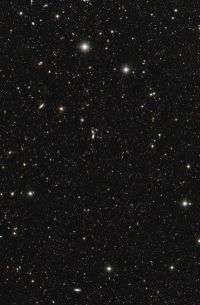
The Chandra Deep Field South, observed in the U-, B-, and R-bands with ESO's VIMOS and WFI instruments. The U-band VIMOS observations were made over a period of 40 hours and constitute the deepest image ever taken from the ground in the U-band. The image covers a region of 14.1 x 21.6 arcmin on the sky and shows galaxies that are 1 billion times fainter than can be seen by the unaided eye. The VIMOS R-band image was assembled by the ESO/GOODS team from archival data, while the WFI B-band image was produced by the GABODS team. Credit: ESO/ Mario Nonino, Piero Rosati and the ESO GOODS Team

This uniquely beautiful patchwork image, with its myriad of brightly coloured galaxies, shows the Chandra Deep Field South (CDF-S), arguably the most observed and best studied region in the entire sky. The CDF-S is one of the two regions selected as part of the Great Observatories Origins Deep Survey (GOODS), an effort of the worldwide astronomical community that unites the deepest observations from ground- and space-based facilities at all wavelengths from X-ray to radio. Its primary purpose is to provide astronomers with the most sensitive census of the distant Universe to assist in their study of the formation and evolution of galaxies.

The new image released by ESO combines data obtained with the VIMOS instrument in the U- and R-bands, as well as data obtained in the B-band with the Wide-Field Imager (WFI) attached to the 2.2 m MPG/ESO telescope at La Silla, in the framework of the GABODS survey.

The newly released U-band image – the result of 40 hours of staring at the same region of the sky and just made ready by the GOODS team – is the deepest image ever taken from the ground in this wavelength domain. At these depths, the sky is almost completely covered by galaxies, each one, like our own galaxy, the Milky Way, home of hundreds of billions of stars.

Galaxies were detected that are a billion times fainter than the unaided eye can see and over a range of colours not directly observable by the eye. This deep image has been essential to the discovery of a large number of new galaxies that are so far away that they are seen as they were when the Universe was only 2 billion years old.

In this sea of galaxies – or island universes as they are sometimes called – only a very few stars belonging to the Milky Way are seen. One of them is so close that it moves very fast on the sky. This "high proper motion star" is visible to the left of the second brightest star in the image. It appears as a funny elongated rainbow because the star moved while the data were being taken in the different filters over several years.

Source: ESO


print this article email this article download pdf blog this article bookmark this article     Stumble it Digg this share on Facebook retweet share on Reddit add to delicious
Rate this story - 4.6 /5 (33 votes)

Rank Filter

Move the slider to adjust rank threshold, so that you can hide some of the comments.


Display comments: newest first

  • Quantum_Conundrum - Nov 07, 2008
    • Rank: 1 / 5 (3)
    Galaxies were detected that are a billion times fainter than the unaided eye can see and over a range of colours not directly observable by the eye. This deep image has been essential to the discovery of a large number of new galaxies that are so far away that they are seen as they were when the Universe was only 2 billion years old.


    If the galaxies are really that far away, the Standard Model says that their ultraviolet light should be "red shifted" into the visible spectrum...so why isn't it?
  • Quantum_Conundrum - Nov 07, 2008
    • Rank: 1 / 5 (2)
    This implies the objects were at least 13 billion light years distant at the time the light was produced. How long did it take the objects to reach the distance of 13 billion light years?

    The "When the universe was only 2 billion years old" statement is absurd, because in the standard model there is no good way of knowing how old anything actually is, you can only know apparant distances. The so called "inflationary period" in the standard model negates any concept of "when the universe was X years old", since the laws of space and time have not been constant.

    Standard model// big bang.

    "one day there was nothing, then one day there was this big explosion and everything moved away from everything else at a near infinite speed. Then suddenly, after a while, evertyhing slowed to
  • Ivan2 - Nov 07, 2008
    • Rank: 4 / 5 (1)
    Would there be any chance this image possibly can be cross-referenced with any GalaxyZoo photo?
  • earls - Nov 07, 2008
    • Rank: 3.5 / 5 (2)
    !explosion

    expansion!

    Also, this is the current state of the lightrays. Perhaps they downshifted from a higher frequency to ultra-violet.

    We should create light shifting software.
  • yyz - Nov 10, 2008
    • Rank: 1 / 5 (1)
    @Ivan2, I doubt that any galaxies in the Chandra Deep Field -South could be cross-referenced with the Galaxy Zoo images as GZ images were collected by the SDSS consortium which imaged galaxies in the Northern Hemisphere as opposed to the CDF-South field imaged in the Southern Hemisphere. LSST may alleviate this situation when it revs up soon.

November 7, 2008 all stories

Comments: 5

4.6 /5 (33 votes)
  • Stumble this up

  • Digg this

  • share this

  • hide
  • Related Stories

  • Maps Unveil the Source of Starburst Galaxy's Winds
    created Nov 18, 2009 | popularity not rated yet | comments 0
  • Rapid supernova could be new class of exploding star
    created Nov 05, 2009 | popularity not rated yet | comments 0
  • The Ring Nebula
    created Nov 02, 2009 | popularity not rated yet | comments 0
  • Physicist makes new high-res panorama of Milky Way
    created Oct 28, 2009 | popularity not rated yet | comments 0
  • DOE to explore scientific cloud computing at Argonne, Lawrence Berkeley National Laboratories
    created Oct 14, 2009 | popularity not rated yet | comments 0


  • hide
  • Relevant PhysicsForums posts

Other News

New computer-developed map shows more extensive valley network on Mars

New computer-developed map shows more extensive valley network on Mars

Space & Earth / Space Exploration

created 13 hours ago | popularity 4.5 / 5 (8) | comments 0

New research adds to the growing body of evidence suggesting the Red Planet once had an ocean.


Supervolcano eruption -- in Sumatra -- deforested India 73,000 years ago

Supervolcano eruption -- in Sumatra -- deforested India 73,000 years ago

Space & Earth / Earth Sciences

created 14 hours ago | popularity 4.3 / 5 (10) | comments 2

A new study provides "incontrovertible evidence" that the volcanic super-eruption of Toba on the island of Sumatra about 73,000 years ago deforested much of central India, some 3,000 miles from the epicenter, ...


Is global warming unstoppable?

Space & Earth / Environment

created 23 hours ago | popularity 3.9 / 5 (26) | comments 25

In a provocative new study, a University of Utah scientist argues that rising carbon dioxide emissions - the major cause of global warming - cannot be stabilized unless the world's economy collapses or society builds the ...


Spitzer Telescope Observes Baby Brown Dwarf

Spitzer Telescope Observes Baby Brown Dwarf

Space & Earth / Astronomy

created 11 hours ago | popularity 4.7 / 5 (9) | comments 0

(PhysOrg.com) -- NASA's Spitzer Space Telescope has contributed to the discovery of the youngest brown dwarf ever observed -- a finding that, if confirmed, may solve an astronomical mystery about how these ...


Scientist: Leak of climate e-mails appalling

Space & Earth / Environment

created 17 hours ago | popularity 3.2 / 5 (10) | comments 8

(AP) -- A leading climate change scientist whose private e-mails are included in thousands of documents that were stolen by hackers and posted online said Sunday the leaks may have been aimed at undermining next month's ...