Scientists revisit 1833 hydrogen production experiment
November 7, 2008 By Lisa Zyga
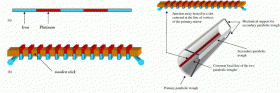
(Left) Botto’s iron-platinum thermocouple (a chain wrapped around a wooden stick) could generate a current when heat from a flame was applied. The heat created a temperature difference, and the thermocouples converted the temperature difference into an electric voltage. (Right) The modern proposal uses solar radiation as the heat source, with a parabolic trough solar collector, and water traveling through a hollow core as the cooling system. Image credit: Roberto De Luca, et al.
(PhysOrg.com) -- In the early 1800s, during the peak of the Industrial Revolution, modern science revolved around steam engines and other coal-powered applications. So it may seem a bit out of place that, in 1833, an Italian physicist named G. D. Botto was performing experiments on a technique for generating hydrogen.
“Hydrogen is the most common element on Earth, the lightest and the simplest in its structure,” Roberto De Luca of the University of Salerno in Italy told PhysOrg.com. “Hydrogen gas was already known to [French chemist Antoine-Laurent] Lavoisier at the end of the eighteenth century. However, the production of hydrogen, at the time Botto performed his experiment, can only be viewed as a sub-product of electrolysis. Botto’s main objective was to show to the scientific community that electricity could be obtained by a source of heat through his ingenious device.”
De Luca is part of an Italian team of scientists who have revisited Botto’s experiments to investigate whether the technique could have applications for today’s energy problems. The Italian group was inspired by the convenience of Botto’s device, which can be easily fabricated and is composed of widely available materials. The researchers calculated that, although a modified version of Botto’s device has a very low power conversion efficiency, it can still produce enough electromotive force to generate hydrogen.
“We learned about Botto’s idea through the invaluable work of Professor [Salvatore] Ganci [also a co-author of this study], who is an expert in the history of physics,” De Luca said. “He is now writing a book on scientific instruments constructed by physicists from the province of Genoa in the early 19th century. Among his studies, there is the device used by Botto, by which it was possible to prove that electricity could be generated by heating an array of thermocouples. Without the invaluable contribution of Professor Ganci, this work would have not been possible.”
Botto’s original 19th-century device is quite simple. It consists of a chain of iron and platinum wires alternately connected as thermocouples, which are used to convert a temperature difference into an electric voltage. Botto then wrapped the chain around a wooden stick so that the iron-platinum junctions were evenly positioned on opposite sides of the stick. By heating the contraption with a flame of burning alcohol, Botto could generate an electromotive force. Further, by passing the generated electric current through water, he demonstrated how the method could be used to produce hydrogen through electrolysis.
The Italian team studied Botto’s device, but made some significant adjustments. They first considered substituting copper for platinum in the thermocouples. They also proposed completely replacing Botto’s thermocouples with thermoelectric semiconductors for greater efficiency.
Also, rather than use a flame of burning alcohol as the heat source, the Italian team considered using solar power to heat the thermocouples/semiconductors and create a temperature difference. They suggested that two parabolic mirrors could be arranged to concentrate solar radiation on the thermocouples and heat one side. To cool the other side (in order to create a temperature difference), the wooden stick might be replaced with a hollow electrically insulating material through which water could run to cool the desired junctions.
The researchers then estimated the temperature difference, which could be used to estimate the voltage difference, which was only about 1 mV. They also estimated a small power output of about 20 mW. Despite the low power conversion efficiency, the Italians’ proposed solar-powered device could generate enough current to produce hydrogen gas through electrolysis.
“We think that this idea can be used in the production of hydrogen gas directly from solar energy, through electrolysis,” De Luca said. “However, nowadays, one would not use thermocouples, as in Botto’s experiment, but could, more efficiently, use thermoelectric semiconductors to obtain a much higher power output. The important point in this work is also that, while there has always been solid scientific ground for these ideas, there has also been a lot of resilience in their applications.”
As for why the researchers suggested using solar radiation to heat the device rather than a flame, De Luca emphasized the economic benefits. He and others have investigated unique, simple methods for capturing sunlight in other studies, and explained the advantages of solar energy.
“It makes a great difference, in hydrogen production, to use free energy from a nuclear power plant which starts working early in the morning and stops early at night,” he said, referring to our Sun. “This energy will be free for the next five billion years, approximately. Hydrogen can thus be freely produced (unless we consider the cost of water) as long as this wonderful, perfectly clean power plant will be shining upon us. Hydrogen can then be used to run our cars and to make our houses bright at night in the future, despite the fact that Earth might sooner or later run out of oil.”
More information: De Luca, R.; Ganci, S.; and Zozzaro, P. “Revisiting an idea of G D Botto: a solar thermoelectric generator.” Eur. J. Phys. 29 (2008) 1295-1300.
Copyright 2008 PhysOrg.com.
All rights reserved. This material may not be published, broadcast, rewritten or redistributed in whole or part without the express written permission of PhysOrg.com.
-
Carbonized coffee grounds remove foul smells
1 hour ago |
not rated yet |
0
-
Solvay hails world's largest fuel cell of type in Flanders, one can power 1,400 homes
Feb 06, 2012 |
4.4 / 5 (8) |
5
-
A pocket of star formation
Feb 01, 2012 |
not rated yet |
0
-
Chemists to develop new materials for hydrogen storage in vehicles
Jan 27, 2012 |
3.3 / 5 (4) |
5
-
NASA's J-2X engine kicks off 2012 with powerpack testing
Jan 26, 2012 |
5 / 5 (3) |
0
-
Engineers build first sub-10-nm carbon nanotube transistor
Feb 01, 2012 |
4.9 / 5 (29) |
30
-
Something old, something new: Evolution and the structural divergence of duplicate genes
Jan 31, 2012 |
4.6 / 5 (7) |
1
-
The hidden nanoworld of ice crystals: Revealing the dynamic behavior of quasi-liquid layers
Jan 30, 2012 |
5 / 5 (3) |
1
-
Stock market network reveals investor clustering
Jan 27, 2012 |
3.9 / 5 (23) |
8
-
Of microchemistry and molecules: Electronic microfluidic device synthesizes biocompatible probes
Jan 26, 2012 |
5 / 5 (1) |
0
-
How to magnetize water using super magnet?
2 hours ago
-
Anti-Gravity Q
2 hours ago
-
Help my dad and I settle a argument
3 hours ago
-
Is 'straightness' relative to earths curviture?
3 hours ago
-
Integrating a squared velocity
3 hours ago
-
Acceleration and Normal Force
6 hours ago
- More from Physics Forums - General Physics
More news stories
Transparent iron? For the first time, an experiment shows that atomic nuclei can become transparent
At the high-brilliance synchrotron light source PETRA III, a team of DESY scientists headed by Dr. Ralf Röhlsberger has succeeded in making atomic nuclei transparent with the help of X-ray light. At the ...
8 hours ago |
5 / 5 (4) |
1
|
Physicists build highly efficient 'no-waste' laser
A team of University of California, San Diego researchers has built the smallest room-temperature nanolaser to date, as well as an even more startling device: a highly efficient, "thresholdless" laser that ...
8 hours ago |
5 / 5 (14) |
2
|
Quantum physicist explains $100K offer for proof scaled-up quantum computing is impossible
(PhysOrg.com) -- MIT researcher Scott Aaronson has certainly riled the physics community with his offer this past Friday, of $100,000 to anyone who can prove that scaled-up quantum computing is impossible. ...
Flipping a light switch in the cell: Quantum dots used for targeted neural activation
By harnessing quantum dotstiny light-emitting semiconductor particles a few billionths of a meter acrossresearchers at the University of Washington (UW) have developed a new and vastly more targeted ...
10 hours ago |
5 / 5 (3) |
0
|
Unusual 'collapsing' iron superconductor sets record for its class
(PhysOrg.com) -- A team from the National Institute of Standards and Technology and the University of Maryland has found an iron-based superconductor that operates at the highest known temperature for a material ...
13 hours ago |
4.3 / 5 (3) |
2
|
Astronomy team discovers nearby dwarf galaxy
(PhysOrg.com) -- A team led by UCLA research astronomer Michael Rich has used a unique telescope to discover a previously unknown companion to the nearby galaxy NGC 4449, which is some 12.5 million light years ...
Amasia: As next supercontinent forms, Arctic Ocean, Caribbean will vanish first
(PhysOrg.com) -- Geologists at Yale University have proposed a new theory to describe the formation of supercontinents, the epic process by which Earths major continental blocks combine into a single ...
Why are there so few fish in the Earth's oceans?
(PhysOrg.com) -- A Stony Brook University researcher has found that, contrary to popular belief, there are not plenty of fish in the sea.
Scientists strengthen memory by stimulating key site in brain
Ever gone to the movies and forgotten where you parked the car? New UCLA research may one day help you improve your memory.
Most stretchable spider silk reported
The egg sac silk of the cocoon stalk of the cave spider Meta menardi is the most stretchable egg sac silk yet tested, according to a study published Feb. 8 in the open access journal PLoS ONE.
Study shows how DNA finds its match
It's been more than 50 years since James Watson and Francis Crick showed that DNA is a double helix of two strands that complement each other. But how does a short piece of DNA find its match, out of the millions ...
Nov 07, 2008
Rank: 3.4 / 5 (7)
Nov 07, 2008
Rank: 4.6 / 5 (5)
I think (although I'm not sure) that this might be seen as a cheaper method, requiring less manufacturing and possibly toxic materials. If they can just slap together massive electricity-generating arrays from a rubber band, two pencils and a turkey baster, that's a GOOD thing.
Nov 07, 2008
Rank: 3 / 5 (1)
The article discusses thermocouples, not PV cells, therefore heat is already in the equation.
Nov 07, 2008
Rank: 5 / 5 (2)
Nov 07, 2008
Rank: not rated yet
Nov 07, 2008
Rank: 5 / 5 (1)
But that was kind of my point. I understand the device necessarily includes heat to be operational. My point...was that it seems to be inefficient if you're going to use solar energy (as the article suggests in the latter paragraphs) to put heat into an equation which could just be direct electrolysis...
Now if your talking about economics and not efficiency well then that's another matter.
Nov 07, 2008
Rank: 5 / 5 (1)
The high temperatures generated by concentrated Solar energy would kill PV cells; on the other hand, thermocouples thrive on high temperature differentials.
And, thermocouples are substantially less costly to make and maintain than are PV cells.
Nov 07, 2008
Rank: not rated yet
Nov 07, 2008
Rank: 4.2 / 5 (5)
I'm looking on my calendar to see if it's April 1.
Nov 07, 2008
Rank: not rated yet
Nov 07, 2008
Rank: 2.3 / 5 (3)
Nov 08, 2008
Rank: 4 / 5 (3)
Absurd. The PV cell is less efficient and less durable at high temperatures; any concentrating system that might need cooling is going to keep the coolant as close to ambient as possible and that means the waste heat is only going to be a handful of degrees above ambient.
Nov 08, 2008
Rank: 5 / 5 (2)
We actually can burn rocks. The average piece of the Earths crust(i.e. not ore grade) contains ~3.3 ppm of uranium and ~10 ppm of thorium.
It is in principle possible to fission nearly all of that(thorium being bred into uranium-233 before being fissioned and uranium-238 being bred into plutonium-239); that would give you ~140 barrels of oil equivalent per tonne of your average rock.
Nov 08, 2008
Rank: not rated yet
good luck
Nov 09, 2008
Rank: not rated yet
Nov 09, 2008
Rank: 5 / 5 (3)
Pitiful. I thought we weren't supposed to advertise here? But once again, here he is...I guess handing fliers out at the mall didn't get him the VC he thinks he deserves.
Nov 09, 2008
Rank: 3.7 / 5 (3)
Here's a couple of good reasons:
1) Thermocouples are substantially easier to build and maintain then PV cells.
2) Thermocouples have access to a wider spectrum of energies than PV cells.
3) Thermocouples are generally more durable than PV cells.
Nov 10, 2008
Rank: not rated yet
Nov 10, 2008
Rank: not rated yet
Feb 05, 2009
Rank: 1 / 5 (1)